


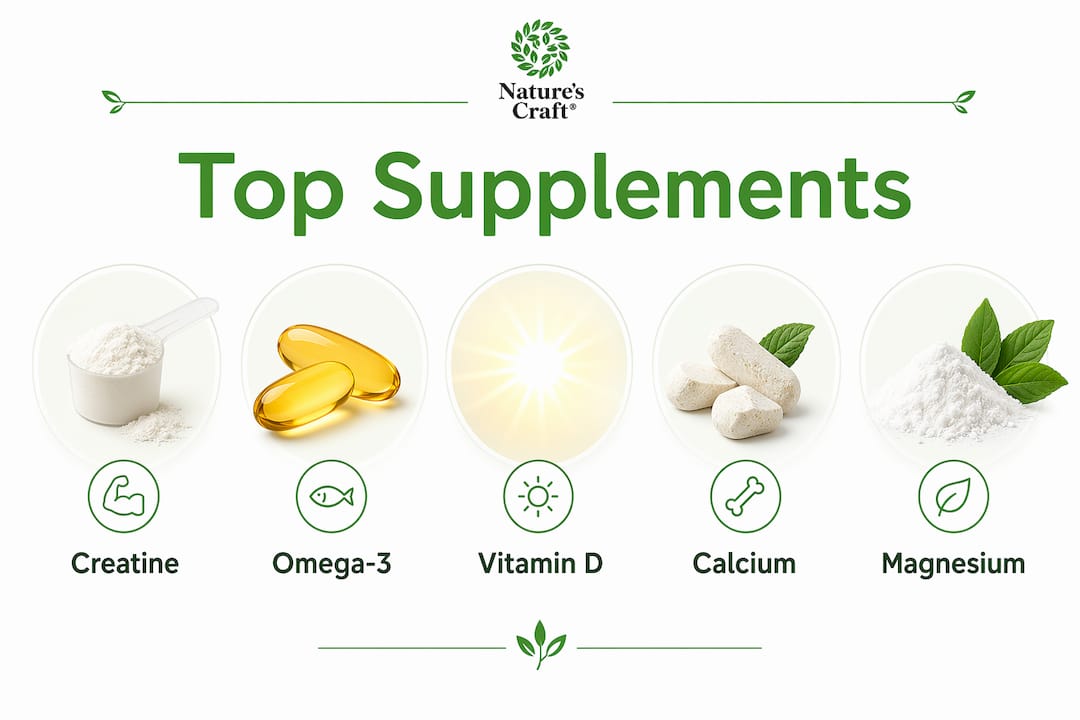
Men’s supplements for healthy aging are targeted nutrients that help preserve muscle mass, support cognitive function, strengthen bones, and maintain vitality as your body changes after 40. The core lineup includes creatine, omega-3 fatty acids, vitamin D, calcium, and magnesium. These are not replacements for a solid diet and regular exercise. They are precision tools that fill the gaps your food and lifestyle leave behind. This guide covers what the research actually says, how much to take, and how to avoid the common mistakes that waste money or cause harm.
What key supplements should aging men prioritize for muscle and cognitive health?
Creatine monohydrate is the most evidence-backed supplement for men who want to preserve muscle and protect brain health as they age. Cedars-Sinai confirms creatine is one of the safest and most studied supplements available, with documented benefits for both physical and cognitive functioning in healthy adults. The practical takeaway: 3 to 5 grams per day is the sweet spot, and you do not need a loading phase. Loading phases can cause gastrointestinal discomfort and offer no meaningful advantage over a steady daily dose.

A 2026 meta-analysis of 35 trials with 1,211 participants found creatine produces superior results for muscle strength, while omega-3 leads for recovery, and protein for endurance. This means your supplement choice should match your specific goal. If preserving strength is the priority, creatine belongs in your stack. If you are dealing with joint soreness and slow recovery after workouts, omega-3 fatty acids are the more targeted option.
Omega-3 fatty acids, specifically EPA and DHA, deliver benefits well beyond the gym. AARP reports omega-3s help reduce inflammation, aid recovery, and slow cognitive decline, with roughly 1 gram per day as the recommended starting point. That matters because chronic low-grade inflammation is one of the primary drivers of accelerated aging in men. Omega-3s address that at the source. For cardiovascular support specifically, you can explore heart health supplements that include high-quality EPA and DHA formulations.
Here is what to look for when choosing creatine and omega-3 products:
- Creatine: Choose creatine monohydrate over fancier forms like creatine HCl or ethyl ester. The monohydrate form has the most research support and is the most cost-effective.
- Omega-3: Look for products that list EPA and DHA amounts separately on the label. A combined 1 gram of EPA plus DHA per serving is the target.
- Third-party testing: Products verified by NSF International, USP, or Informed Sport have been independently tested for purity and label accuracy.
- Creatine pairing: Creatine works best alongside resistance training. Taking it without lifting weights reduces its effectiveness significantly.
Pro Tip: If you are new to creatine, skip the loading phase entirely. A consistent 3 to 5 gram daily dose builds muscle creatine stores within 3 to 4 weeks with no stomach upset.
How do vitamin D and calcium contribute to bone health and fall prevention in men over 40?
Vitamin D and calcium work as a team. Vitamin D controls how much calcium your gut absorbs, and without adequate vitamin D, even a high calcium intake does little for your bones. For men over 40, this pairing directly reduces the risk of fractures and falls, two of the most serious health threats in the second half of life.
The dosing guidance from Harvard Health is specific and worth taking seriously. Harvard Health recommends 800 IU for men over 70 and warns against exceeding 4,000 IU per day without clinician guidance. Doses above 2,000 IU per day can trigger hypercalcemia and, counterintuitively, increase fall risk in older adults. More is not better here. The right dose is the one matched to your actual blood level, not a number you picked from a label.
Key caution: Vitamin D toxicity is real and underreported. Before taking high-dose vitamin D, get a 25-hydroxyvitamin D blood test. A level between 40 and 60 ng/mL is the target range for most men. Supplementing without knowing your baseline is guesswork.
For calcium, AARP advises men aged 51 to 70 aim for 1,000 to 1,200 mg per day total, with no more than 500 mg taken at one time due to absorption limits. Excess calcium from supplements, not food, is linked to kidney stones and potential cardiovascular complications. Food sources like dairy, fortified plant milks, and leafy greens should cover the majority of your intake. Supplements fill the remaining gap.
Practical guidance for vitamin D and calcium:
- Vitamin D3 over D2: D3 (cholecalciferol) raises blood levels more effectively than D2 (ergocalciferol).
- Calcium citrate vs. carbonate: Calcium citrate absorbs well with or without food. Calcium carbonate requires stomach acid and is best taken with meals.
- Split your calcium dose: If you need 1,000 mg from supplements, take 500 mg twice daily rather than all at once.
- Monitor annually: Ask your doctor for a vitamin D blood test each year to adjust your dose based on actual levels.
Shopnaturescraft offers calcium gummies designed for easy daily use, which is a practical option if you find standard calcium tablets hard to swallow or easy to forget.
What other vitamins and minerals support healthy aging for men?
Beyond the headline supplements, several other nutrients fill critical gaps in healthy aging nutrition for men. The most important ones address energy metabolism, nerve health, and inflammation.
-
Magnesium: Magnesium supports muscle and nerve function, blood sugar regulation, and sleep quality. Deficiency becomes more common with age, and low magnesium is linked to increased inflammation and oxidative stress. The safe upper limit from supplements is 350 mg per day. Getting the rest from food sources like nuts, seeds, and whole grains is the smarter approach.
-
Vitamin B12: B12 deficiency is common in older adults because stomach acid production declines with age, reducing the body’s ability to extract B12 from food. Supplementation supports nerve health, red blood cell production, and cognitive function. The recommended daily intake is 2.4 mcg, though many older adults benefit from higher supplemental doses due to absorption issues.
-
Curcumin: Curcumin reduces inflammation and relieves joint pain, with doses up to 8,000 mg of turmeric daily considered safe for several months according to a BMJ Open Sport and Exercise Medicine review. For men dealing with stiff knees or post-workout joint soreness, curcumin is one of the most evidence-supported natural options available. Shopnaturescraft’s turmeric gummies provide a convenient daily format.
-
Niacin, resveratrol, and taurine: These are emerging options with promising early research but less clinical consensus than the above. Niacin supports cholesterol management. Resveratrol shows potential for cardiovascular and metabolic health. Taurine is being studied for its role in cellular aging. None of these belong in your core stack yet, but they are worth watching.
Pro Tip: Before adding any new supplement, pull your most recent bloodwork. Magnesium and B12 deficiencies show up clearly in standard panels, and knowing your actual levels prevents you from supplementing nutrients you already have enough of.
Supplements that are often overhyped for men in this age group include high-dose vitamin E, vitamin C megadoses, and folic acid beyond standard dietary amounts. The evidence for anti-aging benefits from these at supplemental doses is weak, and excess vitamin E has been associated with increased bleeding risk.
How to safely integrate supplements into your daily routine
The foundation of healthy aging for men is not supplements. It is strength training, quality sleep, a protein-adequate diet, and stress management. Supplements work on top of that foundation, not instead of it. Men who skip the gym but take creatine are leaving most of the benefit on the table.
Safe integration comes down to a few clear principles:
- Start with food first: Prioritize getting calcium, magnesium, and B12 from whole foods before adding supplements. Supplements fill gaps, not plates.
- Avoid megadoses: Exceeding the tolerable upper intake levels for vitamin D and calcium creates real health risks, including kidney stones and cardiovascular complications.
- Check labs before high-dose supplementation: Vitamin D, B12, and magnesium levels are all measurable. Know your numbers before committing to a dose.
- Disclose everything to your doctor: If you have kidney disease, take blood thinners, or use medications for blood pressure or diabetes, certain supplements interact directly with those conditions. Creatine and calcium both require extra caution with kidney function.
- Buy from verified sources: Third-party tested products from brands with transparent labeling reduce the risk of contamination or inaccurate dosing.
For a broader look at how supplements fit into a muscle-building strategy for men, the research on protein, creatine, and resistance training alignment is worth reviewing.
A consistent daily routine beats any complicated cycling or loading protocol. Take your supplements at the same time each day, pair fat-soluble vitamins like D with a meal that contains fat, and track how you feel over 8 to 12 weeks before deciding whether a supplement is working.
Key takeaways
The most effective approach to men’s supplements for healthy aging combines creatine, omega-3, vitamin D, calcium, and magnesium with strength training and lab-guided dosing.
| Point | Details |
|---|---|
| Creatine for muscle and brain | Take 3 to 5 grams daily with resistance training for strength and cognitive support. |
| Omega-3 for recovery and heart health | Aim for 1 gram of combined EPA and DHA per day to reduce inflammation and support the heart. |
| Vitamin D requires lab monitoring | Get a blood test before supplementing; target 40 to 60 ng/mL and stay under 4,000 IU without clinical guidance. |
| Calcium from food first | Keep total intake at 1,000 to 1,200 mg per day and limit supplement doses to 500 mg at a time. |
| Magnesium and B12 fill common gaps | Both become harder to obtain adequately with age; check levels and supplement to address confirmed deficiencies. |
What I’ve learned after years of watching men supplement wrong
Most men I see approach supplements the same way: they buy a stack of eight products, take them all at once for three weeks, feel nothing definitive, and quit. The problem is not the supplements. It is the absence of a baseline.
The single most underused tool in men’s healthy aging is a standard blood panel. Vitamin D, B12, magnesium, and inflammatory markers like CRP tell you exactly where your gaps are. Without that data, you are guessing. And guessing with supplements that carry real toxicity risks at high doses is not a strategy.
Creatine is the one supplement I would put in front of almost every man over 45 who lifts weights. The evidence from Cedars-Sinai is clear, the safety profile is excellent, and the cognitive benefits are an underappreciated bonus. But it only works if you are training. That is the part most supplement marketing conveniently leaves out.
The other thing I would push back on is the obsession with exotic anti-aging compounds. Resveratrol and taurine get a lot of attention, but the research on creatine, omega-3, and vitamin D is orders of magnitude more robust. Build your stack on what works, then explore the emerging options once the fundamentals are covered.
Supplements are an adjunct to healthy behavior, not a substitute for it. The men who age well are the ones who train consistently, sleep 7 to 8 hours, eat enough protein, and use supplements to fill specific, confirmed gaps. That combination is what the research actually supports.
— SuperNatural
Support your healthy aging with Nature’s Craft
Shopnaturescraft has been formulating clean, quality supplements since 2013, with a product range built specifically to support men’s health at every stage.

For men focused on healthy aging, the Shopnaturescraft lineup includes Creatine Tri-Phase for muscle and cognitive support, calcium gummies for bone health, and turmeric gummies for joint and inflammation management. Every product is made with quality ingredients and designed for consistent daily use. For cardiovascular and overall wellness support, explore the full heart health collection or browse the complete supplement range to find what fits your specific health goals.
FAQ
What are the best supplements for men over 50?
Creatine monohydrate, omega-3 fatty acids, vitamin D3, calcium, and magnesium are the most evidence-supported supplements for men over 50. Each addresses a specific aging concern, from muscle loss and cognitive decline to bone density and inflammation.
How much creatine should aging men take daily?
A steady dose of 3 to 5 grams of creatine monohydrate per day is optimal for healthy aging benefits. Loading phases are unnecessary and can cause gastrointestinal discomfort without adding meaningful benefit.
Can you take too much vitamin D?
Yes. Harvard Health warns that doses above 4,000 IU per day without clinical guidance can cause hypercalcemia and increase fall risk in older adults. Always test your blood levels before supplementing at high doses.
Do anti-aging supplements for men actually work?
The most effective ones do, when matched to confirmed deficiencies and paired with strength training and a quality diet. Creatine, omega-3, and vitamin D have the strongest clinical evidence for supporting male health as men age.
What supplements support male health beyond muscle and bone?
Vitamin B12 supports nerve and cognitive health, magnesium aids sleep and blood sugar control, and curcumin reduces joint inflammation. These address the broader spectrum of healthy aging nutrition for men beyond physical performance alone.

