


Walk into any health food store or scroll through Amazon and you will find thousands of supplement options all claiming to support your health. The problem is that supplements skip FDA pre-market approval, meaning a product can legally reach store shelves without anyone verifying its safety, potency, or label accuracy. That gap leaves a lot of room for poor quality, mislabeled, or contaminated products. Identifying high quality supplements takes more than reading the front of the label. This guide gives you a clear, step-by-step framework to evaluate any supplement with confidence before you spend a dollar.
Table of Contents
- Key takeaways
- Identifying high quality supplements: what to check first
- How to verify supplement quality step by step
- Red flags and pitfalls to watch out for
- Matching your evaluation approach to your health goals
- My honest take on supplement quality
- Why Nature’s Craft stands out for verified quality
- FAQ
Key takeaways
| Point | Details |
|---|---|
| FDA does not pre-approve supplements | Products can be sold without any pre-market safety or potency review, so quality varies widely. |
| cGMP is a baseline, not a quality badge | Manufacturing compliance sets minimum standards but does not confirm ingredient accuracy or purity. |
| Third-party certifications matter | Seals from USP, NSF, or ConsumerLab independently verify label claims, purity, and contaminant levels. |
| Batch-specific COAs are your best evidence | A Certificate of Analysis tied to the exact lot number on your bottle confirms results apply to your product. |
| Red flags are easy to spot once you know them | Vague “tested” claims, missing lab names, and mismatched batch numbers are all signs to walk away. |
Identifying high quality supplements: what to check first
Before you pull out your credit card, understanding a few foundational quality markers will save you money and protect your health. These are the criteria that separate trustworthy products from everything else on the shelf.
Look for cGMP-compliant manufacturing
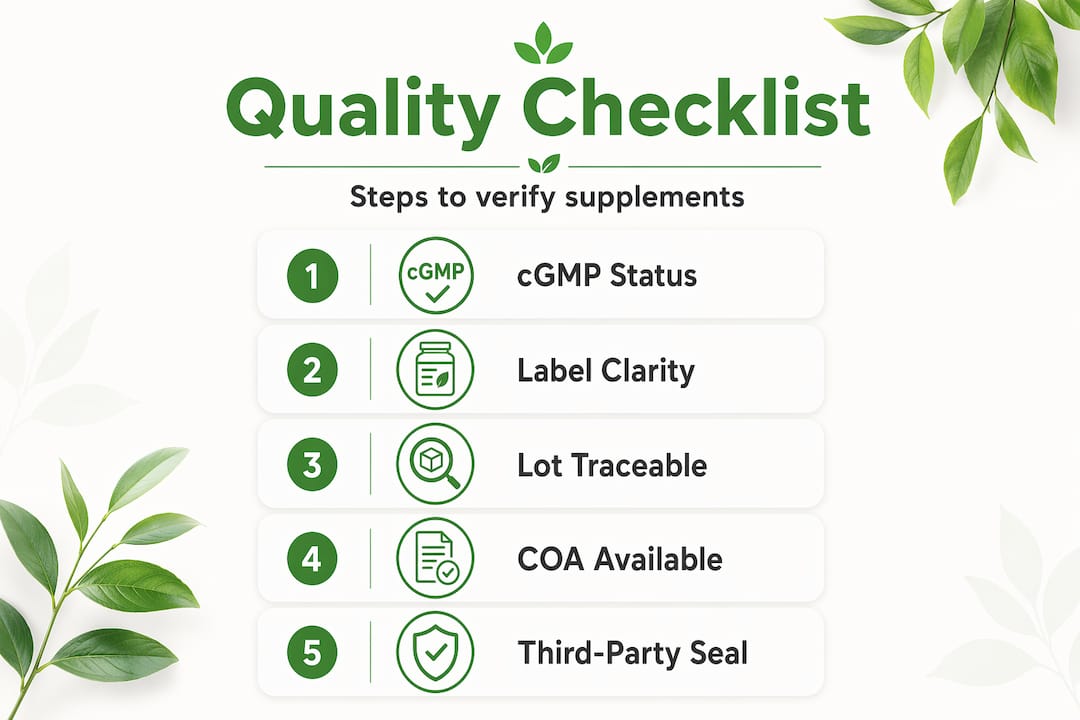
Current Good Manufacturing Practices, known as cGMPs, are regulations under 21 CFR Part 111 that set minimum standards for how supplements are made, tested, and stored. cGMP compliance is a regulatory floor, not a quality guarantee. The FDA registers and inspects facilities but does not issue certificates. Third-party organizations like NSF International and the Natural Products Association offer their own GMP registration programs, which carry more weight because they involve regular audits.
A cGMP-compliant manufacturer is a starting point, not a finish line. Pair it with other verification steps.
Check label transparency and ingredient disclosure
Honest labeling is a strong signal of brand integrity. Look for supplements that list every ingredient with its exact dose, not a vague “proprietary blend” that hides how much of each compound you are actually getting. Nutritional supplement quality depends heavily on knowing what is in each capsule at what level.
Here are the labeling basics to confirm before buying:
- Every active ingredient listed with an exact milligram or microgram dose
- Full disclosure of inactive ingredients and fillers
- Country of origin for key raw materials when possible
- Clear allergen information
Pro Tip: If a label shows a proprietary blend without individual ingredient amounts, you have no way to confirm whether the doses are clinically relevant or just trace amounts added for marketing purposes.
Prioritize brands with lot traceability
Reliable supplement brands can trace any product back to the specific batch of raw ingredients used to make it. This is called lot traceability, and it means that if a problem is found, the brand can identify and address it quickly. Ask yourself whether the brand publishes Certificates of Analysis, or COAs. A COA is a document showing the actual test results for a specific production batch, including identity, potency, and purity data.

How to verify supplement quality step by step
Once you have the basics down, this process helps you confirm quality for any specific product you are considering.
-
Check for a recognized certification seal. Look on the label or product page for verification from organizations like USP, NSF International, ConsumerLab, or Informed Sport. These certifications independently verify identity, purity, and potency through voluntary but rigorous testing programs.
-
Verify the certification is real. Go directly to the certifying organization’s website. USP, NSF, and Informed Sport all maintain searchable databases of certified products. If the product does not appear in the database, the seal on the label may be misleading.
-
Request or locate the batch-specific COA. A legitimate brand will either publish COAs on its website or provide them on request. The COA should include the product name, batch or lot number, name and accreditation of the testing lab, specific testing methods used, and the actual results for each test.
-
Match the COA lot number to your bottle. Mismatched batch numbers are a serious red flag indicating counterfeit documentation or results that do not apply to the product you hold. Open the bottle, find the lot number printed on the bottom or side, and compare it directly to the COA.
-
Check the testing lab’s credentials. The lab that performed the analysis should be ISO 17025 accredited. This accreditation confirms the lab meets internationally recognized standards for technical competence and measurement accuracy.
-
Contact the brand if information is missing. Email or call customer service and ask for the COA for your specific lot. A responsive, transparent brand will provide it promptly. A brand that deflects or offers only a generic document without a matching lot number is one to avoid.
Pro Tip: Set a five-minute rule. If you cannot find a published COA and receive no response to a COA request within 48 hours, move on. Trustworthy brands treat this documentation as a standard customer service item, not a hidden trade secret.
Here is how the major certification programs compare by scope and focus:
| Certifier | What they test | Best for |
|---|---|---|
| USP Verified | Identity, potency, purity, dissolution | General daily supplements |
| NSF Certified for Sport | Contaminants, banned substances, label accuracy | Athletes and performance users |
| ConsumerLab | Potency, purity, label accuracy (spot testing) | Consumer research and price comparisons |
| Informed Sport | Banned substance screening, potency | Competitive athletes with strict testing requirements |
It is worth noting that third-party certification reduces uncertainty without guaranteeing personal effectiveness. A certified supplement contains what it says it contains in the amounts listed. Whether it produces the health outcome you want still depends on many individual factors.
Red flags and pitfalls to watch out for
Knowing what to avoid is just as useful as knowing what to look for. The supplement market has real problems, and some of them are not obvious until you know where to look.
- Vague “third-party tested” claims. Saying a product is “third-party tested” without naming the lab, specifying the batch, or showing a date is weak evidence of quality. Generic tested claims without specifics tell you very little about actual product integrity.
- Missing or generic COAs. A COA that lacks a specific lot number, a named and accredited lab, or detailed test results is not useful documentation. It may cover a single batch from years ago or not apply to any product currently on the shelf.
- Contamination risks. This is not theoretical. Over two-thirds of protein powders tested by Consumer Reports had lead levels exceeding safety thresholds, and some fish oil products were found to be rancid. These findings reinforce the need for third-party screening.
- Exaggerated health claims. Language like “cures,” “reverses,” or “eliminates” on a supplement label is not only misleading but is prohibited under FDA rules. Brands that use this language are prioritizing sales over accuracy.
- Counterfeit or unofficial certification logos. Some brands use logos that look like official seals but belong to unrecognized or self-created programs. Always verify the certifier is a legitimate, independent organization with published standards.
Evaluating supplement brands means going beyond the marketing copy. The brands worth trusting are the ones that make it easy to verify their claims, not the ones with the loudest packaging.
Safe dietary supplements are rarely the ones with the most impressive graphics. They are the ones backed by documentation you can check independently.
Matching your evaluation approach to your health goals
Not every supplement purchase requires the same level of scrutiny. Here is a practical way to think about how much verification is appropriate for your situation.
| Use case | Priority certifier | Key documentation to seek |
|---|---|---|
| Daily multivitamin | USP or NSF | Current COA with potency results |
| High potency vitamins (e.g., vitamin D 5000 IU) | USP Verified or ConsumerLab | Potency test results, dissolution data |
| Targeted therapeutic support | NSF or ConsumerLab | Clinical references plus COA |
| Athletic performance | NSF Certified for Sport or Informed Sport | Banned substance screening results |
| Budget wellness stack | Any recognized certifier | At minimum a named lab and lot-matched COA |
If you are taking a supplement to address a specific health concern, the standard rises. You want batch-specific documentation, a recognized certifier, and ideally some published clinical research supporting the ingredient form and dose used in the product. For a general daily supplement, a recognized seal and accessible COA are reasonable benchmarks.
Balancing cost and confidence is a real consideration. Top rated health supplements with full third-party verification and published COAs tend to cost more than uncertified alternatives. That premium usually reflects genuine quality investment. Think of it as paying for documentation, not just ingredients.
My honest take on supplement quality
I have spent years looking at how supplement brands communicate quality, and the single biggest gap I see is this: most brands treat their COAs as background paperwork rather than a consumer-facing trust signal.
The brands that genuinely invest in quality make their COAs searchable by lot number on their website. No email required. No waiting 48 hours. That level of accessibility is rare, and when I find it, it changes how I evaluate everything else about a brand.
What I have also noticed is that batch-specific documentation literacy is the single most transferable skill a supplement buyer can develop. Once you know what a complete COA looks like, you can assess any brand in minutes. You will immediately recognize when a document is generic, outdated, or missing an ISO-accredited lab signature.
The uncomfortable reality is that regulatory gaps mean low-quality products stay on the market until someone files a complaint or a news story breaks. That puts the burden on you as a consumer. The good news is that the verification process described above is genuinely learnable and takes less time than most people expect. Pair your research with a conversation with your healthcare provider, especially for therapeutic doses or products targeting specific conditions. That combination of independent documentation review and professional guidance is the strongest position you can be in.
— SuperNatural
Why Nature’s Craft stands out for verified quality
When you are ready to put these evaluation criteria to work, you want a brand that makes the process easy. Shopnaturescraft was built on exactly that principle since 2013: pure ingredients, transparent documentation, and products that hold up to scrutiny.
Shopnaturescraft offers a full range of premium health supplements covering everything from daily wellness support to targeted formulas for sleep, heart health, and organ support. Each product is manufactured with strict quality controls, and the brand’s commitment to clean ingredients means you are not sorting through fillers to find what matters. If you are looking for a specific product that pairs quality with purpose, the Magnesium Sleeplex 1000mg with Magtein L-Threonate is one example of a formula built around an evidence-supported ingredient form at a meaningful dose. For heart-focused wellness, explore the heart health collection to find options that align with the quality standards covered in this guide. Your wellness goals deserve supplements you can trust completely.
FAQ
What does “third-party tested” actually mean for supplements?
It means an independent lab outside the manufacturer has tested the product, but the term alone says little without specifics. Always look for the certifying organization’s name, the batch number tested, and the lab’s accreditation status to confirm the claim is meaningful.
How do I check if a supplement certification seal is legitimate?
Go directly to the certifying organization’s website and search their product database. USP, NSF International, and Informed Sport all maintain public databases where you can confirm whether a specific product holds an active certification.
What should a Certificate of Analysis include?
A complete COA should list the product name, specific lot number, testing lab name and accreditation, testing methods, and results for identity, potency, and purity. Matching the lot number on the COA to the one printed on your bottle confirms the results actually apply to your product.
Are cGMP-certified supplements automatically high quality?
No. cGMP compliance sets a manufacturing baseline but does not verify potency, ingredient accuracy, or freedom from contaminants. Seek additional third-party program verification from organizations like USP or NSF for greater confidence in nutritional supplement quality.
Do third-party certifications guarantee a supplement will work for me?
Not exactly. Certifications confirm the product contains what the label says in the amounts listed, and that it meets purity standards. Whether a supplement produces your desired health outcome depends on individual factors, and no certification program tests for personal efficacy.

