


Most women assume that feeling tired all the time is just part of a busy life. But persistent fatigue often points to something more specific. Understanding what is a women energy supplement means looking beyond caffeine-loaded drinks and recognizing that your body has nutritional needs shaped by hormonal cycles, stress levels, and lifestyle demands that generic supplements simply don’t address. This article breaks down exactly what these products contain, why those ingredients matter for your biology, and how to choose what actually works for you.
Table of Contents
- Key takeaways
- What women energy supplements actually are
- How these ingredients support energy and mood
- Choosing the right women’s energy supplement
- Integrating supplements with your lifestyle
- My perspective on what women really need from supplements
- Support your energy with Nature’s Craft
- FAQ
Key takeaways
| Point | Details |
|---|---|
| Women have unique nutritional needs | Hormonal cycles, menstruation, and stress deplete specific nutrients that targeted supplements help restore. |
| Adaptogens work long-term | Herbs like ashwagandha and rhodiola regulate cortisol over weeks, not days, so consistency matters. |
| Testing before supplementing is smart | Blood work helps confirm deficiencies so you avoid over-supplementing and target what your body actually needs. |
| Lifestyle supports supplement results | Sleep, nutrition, and stress management amplify what supplements can do. They work together, not separately. |
| Formulation type matters | Multivitamins, targeted blends, and adaptogen-focused products serve different goals and suit different health stages. |
What women energy supplements actually are
A women energy supplement is not a one-size-fits-all product. It is a formulation specifically designed to address the nutritional gaps that affect women’s energy, mood, and hormonal health. These gaps are real and documented. Key nutrients in women’s energy supplements like iron, B12, vitamin D, magnesium, and folate target oxygen transport, cellular energy, nerve function, and hormonal balance. That’s a very different goal from a morning energy drink.
What separates women’s vitality supplements from general multivitamins is the attention to hormonal context. Menstruation depletes iron monthly. Chronic stress burns through B vitamins rapidly. Poor sleep wrecks magnesium stores. A well-formulated women’s supplement accounts for all of this together.
Here is what you typically find in the best energy supplements for women:
- Iron: Supports red blood cell production and oxygen delivery throughout the body
- Vitamin B12: Powers nerve function, DNA synthesis, and cellular energy metabolism
- Folate (B9): Supports red blood cell formation and is especially important during reproductive years
- Vitamin D: Regulates mood, immune response, and hormone signaling
- Magnesium: Helps muscles relax, improves sleep quality, and supports stress regulation
- Ashwagandha: An adaptogen that reduces cortisol and supports hormonal balance over time
- Rhodiola rosea: Improves stress resilience and mental clarity with consistent use
- Maca root: Supports energy, libido, and hormonal equilibrium, especially during cycle changes
- Shatavari: A phytoestrogen herb that supports endocrine function and eases symptoms like mood disturbances and hot flashes
- Holy basil: Helps regulate the body’s stress response and supports mental calm
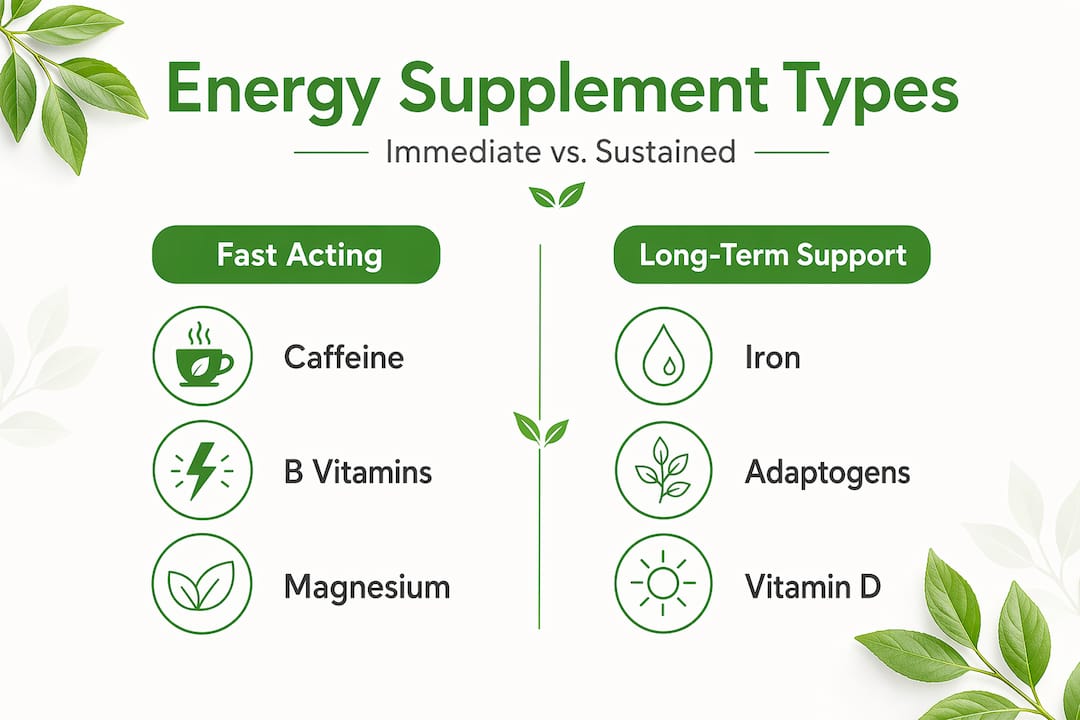
There is an important distinction between female energy boosters designed for immediate effects and those built for long-term vitality. Caffeine and B12 injections hit fast. Adaptogens and mineral replenishment work gradually, restoring what stress and hormonal fluctuations have depleted.
Pro Tip: If a women’s energy supplement promises to work in under an hour without caffeine, read the label carefully. Most genuine hormonal and nutrient support requires weeks of consistent use before you feel the full difference.
How these ingredients support energy and mood
Understanding how energy supplements work means looking at what happens inside your cells when key nutrients are missing or depleted. Each ingredient targets a different piece of the energy puzzle.
Iron and oxygen delivery
Iron deficiency is a major cause of fatigue in women, particularly those with heavy menstrual periods. Without sufficient iron, your red blood cells can’t carry enough oxygen to your muscles and brain. The result isn’t just tiredness. It’s low stamina, poor concentration, and that frustrating feeling of being exhausted even after a full night of sleep.
B vitamins and cellular energy
Vitamin B12 supports red blood cell production, nerve function, and DNA synthesis. Deficiency contributes to fatigue and cognitive issues that are surprisingly common in women who eat restrictive diets or have absorption issues. The full B-complex family, including B6 and B2, works together to convert food into usable fuel at the cellular level. B-complex vitamins are rapidly depleted during stress, which is why women going through demanding life periods often feel mentally drained alongside their physical tiredness.
Magnesium and stress recovery
Magnesium improves muscle relaxation, supports nerve function, and enhances sleep quality. Forms like magnesium glycinate are especially well-absorbed and can noticeably improve sleep within a few days of consistent use. Better sleep directly translates to better daytime energy, so this mineral often delivers results faster than people expect.

Vitamin D and mood regulation
Low vitamin D levels are closely linked to low mood and fatigue, two symptoms that often go hand in hand for women during winter months or when spending limited time outdoors. Vitamin D acts more like a hormone in the body than a standard nutrient, regulating multiple systems including immune defense and serotonin production.
Adaptogens and the HPA axis
This is where women’s energy health products get genuinely interesting. Adaptogens normalize cortisol and indirectly improve mood, cycle regularity, and energy by working on the hypothalamic-pituitary-adrenal (HPA) axis. The HPA axis is your body’s central stress response system. When chronic stress keeps cortisol elevated, it disrupts estrogen, progesterone, and thyroid function, leading to deep fatigue. Adaptogens help normalize that response over time.
Creatine: the unexpected addition
Creatine supports muscular energy production, improves metabolism, and offers benefits for mood, especially during hormonal changes. It is not just for athletes. For women dealing with energy dips linked to hormonal shifts, creatine can support rapid ATP production in cells. It works best when paired with adequate protein intake.
| Ingredient | Primary benefit | Timeline for results |
|---|---|---|
| Iron | Oxygen transport, reduced fatigue | 2 to 4 weeks |
| B12 and B-complex | Cellular energy, nerve support | 1 to 3 weeks |
| Magnesium | Sleep quality, muscle relaxation | Days to 1 week |
| Vitamin D | Mood regulation, immune health | 4 to 8 weeks |
| Ashwagandha | Cortisol regulation, stress resilience | 4 to 8 weeks |
| Creatine | Muscular energy, metabolism | 2 to 4 weeks with training |
Pro Tip: Omega-3 fatty acids are not vitamins, but they complement energy and mood support by reducing inflammation and supporting brain health. Look for supplements that include them as part of a broader women’s vitality formula.
Choosing the right women’s energy supplement
Knowing what the ingredients do is only half the equation. Choosing the product that fits your specific situation is where most women get stuck. The three main categories you’ll encounter are general multivitamins, targeted nutrient blends, and adaptogen-focused formulas.
General multivitamins cover broad nutritional bases but may not provide therapeutic doses of specific nutrients like iron or magnesium. Targeted blends address a defined gap, such as iron plus folate for menstruating women. Adaptogen-focused natural energy aids for women prioritize stress and hormonal support rather than raw nutrient replenishment.
Here is what to consider before buying:
- Your menstrual status: Women who menstruate regularly need more iron than those who don’t. Postmenopausal women have different priorities, including bone and cardiovascular health.
- Your diet: Plant-based eaters are at higher risk for B12, iron, and omega-3 deficiencies. Your supplement should fill those specific gaps.
- Your stress level: High-stress periods call for B-complex support and adaptogenic herbs. Moderate stress with good sleep might only need a quality multivitamin.
- Current medications: Some supplements interact with medications. Magnesium affects certain blood pressure drugs, and St. John’s Wort is a known interaction risk.
Taking vitamins without confirming deficiency can be harmful. Blood tests covering CBC, iron studies, B12, and thyroid levels give you a clear picture of what your body actually needs before you spend money on supplements you might not need.
Timing also matters more than people realize. Fat-soluble vitamins like D and K absorb better with meals containing healthy fats. Iron absorbs best on an empty stomach but can cause nausea, so pairing it with a small amount of vitamin C and food helps. Magnesium taken at night supports sleep directly.
Integrating supplements with your lifestyle
Supplements support your health. They do not replace it. Getting the most out of any natural energy aid for women requires building a consistent routine around the basics too.
Here is a practical approach to get started:
- Get tested first. Ask your doctor for a panel that includes ferritin, B12, vitamin D, and thyroid function. This removes guesswork and helps you target your actual gaps rather than supplementing broadly.
- Address sleep. No supplement fully compensates for chronic sleep deprivation. Magnesium at night can help you fall into deeper sleep, which then makes every other supplement work better.
- Clean up your nutrition baseline. High-sugar diets spike and crash blood sugar, creating energy swings that supplements cannot fix. Add protein to every meal to stabilize energy throughout the day.
- Manage stress deliberately. If cortisol is chronically high, adaptogens need time to work and lifestyle support to be effective. Exercise, breathwork, and even 10-minute walks lower cortisol in measurable ways.
- Start with one supplement at a time. Introducing multiple products simultaneously makes it impossible to tell what’s working. Start with your most deficient nutrient, give it four weeks, then layer in additional support.
- Be consistent. Adaptogens like ashwagandha require weeks of consistent use for stress resilience benefits. Taking them sporadically produces minimal results.
- Reassess every three months. Your needs change with seasons, stress cycles, and life stages. What worked at 28 may need adjusting at 38. Regular check-ins with your doctor keep your regimen aligned with your current biology.
My perspective on what women really need from supplements
What I’ve seen repeatedly is this: women come to supplements expecting a fast fix and leave disappointed not because the products failed, but because the expectations were misaligned.
The most common mistake is reaching for the most popular product rather than the most relevant one. Maca root is genuinely helpful for women managing cycle-related fatigue and libido shifts, but it does nothing for someone whose core issue is iron deficiency. Matching the supplement to the actual problem is everything.
What I’ve also learned is that hormonal health and energy are inseparable for women in ways that conventional wellness advice often ignores. If your estrogen and progesterone are out of balance because of stress, no amount of B12 will restore your vitality. You need to address the cortisol-hormone cascade directly, which is exactly what quality hormone balance support products are designed to do.
My honest take: the women who benefit most from supplements are those who treat them as one piece of a larger plan. They sleep reasonably well, eat mostly whole foods, and manage their stress with some intentionality. For those women, targeted supplementation can genuinely shift how they feel within weeks. For women running on no sleep, high stress, and processed food, supplements help but they won’t transform anything until the basics improve.
The patience required is real. Sustainable vitality is built over months, not days. But when you get the right nutrients in place consistently, the shift is unmistakable.
— SuperNatural
Support your energy with Nature’s Craft
Shopnaturescraft has been formulating clean, high-quality supplements since 2013 with one goal: to give your body exactly what it needs, nothing unnecessary. For women specifically, the product range covers every stage of your wellness journey.
The Women’s Multivitamin Gummies deliver a complete spectrum of nutrients in a form your body actually absorbs well. For hormonal and energy support, the Women’s Maca Root Complex provides 1500mg per serving to support libido, energy, and cycle balance. The Creatine Tri-Phase formula supports muscular energy and metabolism for women incorporating strength training. And for targeted hormonal support, the Women’s DIM Complex helps the body metabolize estrogen more efficiently.
Browse the full women’s health collection to find the right fit for your energy goals. Always consult your healthcare provider before starting a new supplement regimen.
FAQ
What is a women energy supplement?
A women energy supplement is a product formulated to address nutritional and hormonal gaps that commonly cause fatigue in women, including deficiencies in iron, B12, vitamin D, and magnesium, alongside adaptogenic herbs that support stress regulation and hormonal balance.
How long does it take for women’s energy supplements to work?
It depends on the ingredient. Magnesium can improve sleep quality within days, while adaptogens like ashwagandha typically require four to eight weeks of consistent use to noticeably reduce stress and improve energy.
Do I need a women-specific supplement or will a general multivitamin work?
Women-specific formulas account for menstruation-related iron loss, hormonal fluctuations, and stress-depleted B vitamins in ways general multivitamins often don’t. If you experience cycle-related fatigue or stress-driven energy dips, a targeted women’s supplement is the more effective choice.
Is it safe to take energy supplements for women every day?
For most women, yes, but medical evaluation is recommended before starting any regimen. Blood tests help confirm which nutrients you actually need, reducing the risk of over-supplementation, which can be harmful with fat-soluble vitamins and iron.
What are the best natural energy aids for women without caffeine?
Iron, B-complex vitamins, magnesium, and adaptogens like ashwagandha and rhodiola are among the most effective caffeine-free options. They work by restoring depleted nutrients and normalizing the body’s stress response rather than stimulating the nervous system directly.

