


Vitamins are absorbed by two distinct pathways: water-soluble vitamins (the nine B vitamins and vitamin C) use carrier-mediated transport into the bloodstream, while fat-soluble vitamins (A, D, E, and K) require bile, micelle formation, and lymphatic transport before reaching circulation. Understanding which pathway your vitamins use changes how you eat, when you supplement, and what warning signs to watch for.
TL;DR
- Most vitamin absorption happens in the small intestine, primarily the duodenum and jejunum.
- Water-soluble vitamins travel directly into portal blood; fat-soluble vitamins ride chylomicrons through the lymphatic system.
- Take fat-soluble vitamins with a meal that contains dietary fat to meaningfully increase uptake.
Table of Contents
- Where does vitamin absorption actually happen?
- How water-soluble vitamins are absorbed
- How fat-soluble vitamins (A, D, E, K) are absorbed
- What helps or blocks vitamin absorption?
- When absorption fails: causes, signs, and testing
- How supplement form, timing, and dosing affect what you absorb
- How your genes shape vitamin absorption efficiency
- How gut microbiota influence vitamin uptake
- How aging changes the way you absorb vitamins
- Key Takeaways
- The food-first approach still wins
- Useful sources
- FAQ
Where does vitamin absorption actually happen?
The stomach plays a supporting role. Gastric acid loosens vitamins from food proteins and activates enzymes, but very little absorption occurs there. The real work begins in the small intestine, which is divided into three segments with distinct jobs.
The duodenum (roughly 30 cm long) is the first stop after the stomach. It receives bile from the gallbladder and digestive enzymes from the pancreas, and it is the primary absorption site for iron, calcium, folate, and the fat-soluble vitamins A, D, E, and K. The jejunum (about 244 cm) handles the bulk of nutrient uptake, including most B vitamins, vitamin C, and additional fat-soluble vitamins. The ileum (about 150 cm) specializes in vitamin B12, bile salt recycling, and some vitamin D and K.
Once a vitamin crosses the intestinal lining, it takes one of two routes. Most nutrients enter the villous capillaries and travel through the portal vein to the liver. Lipids and fat-soluble vitamins instead enter the lacteals, specialized lymphatic vessels inside each villus, and reach the bloodstream via the thoracic duct.
How water-soluble vitamins are absorbed
Water-soluble vitamins do not rely on fat or bile. Each one uses a specific carrier-mediated mechanism rather than simple passive diffusion, which means the intestinal lining actively pulls them in using dedicated transport proteins.
Vitamin C, for example, enters enterocytes through sodium-dependent vitamin C transporters (SVCT-1 and SVCT-2). Biotin, pantothenic acid, and lipoate share the sodium-dependent multivitamin transporter (SMVT). Thiamine uses THTR-1 and THTR-2, which are pH-dependent and expressed along both the small and large intestine. This specificity matters: when a transporter is saturated or damaged, absorption drops even if dietary intake is adequate.

Vitamin B12 is the notable exception. It must bind to intrinsic factor, a glycoprotein secreted by gastric parietal cells, before the ileum can absorb it. Conditions that destroy parietal cells (autoimmune gastritis, causing pernicious anemia) or surgeries that remove the stomach or ileum can cut B12 absorption almost entirely. After gastric bypass or sleeve gastrectomy, B12 supplementation is typically required for life. You can explore Shopnaturescraft’s dedicated B12 resource for more on supplementation options.
Key clinical points for water-soluble vitamins:
- Proton pump inhibitors (PPIs) reduce gastric acidity, impairing the release of B12 from food protein and lowering its absorption.
- Chronic alcohol use disrupts thiamine and folate uptake by damaging intestinal transporters.
- Because the kidneys excrete excess water-soluble vitamins, toxicity is rare, but regular dietary intake is still necessary since the body stores little of them.
How fat-soluble vitamins (A, D, E, K) are absorbed
Fat-soluble vitamins follow a more complex, multi-step pathway that depends entirely on functional bile secretion and pancreatic enzyme activity.
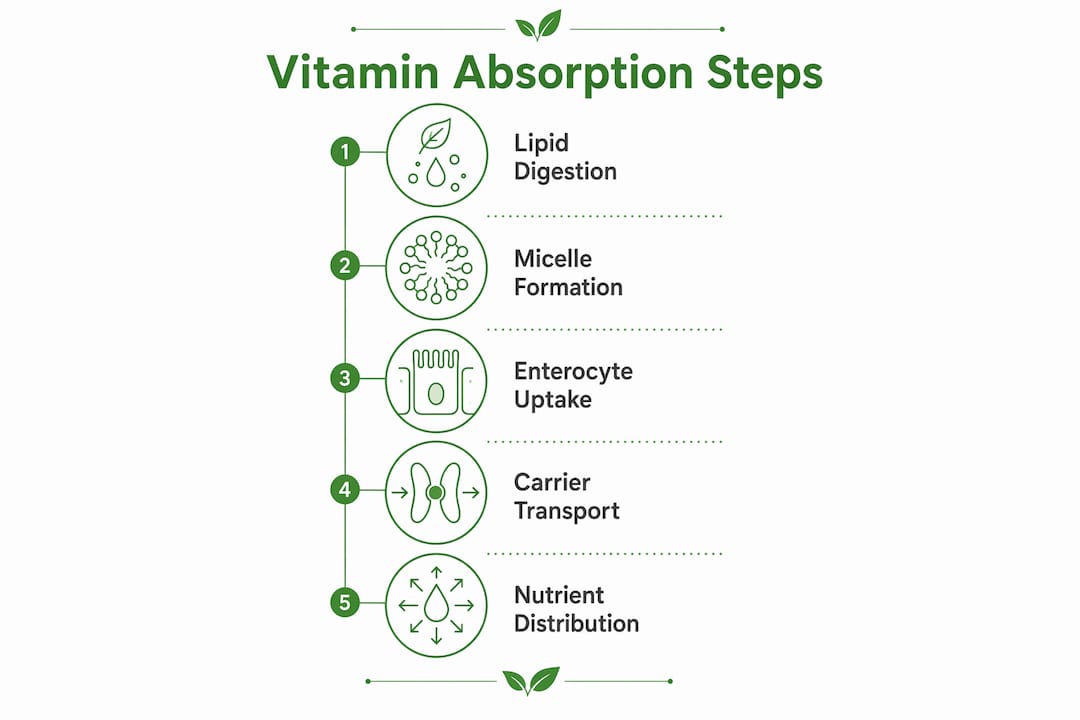
Step 1: Lipid digestion. Pancreatic lipase breaks dietary fats into free fatty acids and monoglycerides in the small intestinal lumen.
Step 2: Micelle formation. Bile acids emulsify these lipid products along with fat-soluble vitamins into tiny structures called micelles. Without adequate bile (as in cholestatic liver disease or bile duct obstruction) or without pancreatic enzymes (as in exocrine pancreatic insufficiency), this step fails and fat-soluble vitamin uptake drops sharply.

Step 3: Enterocyte uptake. Micelles ferry vitamins to the enterocyte brush border, where the vitamins cross the apical membrane by simple diffusion.
Step 4: Chylomicron packaging and lymphatic transport. Inside the enterocyte, vitamins A, D, E, and K are packaged into chylomicrons and secreted into the lacteals. They travel through the lymphatic system before entering the bloodstream via the thoracic duct, bypassing the liver’s first-pass metabolism initially.
Because fat-soluble vitamins accumulate in adipose tissue and the liver, they carry a real toxicity risk with chronic overconsumption. Water-soluble vitamins are renally cleared; fat-soluble ones are not.
Pro Tip: Research shows that some vegetable-derived nutrients can show up to sixfold higher absorption when consumed with dietary fat. Taking your fat-soluble vitamin supplement with a meal that includes avocado, olive oil, or nuts is one of the simplest, highest-yield habits you can build.
What helps or blocks vitamin absorption?
Diet, lifestyle, and medications all shift the vitamin uptake equation. Here is a practical breakdown.
| Factor | Helps absorption | Blocks absorption |
|---|---|---|
| Dietary fat | Boosts fat-soluble vitamin uptake up to sixfold | Absence of fat sharply reduces A, D, E, K uptake |
| Vitamin C | Converts non-heme iron to absorbable form | — |
| Cooking method | Light steaming frees cell-wall-bound carotenoids | Prolonged boiling destroys heat-sensitive vitamin C |
| Polyphenol-rich drinks | — | Tannins in tea and coffee inhibit iron absorption |
| Phytates | — | Bind iron and zinc in plant foods, reducing bioavailability |
| PPIs/antacids | — | Reduce gastric acidity, impairing B12 release from food |
| Calcium supplements | — | Compete with iron for the same intestinal transporter |
Plant-based iron (non-heme) absorbs at roughly 10%, compared to about 18% in mixed Western diets, a gap you can close meaningfully by pairing iron-rich plant foods with vitamin C. That pairing is one of the most evidence-backed dietary strategies for improving nutrient uptake without changing what you eat.
Practical checklist:
- Pair spinach, lentils, or fortified cereals with citrus, bell pepper, or tomato for better iron uptake.
- Avoid tea or coffee within 1 hour of an iron-rich meal.
- Take fat-soluble supplements with your largest meal of the day, not on an empty stomach.
- Space calcium and iron supplements at least 2 hours apart.
- Support gut health with fiber-rich foods and fermented foods; a damaged gut lining absorbs less of everything.
When absorption fails: causes, signs, and testing
Clinically significant malabsorption usually points to an underlying condition, not just a poor diet. The most common causes include:
- Celiac disease: Immune-mediated damage to the jejunal villi flattens the absorptive surface, causing global malabsorption of fat-soluble vitamins, iron, folate, and calcium.
- Exocrine pancreatic insufficiency (EPI): Without adequate lipase and protease secretion, fat digestion fails, and fat-soluble vitamins are lost in stool (steatorrhea).
- Short-bowel syndrome: Surgical removal of significant intestinal length (typically reducing effective absorptive length to 200 cm or less) causes clinically significant malabsorption across multiple nutrients.
- Small intestinal bacterial overgrowth (SIBO): Excess bacteria deconjugate bile salts, disrupting micelle formation and fat-soluble vitamin uptake.
- Bariatric surgery: Gastric bypass reroutes food past the duodenum, reducing iron, calcium, B12, and fat-soluble vitamin absorption.
“Symptoms of malabsorption include diarrhea, steatorrhea (oily, foul-smelling stools), unintentional weight loss, and signs of specific deficiencies such as night blindness (vitamin A), bone pain (vitamin D), easy bruising (vitamin K), or peripheral neuropathy (B12).” — StatPearls, Malabsorption Syndromes
Diagnostic workup to discuss with your clinician:
- Serum levels: 25-hydroxyvitamin D, B12, folate, ferritin, fat-soluble vitamins A and E.
- Fecal fat testing for steatorrhea.
- Hydrogen breath test for SIBO.
- Tissue transglutaminase antibodies (tTG-IgA) for celiac disease.
- Endoscopy with biopsy if mucosal damage is suspected.
How supplement form, timing, and dosing affect what you absorb
Not all supplements deliver the same amount of a vitamin to your bloodstream, even at identical label doses. Form matters considerably.
Plant-bound vitamin B6 (pyridoxine-β-D-glucoside) has roughly 50% bioavailability compared to near 100% for pyridoxine HCl found in most fortified foods and supplements. Choosing the right form is not a marketing detail; it is a real bioavailability difference with clinical implications.
Delivery format also plays a role. Some evidence suggests liquids may absorb more readily than tablets for certain vitamins, though results vary by nutrient and formulation. Softgels tend to dissolve faster than hard tablets, which can matter for fat-soluble vitamins. Shopnaturescraft’s guide to supplement forms breaks down the practical differences between capsules, gummies, softgels, and liquids.
| Vitamin type | Toxicity risk | Storage | Timing guidance |
|---|---|---|---|
| Water-soluble (B, C) | Low (renally excreted) | Minimal body stores | Daily intake needed; take with or without food |
| Fat-soluble (A, D, E, K) | Higher (stored in fat/liver) | Adipose tissue, liver | Take with a fat-containing meal; avoid megadosing without labs |
Dos and don’ts:
- Do take fat-soluble vitamins with a meal containing at least some dietary fat.
- Do space iron and calcium supplements by at least 2 hours.
- Do check serum 25-hydroxyvitamin D and B12 before starting high-dose supplementation.
- Don’t take high-dose fat-soluble vitamins long-term without clinician oversight.
- Don’t assume more is better; fat-soluble vitamins accumulate and can reach toxic levels.
How your genes shape vitamin absorption efficiency
Two people eating identical diets can end up with very different vitamin status, and genetics is a significant reason why. Variants in genes encoding intestinal transporters, metabolic enzymes, and vitamin-binding proteins alter how efficiently your body absorbs and uses specific nutrients.
A well-studied example is the MTHFR gene. Common variants (C677T and A1298C) reduce the activity of methylenetetrahydrofolate reductase, the enzyme that converts folate to its active form. People with these variants may have suboptimal folate status even with adequate dietary intake, and they often respond better to methylfolate supplements than to folic acid. Similarly, variants in the VDR gene (vitamin D receptor) affect how cells respond to vitamin D after absorption, meaning two people with the same serum vitamin D level can have different physiological outcomes.
Genetic differences in CYP2R1 (which converts vitamin D to its 25-hydroxy form in the liver) and in BCMO1 (which converts beta-carotene to vitamin A) also explain why some people convert plant-based carotenoids to active vitamin A poorly. For these individuals, relying solely on beta-carotene from vegetables may not meet vitamin A needs.
How gut microbiota influence vitamin uptake
Your gut microbiome contributes to vitamin nutrition in two direct ways: synthesis and absorption support. Bacteria in the large intestine produce meaningful amounts of vitamin K2 (menaquinones), biotin, folate, riboflavin, and thiamine. The colon has specific, efficient uptake systems for several of these bacterially synthesized vitamins, meaning the microbiome genuinely contributes to your total vitamin status.
Beyond synthesis, a healthy microbiome maintains the integrity of the intestinal lining. Dysbiosis (an imbalanced microbial community) increases intestinal permeability and low-grade inflammation, both of which impair transporter function and reduce absorption efficiency across the board. Antibiotic courses that wipe out beneficial bacteria can temporarily reduce vitamin K and biotin production, which is one reason clinicians sometimes recommend probiotic support after prolonged antibiotic use.
Fermented foods (yogurt, kefir, kimchi, sauerkraut) and prebiotic fiber support a diverse microbiome. Shopnaturescraft’s fiber gummies are one convenient option for supporting daily fiber intake when whole-food sources fall short.
How aging changes the way you absorb vitamins
Age brings predictable, physiologically significant changes to digestion that affect vitamin uptake at every stage of the process.
Gastric acid production declines with age (a condition called atrophic gastritis affects a meaningful proportion of older adults). Less acid means reduced release of B12 from food protein, lower ionization of calcium and iron, and impaired activation of some B vitamins. This is why crystalline B12 (found in supplements and fortified foods) is better absorbed in older adults than food-bound B12, and why the Institute of Medicine recommends adults over 50 meet most of their B12 needs through supplements or fortified foods.
Bile production and flow slow down. The gallbladder empties less efficiently with age, and bile acid synthesis decreases. Both changes reduce micelle formation, directly lowering fat-soluble vitamin absorption. Vitamin D deficiency is especially common in older adults partly for this reason, compounded by reduced skin synthesis.
Pancreatic enzyme output decreases gradually, further limiting fat digestion and fat-soluble vitamin uptake. Combined with reduced physical activity and often lower overall food intake, these changes make older adults particularly vulnerable to deficiencies in vitamins D, B12, and K.
Key Takeaways
Vitamin absorption follows two distinct pathways, and knowing which pathway each vitamin uses lets you make smarter choices about food pairings, supplement timing, and when to seek clinical testing.
| Point | Details |
|---|---|
| Two pathways, different needs | Water-soluble vitamins use carrier-mediated transport into blood; fat-soluble vitamins require bile, micelles, and lymphatic transport. |
| Fat boosts fat-soluble uptake | Some vegetable-derived nutrients show significantly higher absorption when consumed with dietary fat. |
| Pair iron with vitamin C | Plant-based iron has lower absorption compared to mixed diets; vitamin C significantly closes that gap. |
| Aging raises deficiency risk | Declining gastric acid, bile flow, and enzyme output make vitamins D, B12, and K harder to absorb after age 50. |
| Fat-soluble vitamins carry toxicity risk | Unlike water-soluble vitamins, A, D, E, and K can accumulate in adipose tissue and liver; high-dose supplementation requires clinician oversight. |
The food-first approach still wins
The science of vitamin absorption is genuinely complex, but the practical takeaways are not. Most healthy adults get the best results from a food-first strategy: eating varied, minimally processed meals, pairing nutrients intelligently (iron with vitamin C, fat-soluble vitamins with healthy fats), and supporting gut health with fiber and fermented foods. Supplements fill real gaps, especially for diagnosed deficiencies, plant-based diets with lower B12 and iron bioavailability, or adults over 50 with declining gastric function. But chasing a single high-dose supplement without knowing your baseline levels is rarely the right move.
Three practical next steps worth taking today: adjust one meal to pair a fat-soluble vitamin source with dietary fat; request a serum 25-hydroxyvitamin D and B12 panel at your next checkup; and if you suspect malabsorption, ask your clinician about a fecal fat test or breath test before self-treating. Shopnaturescraft’s educational resources are a good starting point for understanding which supplement forms and formulations best match your absorption needs.
This article is for general educational purposes only and is not a substitute for professional medical advice. Consult a qualified clinician or registered dietitian for guidance specific to your health situation.
Useful sources
- Physiology, Nutrient Absorption — StatPearls/NCBI: Covers intestinal segment roles, transcellular vs. paracellular transport, and the portal vs. lymphatic routing of nutrients.
- Biochemistry, Fat Soluble Vitamins — StatPearls/NCBI: Details micelle formation, chylomicron assembly, lacteal uptake, and toxicity risk for vitamins A, D, E, and K.
- Intestinal Absorption of Water-Soluble Vitamins — PMC: In-depth review of carrier-mediated transport systems (SVCT, SMVT, THTR) for each water-soluble vitamin.
- Malabsorption Syndromes — StatPearls/NCBI: Clinical overview of celiac disease, EPI, SIBO, and diagnostic workup including stool fat testing and breath tests.
- Short Bowel Syndrome — NCBI Bookshelf: Explains how reduced intestinal length causes clinically significant malabsorption.
- Frontiers in Nutrition — 2025 bioavailability review: Quantifies the impact of dietary fat on nutrient uptake, iron bioavailability differences across diet patterns, and form-dependent bioavailability for B vitamins.
FAQ
What is the hardest vitamin to absorb?
Vitamin B12 is widely considered the most absorption-dependent vitamin because it requires intrinsic factor from the stomach, a functional ileum, and adequate gastric acid, making it vulnerable to multiple points of failure.
How do I know if I’m absorbing my vitamins?
Blood tests are the most direct signal: serum 25-hydroxyvitamin D, B12, ferritin, and folate levels reflect actual absorption status. Persistent fatigue, neurological symptoms, or unexplained weight loss alongside a poor diet are reasons to request these labs.
What blocks the absorption of vitamins?
Tannins in tea and coffee inhibit iron uptake, phytates in grains and legumes bind iron and zinc, calcium competes with iron for intestinal transporters, and PPIs reduce gastric acidity needed for B12 release from food.
What is the most effective way to absorb vitamins?
Eat fat-soluble vitamins (A, D, E, K) with a meal containing dietary fat, pair plant-based iron sources with vitamin C, avoid polyphenol-rich drinks around iron-rich meals, and maintain gut health with fiber and fermented foods.

