


Why women need iodine supplements: the direct answer
Iodine supplements are not optional for many women. They are a practical necessity, especially during pregnancy, breastfeeding, and the years leading up to conception. Your body cannot make iodine on its own, so every microgram has to come from food or supplements. When intake falls short, thyroid hormone production drops, and the consequences range from fatigue and weight gain to serious fetal developmental harm.
The numbers from the NIH Office of Dietary Supplements make the need clear:
- Non-pregnant adult women: 150 mcg/day
- Pregnant women: 220 mcg/day
- Breastfeeding women: 290 mcg/day
- The tolerable upper intake level: 1,100 mcg/day
Surveys consistently show that many pregnant women in the United States fall below the 150 mcg/L urinary iodine threshold the WHO uses to define adequate status during pregnancy. Diet alone, even a healthy one, often cannot close that gap. That is the core reason supplementation matters.
Pro Tip: Check the label on your prenatal vitamin before assuming it covers your iodine needs. Only about half of prenatal multivitamins sold in the United States contain iodine, and some provide far less than the recommended 150 mcg.
What iodine does for your body and why it matters for women
Iodine is a trace mineral with one primary job: it is the raw material your thyroid uses to produce thyroxine (T4) and triiodothyronine (T3). Those two hormones regulate your metabolism, body temperature, heart rate, and energy levels. Without enough iodine, the thyroid cannot do its job, and virtually every system in your body feels the effects.

Women face a higher risk of iodine insufficiency than men for several reasons. Hormonal fluctuations across the menstrual cycle, pregnancy, and breastfeeding all increase iodine demand. The thyroid itself is more active during pregnancy, producing roughly 50% more thyroid hormones to support fetal growth. That surge requires a steady, larger supply of iodine than most women get from food alone.
Common dietary sources of iodine include:
- Seafood and fish (cod, tuna, shrimp)
- Dairy products (milk, yogurt, cheese)
- Eggs
- Iodized salt
- Some fortified breads
The challenge is that iodine content in food varies widely depending on soil quality, farming practices, and food preparation. Women who avoid dairy, restrict salt, or follow plant-based diets are especially likely to come up short. For them, a supplement is not a precaution. It is a gap-filler backed by clinical guidance.
Signs, symptoms, and causes of iodine deficiency in women
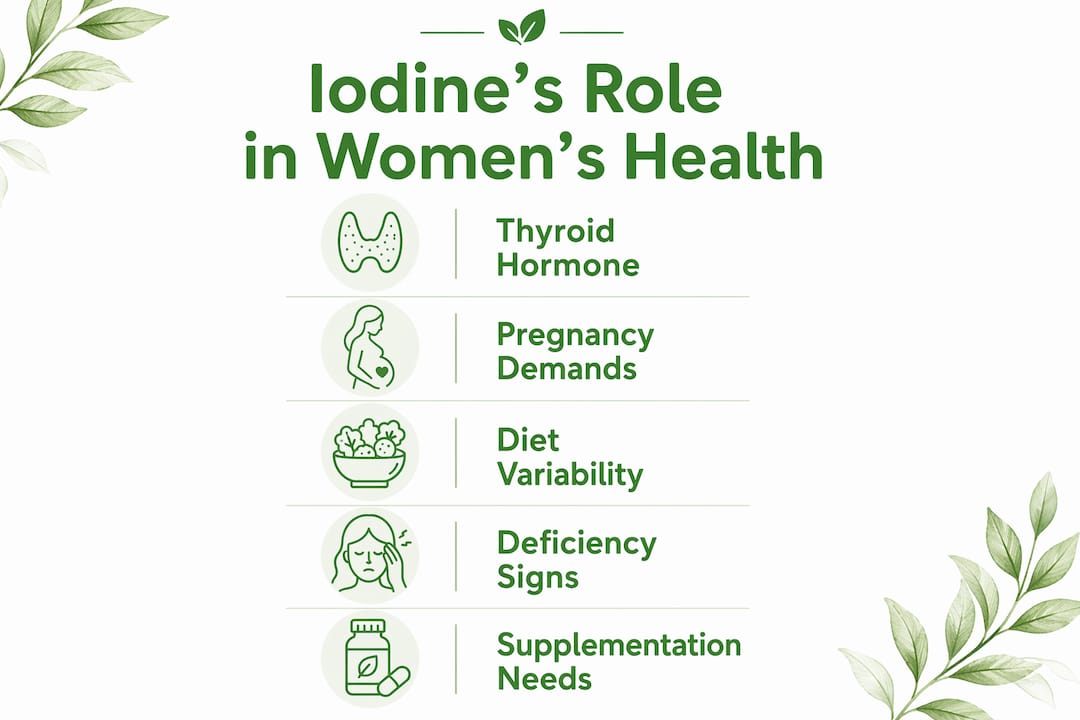
Iodine deficiency does not always announce itself loudly. Many women live with low-grade insufficiency for months before connecting their symptoms to a nutrient gap.
The most recognizable sign is a goiter, an enlarged thyroid gland visible as a swelling at the base of the neck. Goiter is usually the earliest clinical indicator that the thyroid is straining to compensate for low iodine. Beyond that, deficiency symptoms overlap heavily with general hypothyroidism:
- Persistent fatigue and low energy
- Unexplained weight gain
- Dry skin and brittle hair
- Constipation
- Feeling cold even in warm environments
- Depression or brain fog
- Heavier or irregular menstrual periods
Fertility is also affected. Low thyroid hormone from iodine insufficiency can disrupt ovulation and make conception harder. Women who are trying to get pregnant and experiencing irregular cycles should ask their doctor about thyroid function and iodine status.
| Symptom | Possible connection |
|---|---|
| Goiter | Thyroid enlarging to capture more iodine |
| Fatigue, weight gain | Slowed metabolism from low T3/T4 |
| Menstrual irregularities | Hormonal disruption from hypothyroidism |
| Fertility difficulties | Impaired ovulation and implantation |
| Dry skin, hair loss | Reduced cellular turnover from low thyroid hormones |
The causes are straightforward: not enough iodine in the diet, increased physiological demand (pregnancy, breastfeeding), or both at once. Vegan and vegetarian diets, geographic regions with iodine-poor soil, and low-salt diets all raise the risk. You can also learn more about how thyroid dysfunction and fertility issues connect to nutrient gaps.

Why iodine is critical during pregnancy and breastfeeding
Pregnancy is when the iodine importance for women becomes most urgent. The fetal thyroid does not begin functioning independently until around week 18–20 of gestation. Before that point, the fetus depends entirely on maternal thyroid hormones for brain and nervous system development. That means your iodine stores directly shape your baby’s neurological foundation from the very first weeks.
Severe iodine deficiency during pregnancy can cause miscarriage, stillbirth, preterm birth, and permanent neurodevelopmental deficits including intellectual disability and hearing loss. Iodine deficiency is the most common cause of preventable intellectual disability in the world.
The NIH confirms that pregnant women need a higher iodine intake than non-pregnant adults. Breastfeeding further raises the iodine requirement, as infants rely on breast milk for their iodine. The iodine content of your breast milk depends directly on how much you consume.
The American Thyroid Association recommends that women who are pregnant, planning to become pregnant, or breastfeeding take a daily supplement containing iodine as potassium iodide, according to clinical guidelines. The American Academy of Pediatrics echoes that guidance. Starting supplementation before pregnancy is ideal, because building adequate iodine stores takes time.
How iodine deficiency is diagnosed and treated
Diagnosis usually starts with a urine test. Urinary iodine concentration (UIC) is the most practical measure of recent iodine intake, since the kidneys excrete most of what you consume. A median UIC below 150 mcg/L during pregnancy signals insufficient status, according to WHO criteria.
- Urinary iodine concentration (UIC): A spot urine sample or 24-hour collection; the standard first-line test.
- Thyroid function panel: Measures TSH, free T4, and free T3 to assess whether deficiency has already affected hormone output.
- Thyroid ultrasound: Used when goiter is suspected to evaluate gland size and structure.
- Dietary assessment: A registered dietitian reviews food intake to identify gaps in iodine-rich foods.
Once deficiency is confirmed, treatment depends on severity. Mild insufficiency is typically addressed by adding iodized salt, increasing iodine-rich foods, and starting a supplement containing potassium iodide. More significant deficiency, especially during pregnancy, requires medical supervision to determine the right dose and monitor thyroid response.
| Deficiency level | Typical approach |
|---|---|
| Mild (dietary gap) | Iodized salt, iodine-rich foods, 150 mcg supplement |
| Moderate | Supervised supplementation, thyroid monitoring |
| Severe (especially in pregnancy) | Medical management, higher-dose supplementation under physician care |
Preventive action is always easier than corrective treatment. If you are planning a pregnancy, getting your iodine status checked before conception gives you time to build adequate stores.
Risks of taking too much iodine
More iodine is not always better. The relationship between iodine intake and thyroid health follows a U-shaped curve: both too little and too much cause problems. The American Thyroid Association is explicit that ingesting more than 1,100 mcg/day is not recommended and can trigger thyroid dysfunction.
The ATA advises against ingesting iodine or kelp supplements containing more than 500 mcg of iodine daily for children, adults, and during pregnancy and lactation. There is no known thyroid benefit of routine daily iodine doses in excess of the U.S. RDA.
Excess iodine can cause or worsen:
- Hypothyroidism or hyperthyroidism
- Goiter (the same condition deficiency causes)
- Autoimmune flare-ups in people with Hashimoto’s or Graves’ disease
- Congenital hypothyroidism in newborns when mothers consume excessive amounts during pregnancy
The biggest practical risk comes from high-dose supplements. Many iodine and kelp products on the market contain doses up to 100 times the tolerable upper limit. That is not a typo. Reading labels carefully before purchasing any iodine supplement is not optional.
Safety tips when choosing iodine supplements:
- Choose products with 150 mcg per serving, not hundreds or thousands
- Avoid kelp-based supplements unless the iodine content is clearly stated and within safe limits
- Look for potassium iodide as the iodine source, which is the form recommended by the American Thyroid Association
- If you have a thyroid condition, get medical clearance before starting any iodine supplement
What current expert guidelines recommend for women
The guidance from major health organizations is consistent. Here is how the recommendations break down by life stage, based on NIH and American Thyroid Association data:
| Life stage | Recommended daily iodine | Supplement guidance |
|---|---|---|
| Non-pregnant adult women | 150 mcg | Supplement if diet is insufficient |
| Planning pregnancy | 150 mcg (supplement) | Start at least 3 months before conception |
| Pregnant | 220 mcg | Prenatal vitamin with 150 mcg potassium iodide |
| Breastfeeding | 290 mcg | Continue supplement through lactation |
Starting supplementation at least 3 months before conception is the clinical recommendation because iodine stores take time to build. The fetus needs those stores from the earliest weeks of development, well before most women know they are pregnant.
One important caution: of 59 best-selling prenatal multivitamins reviewed in a 2016–2017 analysis, only 34 contained iodine at all. Always verify that your prenatal supplement includes iodine as potassium iodide, and confirm the dose is at or near 150 mcg.
Pro Tip: If you follow a vegan or vegetarian diet, your iodine intake from food is likely lower than average. Discuss a targeted iodine supplement with your healthcare provider, especially if you are pregnant or planning to conceive.
How iodine supplements interact with medications and health conditions
Iodine supplements do not work in isolation. Several medications and health conditions change how your body handles iodine, and some combinations require medical oversight.
Antithyroid drugs such as methimazole and propylthiouracil, used to treat hyperthyroidism, directly affect iodine metabolism. Adding an iodine supplement while taking these medications can interfere with treatment. Lithium, used for bipolar disorder, also affects thyroid function and can amplify the effects of iodine changes. ACE inhibitors combined with potassium iodide may raise potassium levels to unsafe ranges in some women.
People with autoimmune thyroid conditions such as Hashimoto’s thyroiditis or Graves’ disease are particularly sensitive. Even moderate increases in iodine intake can trigger a flare or destabilize thyroid hormone levels. The same caution applies to women who have had a partial thyroidectomy. For anyone in these groups, supplementing iodine without a physician’s guidance carries real risk.
If you take any thyroid medication, heart medication containing amiodarone, or topical antiseptics with iodine, tell your doctor before adding an iodine supplement. The interaction may be minor or significant depending on your specific situation.
How to choose a safe and effective iodine supplement
Not all iodine supplements are created equal, and the differences matter for your health. The form of iodine, the dose, and the quality of the product all affect both safety and effectiveness.
Potassium iodide is the form recommended by the American Thyroid Association for prenatal vitamins and supplements. It is well absorbed (studies show absorption rates near 96%) and predictable in dosage. Sodium iodide is also acceptable. Kelp-derived iodine, by contrast, varies widely in concentration and has been found in products containing doses far above safe limits.
For most women, the right starting point is a prenatal multivitamin that includes 150 mcg of potassium iodide. If you need a standalone iodine supplement, look for one that clearly states the iodine content per serving and stays within the 150–220 mcg range appropriate for your life stage. Shopnaturescraft offers a range of women’s health supplements formulated with clean, clearly labeled ingredients, so you know exactly what you are getting in every serving.
Third-party testing is a meaningful quality signal. Supplements verified by organizations such as USP, NSF International, or ConsumerLab have been independently tested for label accuracy and contaminant levels. That verification matters most for iodine, where label inaccuracies can push you above safe thresholds without your knowledge. You can also explore iodine-specific guidance for breastfeeding women and infant development considerations.
Key Takeaways
Women need adequate iodine daily to support thyroid hormone production, and requirements rise sharply during pregnancy and breastfeeding, making supplementation with 150 mcg potassium iodide the standard clinical recommendation for most women in these life stages.
| Point | Details |
|---|---|
| Daily iodine needs vary by life stage | Non-pregnant women need 150 mcg/day; pregnant women 220 mcg/day; breastfeeding women 290 mcg/day. |
| Prenatal vitamins often lack iodine | Only 34 of 59 best-selling prenatal multivitamins contained iodine in a 2016–2017 review. |
| Start supplementing before conception | Beginning at least 3 months before pregnancy builds the iodine stores the fetus needs from the earliest weeks. |
| Excess iodine causes harm too | Intakes above 1,100 mcg/day can trigger thyroid dysfunction; many kelp supplements exceed this threshold. |
| Autoimmune thyroid conditions require supervision | Women with Hashimoto’s or Graves’ disease should only supplement iodine under direct medical guidance. |
FAQ
What are the signs of low iodine in women?
The most common signs include a goiter (enlarged thyroid), persistent fatigue, unexplained weight gain, dry skin, constipation, depression, and heavier menstrual periods. Fertility difficulties and irregular ovulation can also indicate low thyroid hormone linked to iodine insufficiency.
How can you tell if your body needs iodine?
A urinary iodine concentration test is the standard way to assess recent iodine intake. Your doctor may also order a thyroid function panel measuring TSH and free T4 to determine whether low iodine has already affected hormone production.
What happens if you take iodine and don’t need it?
Taking iodine above your actual needs can cause thyroid dysfunction, including both hypothyroidism and hyperthyroidism. The tolerable upper limit is 1,100 mcg/day for adults, and exceeding it consistently raises the risk of goiter and autoimmune thyroid reactions.
Why should women with thyroid conditions be cautious about iodine?
Women with Hashimoto’s thyroiditis, Graves’ disease, or a history of partial thyroidectomy are sensitive to iodine changes. Even moderate increases can disrupt thyroid hormone levels or trigger an autoimmune flare, so medical supervision is required before starting any iodine supplement.
Do women over 40 need to approach iodine differently?
Women at higher risk for thyroid nodules and subclinical thyroid dysfunction can be more sensitive to iodine changes. Routine supplementation beyond the RDA is not recommended without a physician’s evaluation, especially if thyroid disease runs in the family.

