


You pick up a supplement off the shelf, read the label, and assume you’re getting exactly what it promises. That assumption costs more than money. Research shows that roughly 1 in 4 supplements fails independent quality standards for purity or label accuracy, and approximately 50% of top-selling supplements failed basic label accuracy tests in 2025. Understanding why supplement quality matters is the difference between supporting your health and unknowingly working against it.
Table of Contents
- Key takeaways
- Why supplement quality matters: what the industry isn’t telling you
- The real risks of low-quality supplements
- How to identify genuinely high-quality supplements
- The real benefits of choosing high-quality supplements
- How to apply this knowledge when you shop
- My honest take on supplement quality after years of watching this industry
- Nature’s Craft quality you can actually verify
- FAQ
Key takeaways
| Point | Details |
|---|---|
| Label claims are unreliable | Nearly half of popular supplements fail basic label accuracy tests, meaning you may not get what you pay for. |
| Low-quality supplements carry real health risks | Contamination with heavy metals, toxins, or undisclosed pharmaceuticals can cause serious harm. |
| Certifications alone are not enough | Third-party logos are a starting point, but batch-level Certificates of Analysis provide stronger quality assurance. |
| Extraction methods change effectiveness | For botanicals and mushrooms, how ingredients are extracted determines whether you absorb any active compounds at all. |
| Price signals matter | Extremely low prices often reflect corners cut on ingredients, testing, or manufacturing standards. |
Why supplement quality matters: what the industry isn’t telling you
Most people think of supplement quality as a simple checklist. Third-party tested? Check. GMP certified? Check. Must be good. The reality is far more layered than that, and the gap between what a label says and what a product actually contains can be significant.
There is no single, government-enforced definition of “quality” in the supplement industry. The FDA requires manufacturers to follow Good Manufacturing Practices (GMP), which set standards for consistency, cleanliness, and documentation. However, the FDA does not verify supplement safety or efficacy before a product reaches store shelves. That means brands are largely self-regulating, and compliance varies widely.
True supplement quality involves multiple layers working together:
- Ingredient sourcing: Where raw materials come from, how they are grown or harvested, and whether suppliers are audited
- Manufacturing processes: Equipment calibration, cross-contamination controls, and batch consistency
- Testing rigor: Whether products are tested for identity, potency, purity, and contaminants at the batch level
- Transparency: Whether brands share testing results and sourcing details openly with consumers
Certifications from organizations like USP and NSF are meaningful starting points. But as expert analysis of supplement testing points out, a lab can be ISO certified without validating its methods for every specific analyte or product type. A certification logo on a label tells you the brand met a baseline. It does not tell you whether your specific bottle was tested.
Pro Tip: Ask brands directly for a Certificate of Analysis (COA) for the specific batch number on your product. Any brand serious about quality should be able to provide one.
The real risks of low-quality supplements

This is where the stakes become clear. Low-quality supplements are not just ineffective. Some are genuinely dangerous.
Heavy metals and mycotoxins (mold-related toxins) are among the most commonly documented contaminants, particularly in popular products like turmeric, spirulina, and chlorella. These contaminants can build up in the body over time, contributing to organ stress, neurological issues, and immune disruption.
“Natural” and “herbal” labels do not guarantee safety. Some of the most contaminated supplement categories are plant-based products that consumers assume are inherently clean.
The adulteration problem goes beyond contaminants. Weight-loss and sexual enhancement supplements are especially prone to undisclosed pharmaceuticals mixed in without appearing on the label. These can include prescription-strength compounds that interact dangerously with medications or existing health conditions.
Economic adulteration is another widespread issue. This is when manufacturers dilute expensive ingredients with cheaper fillers to cut costs, while still claiming the full dose on the label. The result is a product that may look identical to a high-quality supplement but delivers a fraction of the active compounds. Many brands fail to fully enforce ingredient specifications, leading to inconsistent potency and potential undisclosed allergens from filler ingredients.
Here is a quick breakdown of the main risk categories:
- Contamination: Heavy metals (lead, arsenic, cadmium), pesticides, and mold toxins in raw botanical materials
- Adulteration with drugs: Unlisted stimulants, diuretics, or erectile dysfunction medications in “natural” products
- Potency mislabeling: Products containing more or less of an ingredient than stated, sometimes by a wide margin
- Filler dilution: Active ingredients stretched with cheap starch, chalk, or undisclosed allergens
The importance of supplement quality becomes impossible to ignore once you see how many ways a product can fail before it reaches you.
How to identify genuinely high-quality supplements
Knowing what to look for changes everything. Here is a practical, prioritized approach to evaluating any supplement before you buy:
- Request a batch-level COA. A Certificate of Analysis at the batch level is the strongest quality signal available. It should show identity testing, potency results, and contaminant screening specific to the product lot you are buying.
- Look beyond the certification logo. NSF, USP, and Informed Sport certifications are valuable but only cover what was submitted for testing. Ask whether the current batch was tested, not just a representative sample from a year ago.
- Understand the ingredient form. Not all forms of an ingredient are equally absorbed. Magnesium glycinate absorbs far better than magnesium oxide. Methylfolate is more bioavailable than folic acid. The specific form listed on the label matters significantly.
- Check extraction details for botanicals and mushrooms. For these products, extraction method determines bioavailability directly. An unextracted mushroom powder may contain almost no active compounds because chitin in the cell wall blocks absorption. Look for products that specify extraction ratios or standardized active compound percentages.
- Avoid proprietary blends. When a label lists “Proprietary Blend 500mg” with no individual ingredient amounts, you have no way to know if any single ingredient reaches an effective dose.
- Research the brand’s manufacturing history. Brands with a track record of FDA compliance, transparent sourcing, and published testing data are significantly lower risk than newer companies without that history.
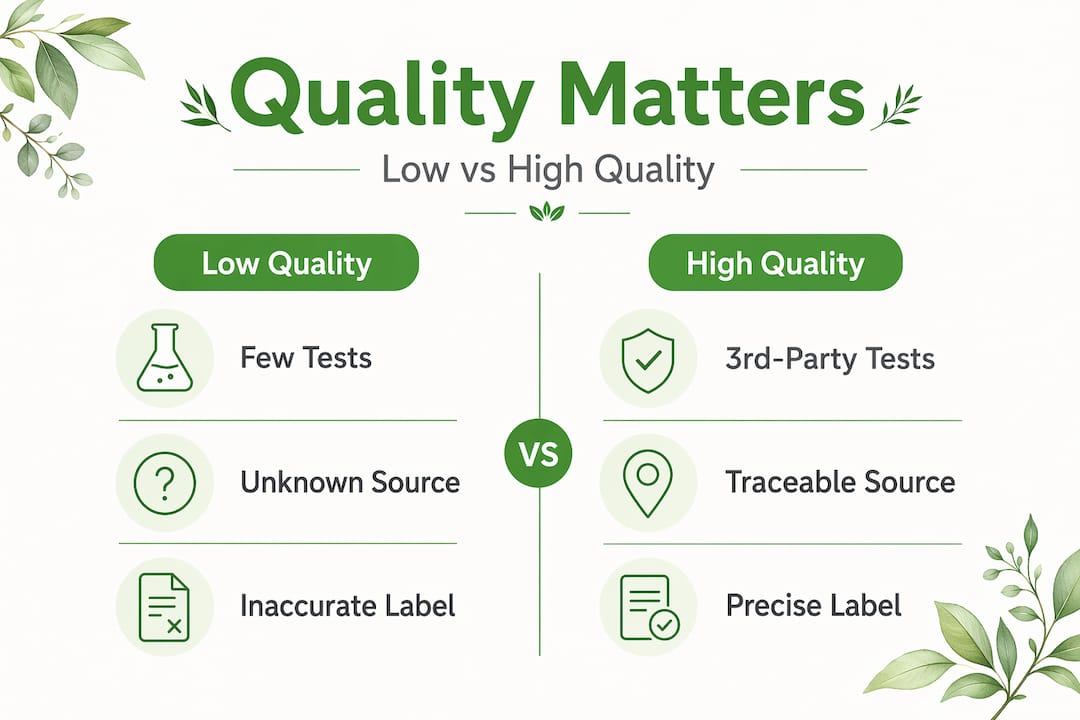
The following table compares key markers between lower-quality and higher-quality supplements:
| Quality marker | Lower quality | Higher quality |
|---|---|---|
| Testing | In-house only or none disclosed | Third-party, batch-level COA available |
| Ingredient form | Generic or poorly absorbed forms | Bioavailable, standardized forms |
| Extraction (botanicals) | Raw powder, no extraction data | Specified extraction ratio or active % |
| Label transparency | Proprietary blends, vague dosages | Full ingredient amounts disclosed |
| Price | Unusually low for category | Reflects real ingredient and testing costs |
Pro Tip: When evaluating a botanical supplement, search for the standardized marker compound on the label. Turmeric, for example, should specify curcuminoid percentage. No standardization often means no reliable potency.
The real benefits of choosing high-quality supplements
Choosing quality supplements is not just about avoiding harm. It produces measurable positive results for your health and your investment.
When you take a supplement formulated with bioavailable ingredient forms, your body actually absorbs and uses what you swallow. You get the research-backed benefits that made you interested in the supplement in the first place. With low-quality products, you may absorb a fraction of the stated dose, or nothing that resembles the active compound at all.
The benefits of high-quality supplements extend across several areas:
- Better absorption and effectiveness: Proper ingredient forms and extraction mean active compounds reach your cells at meaningful concentrations
- Reduced risk of adverse reactions: Cleaner products with verified purity profiles carry significantly lower risk of triggering reactions from contaminants or undisclosed ingredients
- Predictable results: Consistent potency across batches means you can reliably track how a supplement is affecting your health
- Greater confidence in your health spending: Knowing a product has been independently verified removes the guesswork from your wellness routine
- Support for personalized health goals: Evidence-based formulations allow you to match supplements to specific needs, whether that is hormonal support, cognitive function, or immune health
Why quality supplements are essential comes down to this: if a supplement is not what it claims to be, it is not a supplement. It is just a pill. Understanding the importance of natural ingredients and how they are sourced is one of the first steps toward making confident choices.
How to apply this knowledge when you shop
Knowing the theory is one thing. Here is how to translate it into real purchasing decisions, every time.
- Start with the brand’s transparency. Visit the brand’s website before buying. Do they publish COAs? Do they explain where their ingredients come from? Silence on these points is a red flag.
- Read the full ingredient list. Check for the specific form of each ingredient, not just the name. Also check for unnecessary fillers like titanium dioxide, artificial dyes, or hydrogenated oils in the “Other Ingredients” section.
- Verify dosages match research. Look up the clinically studied dose for the key ingredient. If the supplement contains a fraction of that amount, it likely will not produce meaningful results regardless of how it is marketed.
- Avoid high-risk categories without strong vetting. Weight-loss, sexual enhancement, and pre-workout supplements have the highest rates of adulteration with unlisted compounds. If you use these, only purchase from brands with verified third-party testing and published results.
- Use price as a screening signal. Extremely low prices often signal that corners were cut on ingredients or testing. This does not mean the most expensive product is automatically best, but if a price seems too good to be true for a quality supplement, it probably is.
Learning how to take supplements daily with confidence starts with knowing you have chosen products that meet real quality standards. Armed with these criteria, you can evaluate any supplement on the market with clarity.
Pro Tip: When you find a supplement you trust, save the batch COA for your records. If you ever have a reaction or notice inconsistent results, that document helps you compare batch variations.
My honest take on supplement quality after years of watching this industry
I’ve spent years watching health-conscious consumers make genuinely thoughtful decisions about their diets, only to treat their supplement shelf as an afterthought. They’ll spend 30 minutes reading nutrition labels at the grocery store and then buy a supplement based on a single certification logo. That disconnect frustrates me.
What I’ve learned is that the certification system, while valuable, was never designed to give consumers real-time assurance about every bottle leaving a factory. It was designed to set minimum standards. Too many brands treat those minimums as the finish line.
The aspect most consumers miss is the supply chain. A brand can do everything right at the manufacturing stage and still receive adulterated or mislabeled raw materials from a supplier. True quality requires oversight at every step, from the farm or forest where an ingredient originates to the final product testing before shipment. Most brands don’t have full visibility into that chain, and most consumers don’t know to ask.
My honest advice: stop treating supplement shopping as a passive activity. Demand batch-level documentation. Ask questions through customer service and see how brands respond. The brands that take quality seriously will welcome those questions. The ones that deflect are telling you something important.
Consumer pressure is the most effective force for improving industry standards. When you choose quality, you are not just protecting your own health. You are creating a market that rewards the brands doing the work correctly.
— SuperNatural
Nature’s Craft quality you can actually verify
Shopnaturescraft was built from the ground up around one principle: every bottle should reflect genuine care for the person opening it. Since 2013, Nature’s Craft has committed to sourcing clean ingredients, adhering to rigorous manufacturing standards, and formulating products that deliver real results.
Whether you are looking for a biotin supplement with transparent sourcing, turmeric gummies made with quality botanical extracts, or cranberry gummies dosed at 500mg per serving, Nature’s Craft gives you the specifics you need to feel confident. Every product starts with the best ingredients and is crafted to meet the standards that actually protect your health. Explore the full collection at Shopnaturescraft and shop with the assurance that quality here is not just a claim.
FAQ
What makes a supplement ineffective or unsafe?
Low-quality supplements fail due to poor ingredient forms, inaccurate labeling, contamination with heavy metals or toxins, or adulteration with undisclosed compounds. Products that skip third-party batch testing carry the highest risk.
Are third-party certifications enough to guarantee quality?
Certifications like USP and NSF are meaningful baseline indicators, but they are not sufficient on their own. Batch-level Certificates of Analysis provide stronger, product-specific quality assurance than a label logo alone.
How do extraction methods affect supplement quality?
For botanicals and mushroom supplements, extraction is what determines whether active compounds are even accessible to your body. Unextracted powders can deliver very little of the intended benefit because cell walls block absorption without proper processing.
Which supplement categories carry the highest contamination risk?
Weight-loss, sexual enhancement, and pre-workout products have the highest documented rates of adulteration with unlisted pharmaceutical compounds. Botanical supplements like turmeric, spirulina, and chlorella also carry elevated contamination risk from heavy metals and pesticides.
How can I tell if a supplement brand is genuinely transparent?
Brands that prioritize quality will readily provide batch-specific COAs, disclose full ingredient amounts, name their sourcing regions, and respond substantively to consumer questions about their manufacturing practices.

