


A multivitamin is a dietary supplement that combines at least three vitamins, or vitamins and minerals together, to help fill nutritional gaps your daily diet may leave behind. Most people reach for one as a form of nutritional insurance, not because they have a diagnosed deficiency, but because eating a perfectly balanced diet every single day is harder than it sounds. Available as tablets, chewables, gummies, and liquids, multivitamins are typically taken once daily and represent one of the most widely used supplements in the United States. This guide breaks down what they contain, what the science actually says about their benefits, and how to choose one that genuinely supports your health.
What is a multivitamin, exactly?
A multivitamin is defined by its combination of nutrients rather than any single active ingredient. According to the Merck Manual, a product qualifies as a multivitamin when it contains at least three vitamins, or a mix of vitamins and minerals, in doses formulated close to recommended daily amounts. This is the key distinction between a standard multivitamin and a megavitamin. Megavitamins deliver doses far above recommended levels and carry a meaningfully higher risk of toxicity. Most people shopping for daily nutritional support need a multivitamin, not a megavitamin.
The definition of multivitamins also includes an important caveat: there is no government-mandated standard formula. Two products sitting side by side on a pharmacy shelf can have completely different nutrient profiles, different doses, and different forms of each vitamin. That variability is not a flaw in the category. It reflects the fact that different people have different nutritional needs. What it does mean is that reading the Supplement Facts label is not optional. It is the only way to know what you are actually buying.
What ingredients are typically found in multivitamins?
Most multivitamins include the fat-soluble vitamins A, D, E, and K alongside the full B-complex group: B1 (thiamine), B2 (riboflavin), B3 (niacin), B5 (pantothenic acid), B6, B7 (biotin), B9 (folate), and B12. Vitamin C rounds out the water-soluble side. On the mineral front, you will commonly find zinc, iron, magnesium, calcium, potassium, selenium, and manganese, though the amounts vary significantly by product.

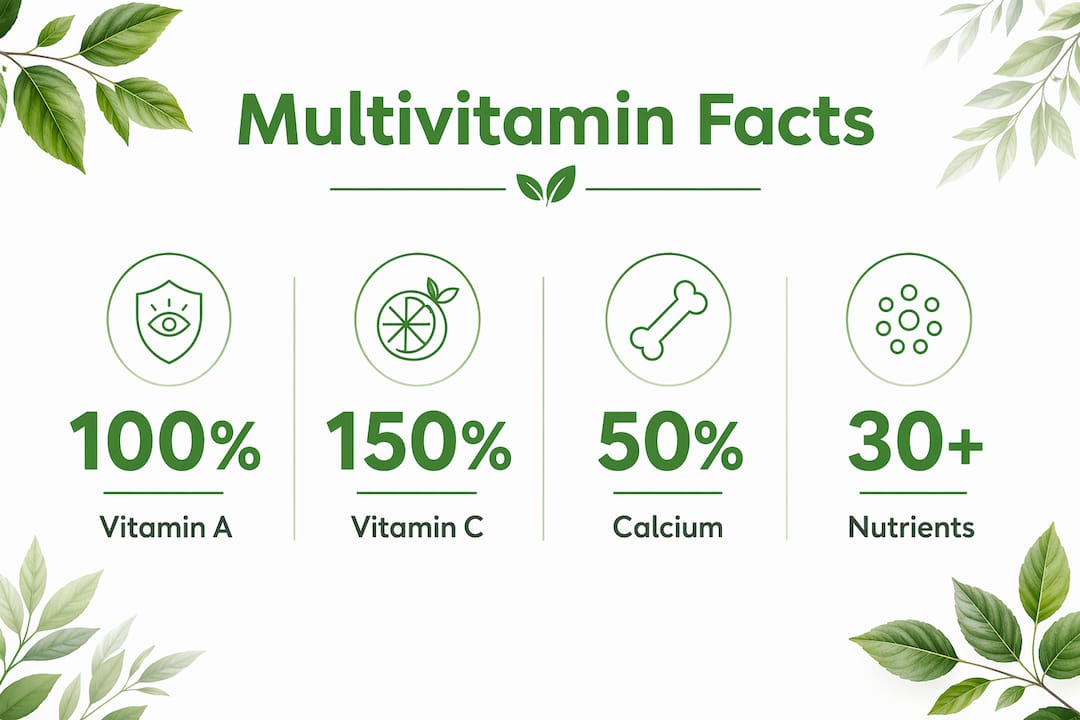
The table below shows typical nutrient ranges you can expect in a standard adult multivitamin and how they compare to the established Daily Value (DV):
| Nutrient | Typical % Daily Value in Multivitamins |
|---|---|
| Vitamin A | 50%–100% DV |
| Vitamin C | 50%–150% DV |
| Vitamin D | 50%–125% DV |
| B12 | 100%–300% DV |
| Iron | 50%–100% DV |
| Calcium | 10%–30% DV |
| Magnesium | 10%–25% DV |
Notice that calcium and magnesium often fall well below 100% DV. This is not an oversight. Both minerals are bulky, and fitting a full daily dose into a single tablet or gummy is physically impractical. The Linus Pauling Institute confirms that these minerals frequently require separate supplementation or strong dietary sources to meet your actual daily needs.
Pro Tip: Check whether your multivitamin uses folate (as methylfolate) rather than synthetic folic acid. People with the MTHFR gene variant absorb methylfolate more effectively, and many quality brands now make this distinction on the label.
Product form also matters more than most people realize. Gummies tend to contain fewer minerals than capsules or tablets due to formulation constraints. If mineral coverage is your priority, a women’s multivitamin or men’s formula in capsule form often delivers a more complete profile than a standard gummy.
What does research say about multivitamin benefits and limitations?
The honest answer is that the evidence is more nuanced than supplement marketing suggests, and more reassuring than the most skeptical headlines imply. The COSMOS trial, one of the largest randomized controlled studies on multivitamin use, found no protection against cardiovascular disease or cancer from daily multivitamin supplementation. The U.S. Preventive Services Task Force (USPSTF) reached a similar conclusion, stating there is no clear evidence to support or discourage multivitamin use specifically for preventing these diseases.
That finding does not mean multivitamins are useless. It means they are not a substitute for medical treatment or a magic shield against chronic disease. What they do well is fill micronutrient gaps in people whose diets are inconsistent or restricted. Harvard Health describes multivitamins primarily as nutritional insurance for gaps rather than a broad disease prevention tool. That framing is accurate and worth holding onto.
“Multivitamins are most useful when diet might not reliably provide micronutrients. They are considered nutritional insurance rather than a replacement for a healthy diet.” — Harvard Health
The risk side of the equation deserves equal attention. Multivitamin users show higher risk of excess intake for certain nutrients, particularly fat-soluble vitamins like A and E, which accumulate in body tissue rather than being flushed out. This risk increases sharply when people take a multivitamin alongside other individual supplements without tracking their total intake. Megavitamins, which push doses well above recommended levels, are not recommended unless a confirmed deficiency exists and a healthcare provider has prescribed them.
How to choose a multivitamin wisely
Choosing a quality multivitamin comes down to three practical criteria: third-party certification, appropriate dosing, and honest self-assessment of your diet.
Third-party certification from organizations like USP (U.S. Pharmacopeia) or NSF International means an independent lab has verified that the product contains what the label claims, in the amounts stated, without harmful contaminants. This matters because the FDA does not pre-approve dietary supplements before they reach store shelves. Certification is the consumer’s best available check on product quality.
For dosing, the Linus Pauling Institute recommends choosing products where most nutrients fall between 50% and 150% of the Daily Value. Exceeding 200% DV for most nutrients adds risk without adding meaningful benefit. The exceptions are B12, vitamin C, and vitamin D, where slightly higher doses are generally considered safe and sometimes beneficial for people with absorption challenges or limited sun exposure.
The table below compares quality indicators against common pitfalls to watch for:
| Quality Indicator | Common Pitfall to Avoid |
|---|---|
| USP or NSF certification seal | No third-party testing mentioned on label |
| Nutrients at 50%–150% DV | Doses exceeding 200% DV for fat-soluble vitamins |
| Methylfolate listed for B9 | Synthetic folic acid only, no folate alternative |
| Transparent Supplement Facts panel | Proprietary blends that hide individual amounts |
| Appropriate form for your needs | Gummy-only options with low mineral content |
Stacking supplements is one of the most common and underappreciated risks in this category. Taking a multivitamin alongside a separate B-complex, vitamin D, and iron supplement can push your total intake of certain nutrients well above safe levels, even when each product individually looks reasonable. Before adding any supplement to your routine, add up your total intake across all products.
Pro Tip: Bring your current supplement list to your next doctor or dietitian appointment. A five-minute review can catch nutrient overlaps that are easy to miss on your own.
How do multivitamins fit into a balanced health regimen?
A multivitamin supports your health best when it works alongside a nutrient-rich diet, not instead of one. Food delivers vitamins and minerals in forms your body recognizes well, alongside fiber, antioxidants, and phytonutrients that no supplement replicates. Daily supplementation makes the most sense when your diet has consistent gaps, not as a workaround for poor eating habits.
Certain groups are more likely to benefit from regular multivitamin use:
- Older adults often absorb B12 and vitamin D less efficiently due to changes in digestion and reduced sun exposure.
- People following vegan or vegetarian diets may fall short on B12, iron, zinc, and omega-3 fatty acids.
- Pregnant individuals have elevated needs for folate, iron, and iodine that diet alone may not cover reliably.
- People with restricted caloric intake due to medical conditions or weight management programs often miss key micronutrients.
- Those with digestive conditions like Crohn’s disease or celiac disease may have impaired nutrient absorption across the board.
For everyone else, the question is less “should I take one?” and more “does my diet actually cover my bases?” A registered dietitian can run a dietary assessment and identify specific gaps far more precisely than any general-purpose supplement can address.
Consistency in timing also matters. Taking your multivitamin with a meal that contains some fat helps absorb fat-soluble vitamins A, D, E, and K more effectively. Morning with breakfast is a common and practical routine that most people find easy to maintain.
Key takeaways
A multivitamin fills nutritional gaps in your diet but does not replace whole foods or prevent chronic disease on its own.
| Point | Details |
|---|---|
| Definition is clear | A multivitamin contains at least three vitamins or vitamins and minerals combined in one product. |
| Benefits are real but specific | Multivitamins support micronutrient adequacy, not broad disease prevention. |
| Certification matters | Look for USP or NSF seals to verify product quality and accurate labeling. |
| Dosing range is key | Choose products with most nutrients at 50%–150% Daily Value to stay within safe limits. |
| Diet comes first | Multivitamins work best as a complement to a nutrient-rich diet, not a substitute for one. |
My honest perspective on multivitamin use
I have spent years looking at supplement labels, reading clinical trial summaries, and talking with people who are genuinely trying to do right by their health. Here is what I keep coming back to: most people who take a multivitamin are making a reasonable, low-risk decision. The evidence does not support the idea that it will add years to your life or protect you from cancer. But for someone eating on the run, traveling frequently, or managing a restricted diet, a well-chosen multivitamin is a sensible safety net.
What concerns me more than whether someone takes a multivitamin is how they choose one. The lack of standardization in this category is real. I have seen products with wildly inflated doses of fat-soluble vitamins sitting next to products with almost negligible amounts of the same nutrients. Both called themselves multivitamins. The label is everything.
My honest recommendation: prioritize your diet, get your bloodwork checked periodically, and if you decide a multivitamin makes sense for your situation, choose one with third-party certification and doses in a moderate range. Do not stack it carelessly with other supplements. And if you are unsure whether you actually need one, a conversation with a dietitian is worth more than any bottle on the shelf.
— SuperNatural
Quality multivitamins from Shopnaturescraft
Shopnaturescraft has been crafting clean, carefully formulated supplements since 2013, and their multivitamin line reflects that commitment to quality. Every product is made with thoughtfully dosed ingredients designed to support your daily nutritional needs without pushing into excess territory.

Whether you prefer the convenience of multivitamin gummies or the fuller mineral profile that capsule formulas deliver, Shopnaturescraft offers options for adults, men, women, teens, and kids. Each product is formulated to complement a balanced diet, not replace it. Browse the full range at shopnaturescraft.com and find the format that fits your routine.
FAQ
What is the definition of a multivitamin?
A multivitamin is a supplement containing at least three vitamins, or a combination of vitamins and minerals, formulated to support daily nutritional needs. It differs from a megavitamin, which delivers doses far above recommended daily amounts.
Are multivitamins necessary for everyone?
Multivitamins are not universally necessary, but they are most useful for people with dietary gaps, restricted diets, or increased nutrient needs such as older adults, vegans, or pregnant individuals. People eating a consistently varied, whole-food diet may not need one.
How do multivitamins work in the body?
Multivitamins deliver vitamins and minerals that your body uses for energy production, immune function, bone health, and hundreds of enzymatic processes. Fat-soluble vitamins (A, D, E, K) are absorbed best when taken with a meal containing dietary fat.
What is the recommended multivitamin dosage?
Most nutrients in a quality multivitamin should fall between 50% and 150% of the Daily Value. Exceeding 200% DV for fat-soluble vitamins like A and E increases the risk of toxicity, particularly when other supplements are taken at the same time.
What is the difference between vitamins and multivitamins?
A vitamin is a single essential nutrient, such as vitamin C or vitamin D, taken in isolation. A multivitamin combines multiple vitamins and often minerals into one product, making it a broader nutritional support tool rather than a targeted single-nutrient supplement.

