


Choosing daily vitamin supplements means matching specific nutrients to real gaps in your diet, not grabbing the most popular bottle off the shelf. Supplementation, the practice of adding concentrated vitamins or minerals to your regular diet, works best when it targets a confirmed need. Mayo Clinic, Harvard Health, and Baylor College of Medicine all agree: the biggest benefit from supplements comes when you address known deficiencies rather than taking a broad preventive approach. Get this right and you protect your health. Get it wrong and you risk spending money on nutrients your body already has enough of, or worse, consuming doses that cause harm. This guide walks you through every decision point, from identifying your actual needs to reading labels and picking the right form.
How to identify your vitamin supplement needs
The first question to ask before choosing daily vitamin supplements is whether your diet already covers your nutritional bases. Canada’s Dietary Guidelines confirm that vitamins are generally not required when you eat a varied, nutritious diet. That said, certain life stages and dietary patterns create genuine gaps that supplements can fill safely and effectively.
Life stage is one of the clearest indicators of supplementation need:
- Pregnancy and pre-conception: Adults who could become pregnant should take a daily multivitamin containing 400 mcg folic acid to support neural tube development.
- Adults over 50: Aging reduces the skin’s ability to synthesize vitamin D and the gut’s ability to absorb B12. Adults 51 and older should consider 400 IU (10 mcg) of vitamin D daily.
- Vegans and vegetarians: Plant-based diets contain no reliable source of vitamin B12. A B12 or vitamin D supplement is often necessary, not optional.
- People with limited sun exposure: Vitamin D deficiency is widespread in northern climates and among people who spend most of their time indoors.
- Those with diagnosed malabsorption conditions: Conditions like Crohn’s disease or celiac disease can impair nutrient uptake significantly.
If you do not fall into one of these categories, taking supplements without evidence of a deficiency adds little benefit and introduces unnecessary risk. A blood panel ordered by your doctor or a registered dietitian consultation can confirm whether your levels actually need support. This is especially true for vitamin D and B12, where deficiency symptoms overlap with many other conditions and are easy to miss without lab work.
Pro Tip: Before buying anything, ask your doctor to include a 25-hydroxyvitamin D and B12 panel in your next routine blood draw. These two tests cover the most common deficiencies in adults and cost very little to check.
For a deeper look at how to personalize your supplement use, the team at Shopnaturescraft has put together a practical guide worth reading alongside this one.
What you need to know about vitamin types, dosing, and safety
Not all vitamins behave the same way in your body, and understanding the difference between fat-soluble and water-soluble vitamins is the foundation of safe supplementation.

Fat-soluble vitamins (A, D, E, and K) are stored in your liver and fatty tissues. Because they accumulate, taking too much over time creates a real toxicity risk. Water-soluble vitamins, including the B vitamins and vitamin C, are not stored in significant amounts. Excess is excreted in urine, which means they need more frequent replenishment but carry a lower toxicity risk at moderate doses.
| Feature | Fat-soluble (A, D, E, K) | Water-soluble (B vitamins, C) |
|---|---|---|
| Storage in body | Yes, liver and fatty tissue | Minimal, excreted in urine |
| Toxicity risk | Higher with excess intake | Lower, but possible at very high doses |
| Dosing frequency | Less frequent possible | Daily or near-daily recommended |
| Best taken with | A meal containing fat | Any time, with or without food |
| Key safety concern | Accumulation over time | Deficiency from irregular intake |
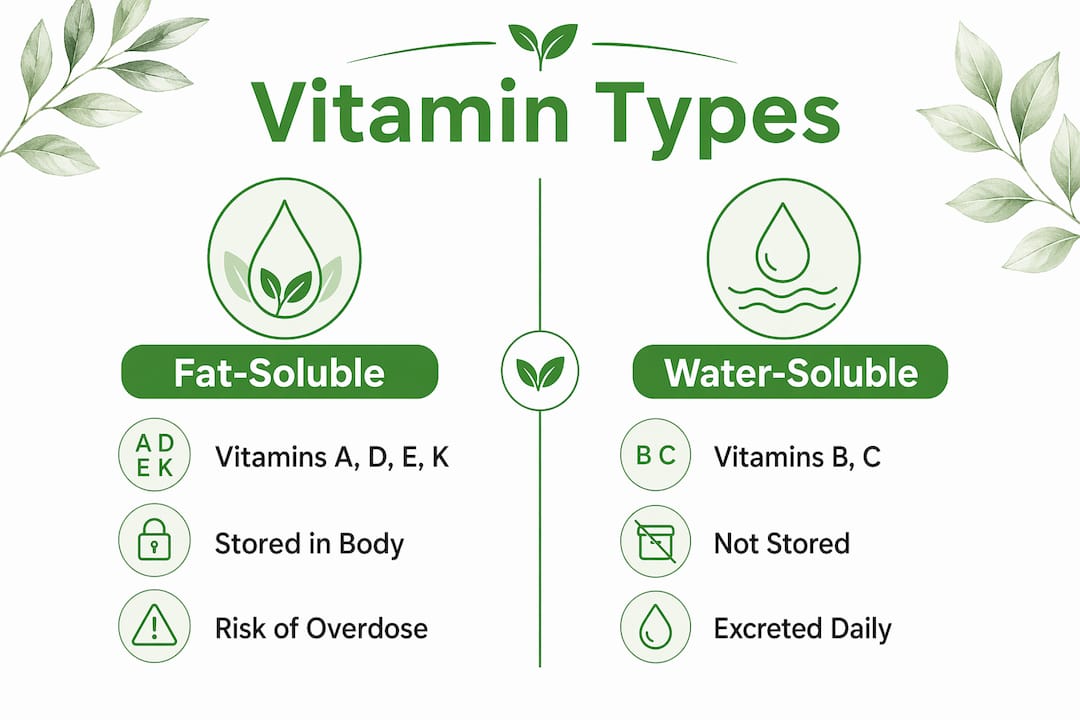
Vitamin D is the clearest example of fat-soluble risk in practice. Harvard Health reports that exceeding 4,000 IU daily can cause hypercalcemia, a condition where calcium builds up in the blood and damages kidneys and heart tissue. This is a real risk for people who stack a multivitamin with a separate vitamin D supplement without checking the combined dose.
Mayo Clinic recommends choosing multivitamins that provide approximately 100% Daily Value of each nutrient, not 200% or 500%. Exceeding the Daily Value does not add benefit and raises the risk of toxicity, particularly for fat-soluble nutrients. Nutrient interactions also matter. Calcium supports vitamin D absorption, and vitamin C improves iron uptake. Caffeine, on the other hand, inhibits vitamin C absorption, which is worth knowing if you take your supplements with your morning coffee.
Pro Tip: Take fat-soluble vitamins (A, D, E, K) with your largest meal of the day, ideally one that contains some healthy fat like avocado, olive oil, or nuts. This simple habit can meaningfully improve how much your body actually absorbs.
How do you evaluate vitamin supplement quality?
The FDA does not approve dietary supplements before they reach store shelves. Manufacturers are responsible for safety and labeling, and the FDA can only act after a product is already on the market and found to be adulterated or mislabeled. This means the quality verification burden falls on you as the consumer.
Third-party certification programs fill this gap. Look for these seals when evaluating any supplement:
- USP Verified: The U.S. Pharmacopeia tests for potency, purity, and proper disintegration. A USP seal means label accuracy and safety have been independently confirmed.
- NSF International: NSF certification is widely respected and required for supplements sold to professional athletes. It confirms the product contains what it claims and nothing it does not.
- ConsumerLab: This independent organization tests products purchased off store shelves and publishes results, including failures. Checking their database before buying is a smart move.
Beyond certifications, watch for these red flags when reading labels:
- Proprietary blends that list ingredients without disclosing individual amounts
- Claims like “cures,” “treats,” or “prevents” any disease (these are illegal for supplements)
- Doses far above the established Tolerable Upper Intake Level without medical context
- No contact information or lot number on the label
Allergen and dietary considerations also belong in your evaluation. If you follow a vegan diet, check that capsules are not made from gelatin. If you have a soy allergy, scan the inactive ingredients list carefully, since soy lecithin appears in many softgels. For people who struggle with swallowing pills, supplement form matters for both compliance and absorption. Gummies, liquids, and chewables are legitimate alternatives, not just marketing gimmicks, as long as they carry a credible certification.
For a thorough breakdown of what separates a trustworthy product from a questionable one, Shopnaturescraft’s guide on identifying high-quality supplements covers the full checklist.
Multivitamin vs. single nutrient supplement: which is right for you?
The choice between a multivitamin and a targeted single nutrient supplement depends entirely on your specific situation. Neither is universally better. The right answer comes from your diet, your lab results, and your life stage.
| Situation | Better choice | Reason |
|---|---|---|
| Restricted diet (vegan, very low calorie) | Multivitamin | Covers multiple potential gaps at once |
| Confirmed single deficiency (e.g., low vitamin D) | Single nutrient supplement | Precise dose without unnecessary extras |
| Pregnancy or pre-conception | Prenatal multivitamin | Folic acid, iron, and DHA in one formula |
| Healthy adult with varied diet | Neither, or reassess after labs | Diet likely sufficient; supplementation adds risk |
| Adults 51+ with limited sun exposure | Vitamin D3 alone or with K2 | Targeted support for the most common gap |
Multivitamins make the most sense when your diet has multiple gaps at once, such as during pregnancy, recovery from illness, or when appetite is consistently poor. Harvard Health notes that evidence does not support universal multivitamin use for preventing cardiovascular disease or cancer. Taking a multivitamin because it feels like a safety net is not a strong enough reason on its own.
Single supplements shine when you have a confirmed deficiency. If your blood work shows low vitamin D, a targeted D3 supplement at the dose your doctor recommends is more precise and easier to monitor than a multivitamin that may contain only 400 IU when you need 2,000 IU. The same logic applies to B12 for vegans. Baylor College of Medicine dietitians confirm that single nutrient supplements are the preferred recommendation when a specific deficiency is identified.
One risk worth flagging: stacking a multivitamin with individual supplements of the same nutrient is a common way to accidentally exceed safe upper limits. If your multivitamin already provides 100% Daily Value of vitamin A and you add a separate vitamin A supplement, you are doubling your intake of a fat-soluble vitamin that accumulates in the liver.
Key takeaways
Smart supplement selection requires matching your choices to confirmed nutritional gaps, not marketing claims or general wellness trends.
| Point | Details |
|---|---|
| Identify gaps before buying | Use lab work and dietary assessment to confirm deficiencies before starting any supplement. |
| Know your vitamin type | Fat-soluble vitamins accumulate and carry toxicity risk; water-soluble ones need regular replenishment. |
| Check for third-party certification | USP Verified, NSF, and ConsumerLab seals confirm potency, purity, and label accuracy. |
| Match the format to your need | Single supplements outperform multivitamins when a specific deficiency is confirmed. |
| Watch your total daily intake | Stacking supplements can push fat-soluble vitamin doses above safe upper limits without realizing it. |
What I’ve learned from years of watching people supplement poorly
Most people who come to supplement use with genuine health goals make the same mistake: they start with the product, not the problem. They see a well-designed bottle with a long ingredient list and assume more coverage equals more protection. It does not work that way.
The most useful shift I have seen is when someone gets a basic blood panel done first. That one step changes everything. Instead of guessing, they know. A person who discovers their vitamin D is at 18 ng/mL does not need a multivitamin. They need a targeted D3 supplement at a therapeutic dose, ideally paired with K2 to support calcium metabolism, and a follow-up test in three months. That is a plan. Buying a multivitamin because it has vitamin D in it is not.
The other pattern I see constantly is supplement stacking without tracking. Someone takes a multivitamin, adds a separate vitamin D, then starts a calcium supplement that also contains D. Suddenly they are at 5,000 IU of vitamin D daily without realizing it. Harvard Health’s guidance on vitamin D toxicity risk is not theoretical. It happens to careful, health-conscious people who just did not add up their total intake.
My honest recommendation: keep a running list of every supplement you take, including the dose of each nutrient. Review it with your doctor or dietitian once a year. Resist the pull of marketing that promises broad protection. Quality over quantity is not just a phrase here. It is the actual strategy that works.
— SuperNatural
Find quality daily vitamins at Shopnaturescraft
Shopnaturescraft has been crafting clean, transparent supplements since 2013, and every product in the lineup reflects that commitment to quality. Whether you need a targeted single nutrient or a well-rounded daily formula, you will find options with clear labels, honest doses, and no unnecessary fillers. The collection includes capsules, gummies, and liquid drops to fit your preference and lifestyle. If you are looking for a trusted starting point, the Organic Vitamin D3 + K2 Drops deliver 2,000 IU per serving in a form that absorbs well and is easy to take daily. For those who prefer a broader selection, the full capsule collection covers everything from B vitamins to specialty formulas, all backed by the same quality standards. Your wellness goals deserve products you can trust.
FAQ
What vitamins do most adults actually need daily?
Most adults with a varied diet do not need a full multivitamin. Vitamin D and vitamin B12 are the two most commonly deficient nutrients in adults, particularly those over 50 or following a plant-based diet.
Can you take too many vitamins at once?
Yes. Fat-soluble vitamins like A, D, E, and K accumulate in the body and can reach toxic levels when you stack multiple supplements containing the same nutrient. Always calculate your total daily intake across all products.
How do I know if a supplement brand is trustworthy?
Look for third-party certifications from USP, NSF International, or ConsumerLab. These programs independently verify that the product contains what the label claims and meets safety standards the FDA does not enforce pre-market.
Is a multivitamin better than individual supplements?
A multivitamin is more practical when you have multiple nutritional gaps, such as during pregnancy or on a very restricted diet. A single nutrient supplement is more precise and effective when you have one confirmed deficiency.
When should I talk to a doctor before taking supplements?
Consult a doctor before starting supplements if you take prescription medications, have a chronic health condition, or are pregnant. Certain vitamins interact with medications, and a clinician can order lab work to confirm what you actually need.

