


Nearly 75% of Americans use dietary supplements, yet most do not get the dramatic health benefits they expect. So why take supplements daily if the science is more nuanced than the marketing? The answer is not black and white. Daily supplements can make a real difference for some people, while others are simply spending money on nutrients their bodies do not need. This guide cuts through the confusion so you can make an informed decision based on your actual health needs, not just popular advice.
Table of Contents
- The science behind daily supplements: what the evidence really says
- Why a balanced diet usually beats a multivitamin
- When daily supplements really make sense: targeted use based on need
- Maximizing the benefits: timing, absorption, and consistency of supplements
- Risks and considerations: avoid common pitfalls with daily supplements
- Why most supplement advice misses the mark — and what truly works
- Explore targeted supplements for your wellness goals
- Frequently asked questions
Key Takeaways
| Point | Details |
|---|---|
| Most healthy adults don’t need daily multivitamins | Clinical studies show multivitamins don’t significantly prevent major chronic diseases in healthy people. |
| Supplements are best for specific deficiencies | Blood tests help identify nutritional gaps for targeted, effective supplementation. |
| Whole foods provide unmatched nutrient benefits | Nutrient synergy and fiber in foods cannot be replicated by supplements. |
| Proper supplement use improves outcomes | Taking supplements with fat-containing meals and consistent timing enhances absorption and effectiveness. |
| Consult professionals before supplementing | Unsuspected interactions and toxicities make personalized medical advice crucial before daily use. |
The science behind daily supplements: what the evidence really says
The supplement industry generates billions of dollars every year, and much of that revenue comes from a simple belief: more nutrients equal better health. The reality is more complicated.
Daily multivitamins show no significant reduction in major chronic diseases like heart disease, stroke, or cancer for most healthy adults. That finding comes from large-scale clinical research, and it is worth taking seriously before adding a new bottle to your morning routine.
That said, supplements are not useless. Here is a clearer picture of what the research actually supports:
- Targeted nutrients work when there is a real gap. Vitamin D, B12, and iron supplementation can produce measurable improvements in people who are genuinely deficient.
- Biological aging may slow slightly. A modest slowing of biological aging equivalent to 2.7 to 5.1 months over two years was observed in adults who took daily multivitamins.
- Older adults see more benefit. The aging-related effects appear most pronounced in people over 60, where nutrient absorption naturally declines.
- Healthy younger adults gain the least. If your diet is varied and balanced, a daily multivitamin is unlikely to move the needle on your long-term health outcomes.
“The benefit you get from a supplement depends almost entirely on whether you actually need what it provides. Without a deficiency, you are often just creating expensive urine.”
If you are curious about how specific nutrients affect organs like the liver, learning about liver support can help you understand why targeted supplementation matters more than blanket multivitamin use.
Why a balanced diet usually beats a multivitamin
Food is not just a collection of individual nutrients. It is a package deal. When you eat a spinach salad with salmon and olive oil, you are getting vitamins, minerals, fiber, antioxidants, phytochemicals, and healthy fats all working together in ways that no capsule can replicate.
Most nutrients are best obtained from a varied and balanced diet because whole foods offer synergistic benefits that isolated supplements simply do not provide. An orange does not just deliver vitamin C. It delivers bioflavonoids, fiber, and other compounds that help your body absorb and use that vitamin C more effectively.
Here are some key reasons why food comes first:
- Fiber is irreplaceable. No supplement delivers the digestive and cardiovascular benefits of dietary fiber from whole grains, legumes, and vegetables.
- Antioxidant complexity. Foods contain hundreds of antioxidants working together. A supplement might include one or two.
- Absorption is naturally regulated. Your body controls how much of a nutrient it absorbs from food. With supplements, especially in high doses, that regulation can break down.
- Drug interactions are real. High doses can interfere with medications, including blood thinners, chemotherapy drugs, and certain antidepressants.
For example, taking a biotin supplement can genuinely support hair and nail health when biotin intake is low. But if your diet already includes eggs, nuts, and leafy greens, you likely have adequate biotin without supplementing.
Pro Tip: Before buying any supplement, track your meals for a week using a free nutrition app. You may discover you are already meeting most of your daily nutrient needs through food.
When daily supplements really make sense: targeted use based on need
Here is where the advantages of taking supplements become clear. The keyword is targeted. Supplements are not meant to replace food or act as nutritional insurance. They are tools for filling specific, confirmed gaps.
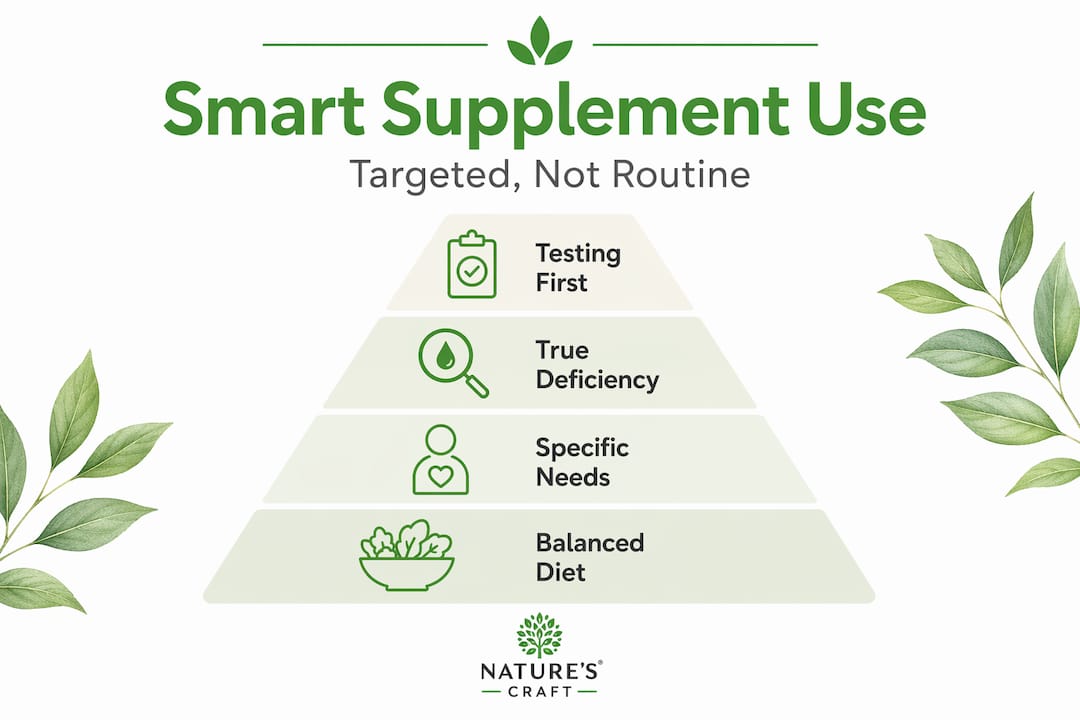
Supplements are most effective when used to address nutrient deficiencies identified by blood tests. That one step, getting tested, separates smart supplementation from guesswork.
The following groups tend to benefit most from daily supplements:
- Older adults: Benefit from targeted supplementation of vitamin B12, vitamin D, folate, and protein because aging reduces both nutrient absorption and dietary intake.
- Vegans and vegetarians: Often deficient in B12, iron, zinc, omega-3s, and calcium since these nutrients are concentrated in animal products.
- Pregnant individuals: Folate and iron supplementation are strongly evidence-based for fetal development and maternal health.
- People with diagnosed medical conditions: Conditions like Crohn’s disease, celiac disease, or osteoporosis create specific nutrient needs that diet alone may not meet.
| Group | Common deficiencies | Recommended supplement type |
|---|---|---|
| Older adults (60+) | B12, vitamin D, protein | B12, D3, protein powder |
| Vegans | B12, iron, omega-3, zinc | B12, algae omega-3, zinc |
| Pregnant individuals | Folate, iron | Prenatal with folic acid |
| Limited sun exposure | Vitamin D | D3 with K2 |
| Digestive conditions | Multiple | Based on testing |
Understanding how your kidneys process certain nutrients is also worth your time, especially if you are taking multiple supplements. Our kidney support resource breaks this down in plain language. And if you have questions about what is safe to combine, our supplement safety FAQ is a solid starting point.
Pro Tip: Ask your doctor for a basic micronutrient panel at your next annual checkup. Testing for vitamin D, B12, iron, and magnesium takes a single blood draw and gives you a clear picture of where you actually stand.
Maximizing the benefits: timing, absorption, and consistency of supplements
Even the right supplement taken the wrong way can underperform. Absorption is everything. The benefits of daily supplements only materialize if your body can actually use what you are taking.

Fat-soluble vitamins (A, D, E, and K) require dietary fat for absorption, so taking them with a meal that contains fat is not optional, it is essential. A vitamin D capsule taken on an empty stomach may absorb poorly. The same capsule taken with eggs and avocado absorbs significantly better.
Here are practical tips for getting the most from your daily supplements:
- Pair fat-soluble vitamins with fat. Vitamins A, D, E, and K all need fat to be absorbed. Take them with meals that include olive oil, nuts, avocado, or fatty fish.
- Water-soluble vitamins are more flexible. Vitamin C and B vitamins can be taken with or without food, though taking them with breakfast helps with consistency.
- Avoid iron with coffee or tea. Tannins in these drinks bind to iron and reduce absorption significantly. Space them at least an hour apart.
- Calcium and magnesium compete. Taking them together in large doses can reduce how much of each you absorb. Split them across different meals if possible.
- Consistency beats perfection. Anchoring supplement intake to existing daily habits like breakfast or teeth brushing improves long-term adherence more than optimizing for the “perfect” time.
If you struggle with sleep quality, pairing your evening supplement routine with a magnesium supplement designed for nighttime use can support relaxation and sleep. Magnesium is best absorbed in the evening and pairs well with an already-established bedtime habit.
Pro Tip: Store your supplements somewhere visible, like next to your coffee maker or toothbrush. Out of sight really does mean out of mind when it comes to daily adherence.
Risks and considerations: avoid common pitfalls with daily supplements
Daily vitamins importance is real, but so is the downside of getting it wrong. Supplements are not regulated with the same rigor as prescription drugs in the United States. That means quality, dosage accuracy, and safety claims vary widely across brands.
Unsupervised supplement use can cause toxicity, interfere with medications, or even increase mortality risk in certain populations. That is not a reason to avoid all supplements. It is a reason to be thoughtful about which ones you choose and why.
Key risks to keep in mind:
- Fat-soluble vitamin toxicity. Unlike water-soluble vitamins, vitamins A, D, and E are stored in body fat and can build up to harmful levels with consistent overdosing.
- Drug interactions. St. John’s Wort reduces the effectiveness of birth control and antidepressants. Vitamin K can interfere with blood thinners. Fish oil at high doses increases bleeding risk.
- The “more is better” trap. Doubling your vitamin D dose does not double the benefit. In excess, certain vitamins may be harmful, particularly A, D, and E.
- Wasted money on overhyped products. Many supplements on the market have minimal research supporting them. Choosing evidence-backed formulas protects both your wallet and your health.
“The supplement aisle is full of products that are not dangerous but are also not necessary. The risk is not always toxicity — it is often simply spending money on something your body does not need.”
If you are taking multiple supplements, it helps to understand how your liver and kidneys process them. Our liver support and kidney support pages explain how these organs handle supplement metabolism and when to exercise extra caution.
Why most supplement advice misses the mark — and what truly works
Here is the honest truth: most supplement advice is designed to sell you something, not to help you figure out whether you need anything at all. Generic daily supplement recommendations ignore the most important variable in the equation — you.
Two people can have the same age, the same diet, and the same activity level and still have completely different nutrient profiles. One may be low in vitamin D due to limited sun exposure. The other may have adequate levels from a diet rich in fatty fish and fortified foods. A blanket recommendation to take a daily multivitamin does nothing to address that difference.
The most effective approach to supplementation is the least exciting one: test first, supplement second. Get your blood work done. Find out where your levels actually stand. Then make targeted decisions based on real data, not marketing claims or a friend’s recommendation.
It is also worth saying clearly that the best supplement addresses a real deficiency, not a marketing promise. Balanced nutrition, regular exercise, quality sleep, stress management, and social connection remain the true foundations of long-term health. No supplement replaces consistent, healthy daily habits.
That said, when you do have a genuine need, the right supplement taken correctly and consistently can make a meaningful difference. The goal is not to dismiss supplements. It is to use them wisely. Check out our supplement guidance FAQ to see how to evaluate your personal needs with clarity.
Explore targeted supplements for your wellness goals
Now that you understand when and why supplements make a real difference, finding the right ones for your specific needs is the logical next step. At Nature’s Craft, we have built our product line around one principle: every supplement should earn its place in your routine by addressing a genuine need with quality ingredients.
Whether you are looking to support your hair and skin with biotin, improve your sleep quality with magnesium, or protect your cardiovascular health with our heart health collection, we offer clean, carefully formulated options backed by real nutritional science. Every product is made to complement a balanced lifestyle, not replace one. Your wellness journey starts with the right information and the right support.
Frequently asked questions
Do daily multivitamins prevent chronic diseases like heart disease or cancer?
Multivitamins do not significantly reduce the risk of major chronic diseases in healthy adults, according to current research. Eating a varied diet and managing lifestyle risk factors remains far more effective.
Who benefits most from taking daily supplements?
Individuals with confirmed nutrient deficiencies, older adults, and those with dietary restrictions benefit most from targeted supplement use. Older adults in particular often need support with vitamin B12, vitamin D, and protein due to age-related absorption changes.
Can taking supplements replace a balanced diet?
No. Supplements lack the synergistic benefits of whole foods, and a food-first approach is always recommended. Think of supplements as a complement to good nutrition, not a substitute for it.
How should I take supplements for best absorption?
Take fat-soluble vitamins with meals that contain healthy fat, and build consistency by anchoring your routine to an existing daily habit. Fat-soluble vitamins require dietary fat for good absorption, and habit anchoring significantly improves long-term adherence.
Are daily supplements safe for everyone?
Not without professional guidance. Unsupervised supplements can cause toxicity and interact with medications, so always consult your healthcare provider before starting any new supplement regimen.

