


Liquid supplement drops are defined as concentrated nutritional fluids that deliver vitamins, minerals, or herbal compounds in a form your body can absorb quickly and easily. The industry term for this category is “liquid dietary supplements,” regulated under the Federal Food, Drug, and Cosmetic Act. Unlike pills that must dissolve before absorption begins, liquid drops enter your digestive system ready to work. Advanced formulations using liposomal or micellar encapsulation push absorption even further, making the format one of the most efficient ways to get nutrients into your body. Shopnaturescraft has offered liquid supplement options since 2013, recognizing that different bodies need different delivery methods.
What are liquid supplement drops and how do they work?
Liquid supplement drops are concentrated on that carry active nutrients in a liquid base, typically water, glycerin, or a carrier oil. You measure a dose with a dropper, place it under your tongue or mix it into a drink, and your body absorbs the nutrients through the digestive tract or, in some cases, directly through the mucous membranes. The liquid format skips the breakdown step that solid pills require, which gives nutrients a head start toward absorption.
The real performance difference comes from formulation technology, not the liquid state alone. Standard aqueous drops dissolve nutrients in water and offer modest absorption gains over capsules. Advanced systems like liposomal encapsulation wrap nutrients in a fat-soluble shell that mimics the body’s own cell membranes, allowing nutrients to pass through intestinal walls more efficiently. A 2026 clinical study found that a liposomal berberine formulation showed 70.1% higher peak plasma concentrations and 42.8% greater total nutrient exposure over 24 hours compared to a standard formulation. That gap is significant enough to matter for anyone serious about getting full value from their supplements.

Micellar encapsulation works on a similar principle. A clinical trial found that a micellar glutathione liquid supplement produced about 2.5 times higher systemic exposure than a standard formulation at a lower dose. That means you may need less of the active ingredient to achieve the same effect, which has real implications for both cost and tolerability.
Pro Tip: When reading a liquid supplement label, look for the words “liposomal,” “micellar,” or “phospholipid complex.” These terms signal that the product uses a delivery system designed to improve absorption, not just a nutrient dissolved in water.
| Delivery system | How it works | Absorption advantage |
|---|---|---|
| Standard aqueous solution | Nutrient dissolved in water | Moderate improvement over solid pills |
| Liposomal encapsulation | Nutrient wrapped in a fat-soluble shell | Up to 70.1% higher peak plasma concentration |
| Micellar encapsulation | Nutrient suspended in tiny fat droplets | Up to 2.5x higher systemic exposure |
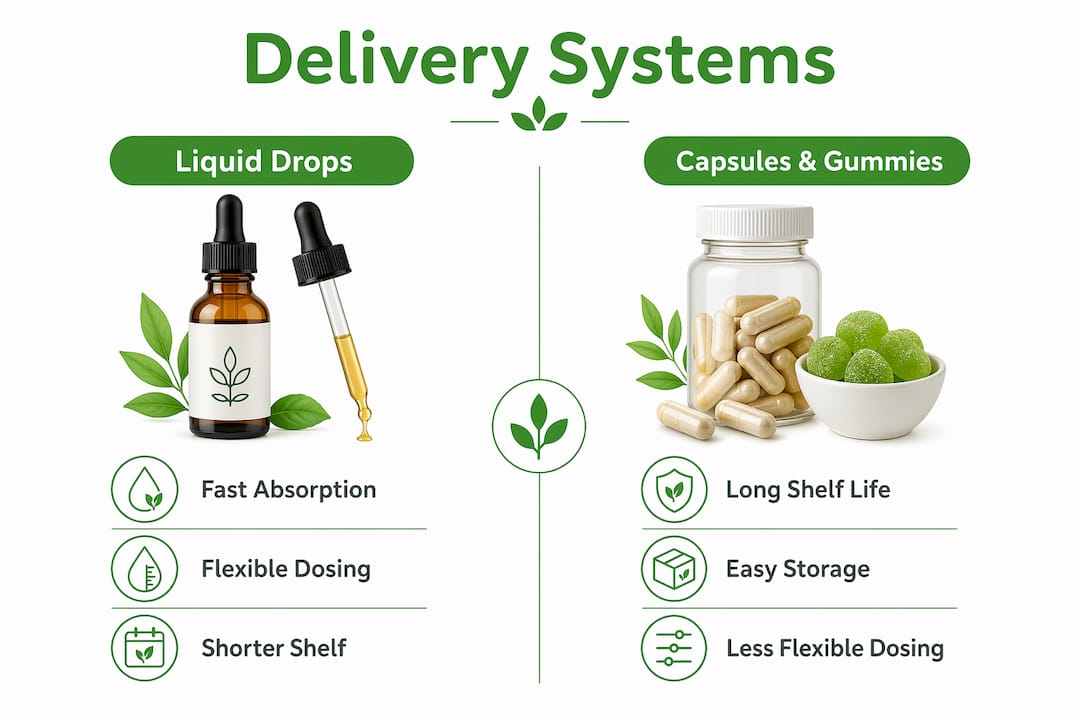
What are the practical benefits and drawbacks of liquid drops?
Liquid drops offer genuine advantages for specific groups of people. Swallowing pills is a real barrier for children, older adults, and anyone with pill fatigue. A liquid format removes that barrier entirely. You can also adjust the dose drop by drop, which is something a fixed capsule simply cannot offer.
Here is a clear breakdown of where liquid drops shine and where they fall short:
Benefits:
- Dosing flexibility: you can increase or decrease intake incrementally without cutting pills
- Faster nutrient onset compared to capsules that require full dissolution
- Easier for children and elderly adults who struggle with swallowing
- Mixable with water, juice, or smoothies for a more enjoyable experience
- Fewer binders and fillers than most solid supplement forms
Drawbacks:
- Shorter shelf life because fewer excipients mean less protection against degradation
- Many formulas require refrigeration after opening
- Carrier oils add a small number of calories and can affect taste
- Bottles are prone to spills and are less convenient for travel than blister-packed capsules
- Measuring accuracy depends on the quality of the dropper included
Pro Tip: If you travel frequently, pre-measure your liquid supplement doses into small, sealed silicone containers before your trip. This protects against spills and keeps your routine consistent without hauling a full glass bottle.
The right format depends on your lifestyle. If you are at home most of the time and want precise dosing control, liquid drops are hard to beat. If you are on the road three weeks a month, capsules or gummies may serve you better on travel days.
How to use liquid supplement drops effectively and safely
Using liquid drops correctly makes a real difference in both safety and results. Follow these steps to get the most from your supplement routine.
- Read the label first. Every liquid supplement carries a Supplement Facts panel with a serving size and maximum daily dose. The FDA requires manufacturers to label products accurately, but pre-market approval is not required for dietary supplements. That means the responsibility for safe use sits with you.
- Measure with the included dropper. Eyeballing a dose is inaccurate. Use the dropper that comes with the product and hold it at eye level to read the measurement line correctly.
- Start at the lower end of the recommended range. Liquid drops allow precise incremental dosing, which makes them ideal for testing your tolerance during the first one to two weeks. Begin with half the recommended dose and increase gradually.
- Choose your delivery method. Some drops work best under the tongue for faster absorption. Others are designed to mix into beverages. Check the label for the manufacturer’s recommendation.
- Time your dose with meals when appropriate. Fat-soluble vitamins like D3 and K2 absorb better when taken with a meal that contains dietary fat. Water-soluble vitamins like B12 can be taken any time.
- Store correctly. Keep the bottle away from direct sunlight and heat. Refrigerate after opening if the label instructs it. Discard any product that changes color, smell, or consistency.
Consulting a healthcare provider before starting any new supplement is the right call, especially if you take prescription medications. Liquid drops can be potent, and interactions are possible.
How do liquid drops fit into a complete supplement strategy?
Liquid drops work best as part of a broader nutrition plan, not as a standalone solution. They excel at delivering nutrients that benefit from fast absorption, such as vitamin D3, vitamin K2, B vitamins, and herbal extracts like berberine or milk thistle. Shopnaturescraft’s Deep Cleanse Liver Drops are a good example of a targeted liquid formula designed for specific nutritional support.
Capsules and gummies still have a place in a well-rounded routine. Capsules offer superior shelf stability and are easier to carry. Gummies provide a format that many people actually enjoy taking, which improves daily consistency. The choice between supplement forms often comes down to your health goals, lifestyle, and how your body responds to each format.
One underappreciated factor is the excipient load. Solid supplements require binders, fillers, and coatings to hold their shape. Liquid drops typically contain fewer of these additives, which matters for people with sensitivities to common fillers like magnesium stearate or microcrystalline cellulose. You can learn more about why supplements need fillers to decide whether that trade-off is relevant for you.
| Format | Absorption speed | Dosing flexibility | Shelf life | Portability |
|---|---|---|---|---|
| Liquid drops | Fast | High | Shorter | Lower |
| Capsules | Moderate | Fixed | Long | High |
| Gummies | Moderate | Fixed | Moderate | High |
The table above shows that no single format wins across every category. A practical approach is to use liquid drops for nutrients where absorption speed matters most, and capsules or gummies for nutrients where convenience and shelf stability are the priority.
Key Takeaways
Liquid supplement drops deliver the strongest absorption benefits when they use advanced delivery systems like liposomal or micellar encapsulation, not simply because they are in liquid form.
| Point | Details |
|---|---|
| Formulation drives absorption | Look for liposomal or micellar labels to confirm a bioavailability-enhancing delivery system. |
| Dosing flexibility is a real advantage | Liquid drops let you adjust intake drop by drop, making tolerance testing straightforward. |
| Storage requires attention | Most liquid drops need refrigeration after opening and have a shorter shelf life than capsules. |
| Format choice depends on lifestyle | Frequent travelers may prefer capsules for portability; liquid drops suit home-based routines best. |
| Regulatory responsibility falls on you | The FDA does not pre-approve dietary supplements, so choosing trusted brands and reading labels carefully matters. |
What I’ve learned from years of watching people use liquid supplements
Most people who switch to liquid drops do so because they read a headline about absorption rates and assume any liquid supplement will outperform any capsule. That assumption is wrong. The efficacy of liquid drops depends on advanced formulation techniques rather than the liquid state alone. A basic vitamin C dissolved in water is not meaningfully better than a well-formulated capsule.
What I have seen work consistently is matching the format to the nutrient and the person. Vitamin D3 and K2 in liquid form, like Shopnaturescraft’s Organic Vitamin D3 + K2 Drops, make particular sense because these fat-soluble vitamins benefit from the carrier oils used in liquid formulas. For children, liquid drops remove the swallowing barrier entirely, and products like Kids Vitamin D3 + K2 Drops are designed with that in mind.
The regulatory picture is worth understanding clearly. The FDA does not evaluate liquid supplements for safety or effectiveness before they reach store shelves. Compliance challenges are real for brands, and that complexity filters down to consumers. Buying from brands that invest in third-party testing and transparent labeling is not optional caution. It is the baseline standard you should hold every supplement to.
My honest advice: do not overcomplicate your routine. Pick one or two nutrients where liquid delivery genuinely adds value, use the dropper correctly, store the product as directed, and give it four to six weeks before evaluating results. Talk to your doctor if you are managing a health condition or taking medications.
— SuperNatural
Premium liquid and gummy supplements from Shopnaturescraft
Shopnaturescraft has built its product line around one principle: every format should deliver real nutritional value, not just convenience. Whether you are looking for liquid drops for precise daily dosing or a gummy supplement that fits your routine without any fuss, the range covers both.

The Turmeric Gummies are a strong starting point if you want the benefits of a well-absorbed anti-inflammatory compound in a format you will actually enjoy taking every day. For those building a broader wellness routine, the full supplement catalog includes options across every major health category, all made with clean ingredients and clear labeling. Quality you can read on the label is the standard Shopnaturescraft has held since 2013.
FAQ
What are liquid supplement drops used for?
Liquid supplement drops deliver concentrated vitamins, minerals, or herbal compounds in a form the body absorbs quickly. Common uses include vitamin D3, B12, herbal extracts, and targeted nutritional support for specific health goals.
Are liquid supplements more effective than capsules?
Liquid supplements using liposomal or micellar delivery systems show significantly higher absorption than standard capsules, with one study showing 70.1% higher peak plasma concentrations. Basic liquid solutions without advanced encapsulation offer only modest advantages over well-formulated capsules.
How do I measure a liquid supplement dose accurately?
Use the dropper included with the product and hold it at eye level to read the measurement line. Start at the lower end of the recommended range and increase gradually over one to two weeks to assess your tolerance.
Do liquid supplements need to be refrigerated?
Many liquid supplements require refrigeration after opening because they contain fewer preservatives and stabilizers than solid forms. Always check the storage instructions on the label and discard any product that changes in color, smell, or texture.
Are liquid supplements safe for children?
Liquid drops are well suited for children because they eliminate the swallowing challenge of pills and allow precise dose adjustment. Choose products specifically formulated for children’s dosing ranges, and consult a pediatrician before starting any new supplement.

