

Nascent iodine does supply iodine to your body, but no high-quality clinical evidence shows it works better than standard iodide supplements for thyroid support. The term “nascent” is a marketing label, not a recognized chemical classification. That distinction matters when you’re deciding whether to pay a premium for it.
Here’s what you need to know before buying:
- The RDA for iodine is 150 μg/day for adult men and women; the Tolerable Upper Intake Level (UL) is 1,100 μg/day.
- Most adults in the U.S. can meet their iodine needs through iodized salt, dairy, and seafood without any supplement.
- If you have a thyroid condition, are pregnant, or are breastfeeding, consult a clinician before starting any iodine supplement.
- If you do supplement, choose a product with clear μg-per-drop labeling, a Certificate of Analysis (COA), and GMP manufacturing.
Table of Contents
- What does “nascent iodine” actually mean?
- Do the claimed benefits hold up to scrutiny?
- How much iodine is safe to take each day?
- Who should avoid nascent iodine or talk to a clinician first?
- How does nascent iodine compare to Lugol’s, potassium iodide, and kelp?
- What should you look for when buying a nascent iodine product?
- How do you use a nascent iodine supplement safely?
- What do authoritative sources and experts say?
- Key Takeaways
- The evidence-first case for keeping it simple
- Nature’s Craft thyroid support supplements: a tested option worth considering
- Useful sources and further reading
- FAQ
What does “nascent iodine” actually mean?
The phrase “nascent iodine” is a marketing term, not a standard chemical classification. You’ll also see it labeled as atomic iodine or monatomic iodine. Manufacturers use these terms to suggest the iodine exists in a uniquely bioavailable, single-atom form that your body absorbs more readily than ordinary iodine supplements.
In chemistry, “nascent” historically referred to a highly reactive element at the moment of its release from a compound. Supplement marketers borrowed that concept to imply their product delivers iodine in a special, energized state. Under real-world conditions, though, iodine in solution rapidly converts to iodide forms. The claim that a stable monatomic species persists in a bottle on your shelf is not supported by measurement.
Common formats and label claims:
- Liquid drops in glycerin, alcohol, or purified water
- Typical dosing varies widely by brand and serving size.
- Label claims often include: superior bioavailability, ionic charge, electromagnetic energy, or “precursor” status for thyroid hormones
- Some products claim a specific percentage of elemental iodine (I₂) versus iodide (I⁻)
Knowing how to read these claims puts you in a much stronger position when comparing products.
Do the claimed benefits hold up to scrutiny?
Short answer: iodine itself is well-supported for thyroid health. The “nascent” form specifically is not proven superior to standard iodide.
Iodine is genuinely essential. The thyroid gland uses it to synthesize triiodothyronine (T3) and thyroxine (T4), the hormones that regulate your metabolism, energy, and body temperature. The NIH Office of Dietary Supplements confirms iodine’s central role in T3/T4 production and notes that the thyroid axis is highly sensitive to intake changes, making conservative, diet-focused approaches preferable to megadosing.
The peer-reviewed literature does not establish nascent iodine as chemically or clinically superior to potassium iodide or iodate. The NIH Office of Dietary Supplements does not recognize “nascent” as a distinct iodine category.
Where the evidence gets thin is on the “nascent” distinction itself. No randomized controlled trials have compared thyroid outcomes in people taking nascent iodine versus potassium iodide at equivalent doses. Consumer guides have noted that the “nascent” marketing claim does not survive scrutiny, and that you may pay a premium without any evidence of superior bioavailability.
Claims that lack human clinical proof:
- Detoxification or heavy-metal removal
- Electromagnetic recharging of cells
- Faster or more complete absorption than iodide
- Unique precursor activity for thyroid hormone synthesis
The body requires iodide for hormone synthesis regardless of the starting form. Potassium iodide is absorbed in approximately 96% in the stomach and duodenum. Any elemental iodine (I₂) you consume converts to iodide during digestion anyway, so the physiological endpoint is the same.

How much iodine is safe to take each day?
The dosing guidance below comes from the NIH Office of Dietary Supplements and the National Academies’ Dietary Reference Intakes.
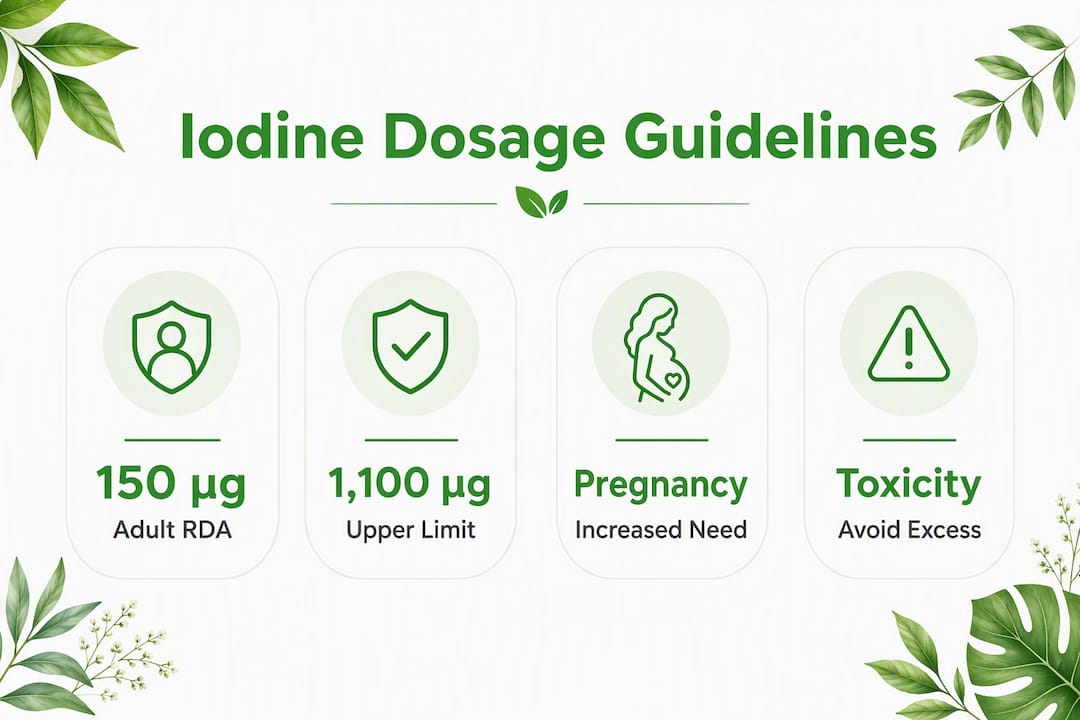
| Group | RDA (μg/day) | Tolerable Upper Intake Level (μg/day) |
|---|---|---|
| Adult men and women | 150 | 1,100 |
| Pregnant people | — | 1,100 |
| Breastfeeding people | — | 1,100 |
| Children (4–8 years) | — | 300 |
Practical label math: If a product delivers a significant dose per drop and you take multiple drops, intake can quickly approach or exceed recommended limits, so careful dosing is important. Many people assume more is better for thyroid support. It isn’t.
Acute iodine toxicity from very high doses can cause burning in the mouth, throat, and stomach, along with fever, abdominal pain, nausea, vomiting, diarrhea, and a weak pulse. Chronic excess is subtler but serious: it can trigger goiter, thyroiditis, or broader thyroid dysfunction. If you notice any of those symptoms after starting a supplement, stop and contact a clinician.
Iodine is also critical during pregnancy. Severe maternal iodine deficiency can cause cretinism and irreversible harm to fetal brain development, which is exactly why pregnant people need clinician guidance on both deficiency and excess.
Who should avoid nascent iodine or talk to a clinician first?
Some groups face real risks from unsupervised iodine supplementation. If you fall into any of the categories below, speak with your doctor before adding any iodine supplement to your routine.
- Pregnant or breastfeeding people: Iodine needs increase during pregnancy and lactation, but the right amount depends on your current intake. Too little and too much are both harmful.
- People with Hashimoto’s thyroiditis or Graves’ disease: Autoimmune thyroid conditions are highly sensitive to iodine shifts. Supplementing without monitoring can worsen inflammation or trigger a flare.
- People taking antithyroid medications: Drugs like methimazole or propylthiouracil interact with iodine intake and can make dosing unpredictable.
- People on amiodarone: This heart medication contains a large amount of iodine and already places the thyroid under significant iodine load.
- People with a history of radioactive iodine treatment or iodine sensitivity: Their thyroid response to additional iodine is less predictable and requires medical oversight.
How does nascent iodine compare to Lugol’s, potassium iodide, and kelp?
Understanding the differences between iodine forms helps you choose the right product for your needs.
Potassium iodide (KI): The most studied form. Iodide is absorbed at approximately 96% in the upper GI tract. Dosing is precise, usually in tablets or capsules with clear μg labeling. Cost per microgram is typically low.
Lugol’s solution: A liquid blend of elemental iodine (I₂) and potassium iodide in water. Lugol’s contains both iodide and molecular iodine, but laboratory analyses show that dissolved supplements primarily deliver iodide at the point of absorption because I₂ converts to iodide in solution. So the mixed-form claim often doesn’t hold in practice.
Nascent iodine drops: Liquid format in glycerin or alcohol. Dosing consistency is harder to judge than with tablets. Because nascent iodine is usually sold in low-dose liquid formats, small measurement errors in drop count can meaningfully affect your daily intake.
Kelp and seaweed: Natural iodine sources, but seaweed can supply highly variable iodine amounts, sometimes far exceeding the UL in a single serving. Standardized supplements are more reliable for predictable dosing. For a deeper look at sea moss and seaweed variability, the Nature’s Craft sea moss supplement guide covers format differences worth knowing.
What to look for on the label:
- Exact μg per drop or per serving (not just “proprietary blend”)
- Whether the iodine source is listed (potassium iodide, sodium iodide, elemental iodine)
- Excipients: glycerin, alcohol percentage, or water base
- Preservatives and any allergen disclosures
What should you look for when buying a nascent iodine product?
A clear buying checklist saves you from overpaying for marketing and keeps you safe.
Green lights (look for all of these):
- Clear μg-per-drop or μg-per-serving labeling on the front panel
- Third-party Certificate of Analysis (COA) confirming potency and purity
- GMP-certified manufacturing facility
- Transparent ingredient list with named iodine source
- Solvent or carrier clearly stated (glycerin, alcohol percentage, or water)
- Expiration date and lot number for traceability
Red flags (walk away if you see these):
- Claims of “electromagnetic recharging,” “detox,” or “cellular energy” with no clinical citations
- No COA available or no response when you ask for one
- Missing μg-per-serving information
- Per-serving amounts that push you close to or above the 1,100 μg UL without clinical supervision
- Prices dramatically higher than equivalent iodide products with no evidence to justify the gap
Pro Tip: To compare value across products, divide the price by the total micrograms in the bottle. A product with 500 servings at 150 μg each delivers 75,000 μg total. Divide the price by 75,000 to get your cost per microgram. Tablet and capsule formats often win this calculation and give you more dosing precision than drops.
For a broader look at how iodine fits into a thyroid supplement protocol, the Nature’s Craft thyroid support guide walks through the key options.
How do you use a nascent iodine supplement safely?
Start by reading the label carefully before opening the bottle.

Step one: Confirm the exact μg per drop. Multiply by the number of drops you plan to take. Compare that total to the RDA (150 μg/day for adults) and make sure you stay well below the UL (1,100 μg/day). For example, if a product delivers 150 μg per drop and you take one drop daily, you’re at the RDA. Two drops puts you at 300 μg, still safe but already double the daily target.
Storage and handling:
- Store in a cool, dark location away from direct sunlight, which can degrade iodine in solution
- Keep the cap tightly closed to prevent oxidation
- Store out of reach of children
- Check the expiration date before each new bottle; iodine concentration can drift over time
- If the product is alcohol-based, keep it away from heat sources
Timing notes:
- No special meal timing is required for iodide absorption
- If you take thyroid medication (levothyroxine, for example), space your iodine supplement by at least four hours and confirm the timing with your prescribing clinician
- Avoid taking iodine supplements alongside calcium or antacids without checking for interactions
Because consistent dosing is harder to judge with liquid drops than with standardized tablets, consider measuring drops into a small amount of water rather than dropping directly onto your tongue, which makes it easier to count accurately.
What do authoritative sources and experts say?
The guidance in this article draws on the highest-authority sources available for iodine supplementation in the U.S.
Trust signals used throughout:
- NIH Office of Dietary Supplements RDA and UL benchmarks (Consumer and Health Professional fact sheets)
- National Academies Dietary Reference Intakes (NCBI Bookshelf)
- Peer-reviewed analyses on iodine forms and dissolution behavior
- PMC review on iodine’s role in thyroid hormone biosynthesis
- Third-party lab testing standards (COA and GMP requirements)
At Shopnaturescraft, Nature’s Craft approaches product quality through third-party lab testing, GMP-certified manufacturing, and transparent labeling that shows you exactly what you’re getting per serving. The Nature’s Craft iodine ingredient page outlines the sourcing and testing approach the brand applies to its iodine-containing products.
Key Takeaways
Nascent iodine provides iodine but is not proven superior to standard iodide; safe dosing, third-party testing, and clinician guidance matter far more than the form you choose.
| Point | Details |
|---|---|
| RDA and UL are your anchors | Adults need 150 μg/day; the safe upper limit is 1,100 μg/day — check every product label against these numbers. |
| “Nascent” is a marketing term | No peer-reviewed evidence shows nascent iodine outperforms potassium iodide for thyroid support. |
| Consult a clinician first | Pregnancy, autoimmune thyroid disease, and certain medications all require medical oversight before supplementing. |
| Prioritize COA and GMP | Third-party testing and GMP manufacturing are the most reliable quality signals when choosing any iodine supplement. |
| Shopnaturescraft’s approach | Nature’s Craft offers thyroid support supplements with transparent μg labeling, COAs, and GMP manufacturing as a tested option. |
The evidence-first case for keeping it simple
The supplement market has a long history of rebranding ordinary ingredients with premium language, and nascent iodine is a clear example. The underlying nutrient is genuinely important. Iodine deficiency is a real clinical problem, and thyroid health depends on adequate intake. None of that is in dispute.
What deserves skepticism is the layered marketing around the “nascent” label: the electromagnetic charge claims, the cellular recognition language, the implication that your body somehow struggles to use ordinary iodide. The thyroid doesn’t care about branding. It converts whatever iodine form arrives in the bloodstream into iodide for hormone synthesis. The chemistry is the same at the point of absorption regardless of what the label says.
The more useful questions are: Does this product tell me exactly how many micrograms I’m getting? Has a third-party lab confirmed that amount? Is the manufacturing facility GMP-certified? Those questions cut through the noise faster than any form comparison. A well-labeled potassium iodide supplement at a fair price, from a manufacturer who publishes its COAs, will serve your thyroid just as well as a premium “nascent” product, and probably better, because you’ll know exactly what you’re taking.
Nature’s Craft thyroid support supplements: a tested option worth considering
If you’ve done the research and decided you want a reliable iodine supplement, the next step is finding one you can actually trust. Nature’s Craft has been formulating dietary supplements since 2013 with a straightforward commitment: clean ingredients, transparent labeling, and third-party lab verification on every product.
The Nature’s Craft thyroid support line is built around that same standard. Products include clear per-serving iodine amounts, COAs available for review, and GMP-certified manufacturing. If you prefer a gummy format, the Thyroid Support Gummies offer a convenient, pre-measured alternative to liquid drops with no guesswork on drop counts.
This article is general health information, not medical advice. If you have a thyroid condition, are pregnant, or take prescription medications, confirm iodine supplementation is appropriate for your situation with a qualified clinician before starting.
Ready to take the next step? Browse the full Nature’s Craft supplement range at shopnaturescraft.com and find the thyroid support option that fits your routine.
Useful sources and further reading
The following authoritative sources informed this article. Each is worth bookmarking if you want to go deeper on iodine and thyroid health.
- Iodine: Consumer Fact Sheet — NIH Office of Dietary Supplements: Covers RDA, UL, food sources, deficiency, and toxicity in plain language. The starting point for any iodine question.
- Iodine: Health Professional Fact Sheet — NIH Office of Dietary Supplements: Detailed clinical reference covering absorption, bioavailability, drug interactions, and population-specific guidance.
- Dietary Reference Intakes for Iodine — NCBI Bookshelf: The National Academies’ full DRI report, including the evidence base for RDA and UL values and seaweed variability data.
- Iodine: Its Role in Thyroid Hormone Biosynthesis and Beyond — PMC: Peer-reviewed review of iodine’s biological roles, including its antioxidant function and thyroid hormone synthesis pathway.
FAQ
What is nascent iodine good for?
Nascent iodine provides iodine, which your thyroid needs to produce T3 and T4 hormones. No clinical evidence shows it offers benefits beyond what standard iodide supplements provide at equivalent doses.
What does “nascent” mean in iodine supplements?
“Nascent” is a marketing term borrowed from chemistry to suggest the iodine exists in a uniquely reactive, single-atom form. It is not a recognized chemical classification, and the claim that this form persists stably in a bottle is not supported by measurement.
Who should not take nascent iodine?
People with autoimmune thyroid disease (Hashimoto’s or Graves’), those taking antithyroid medications or amiodarone, and pregnant or breastfeeding people should consult a clinician before taking any iodine supplement, including nascent iodine.
What is the difference between nascent iodine and Lugol’s iodine?
Lugol’s solution contains both elemental iodine (I₂) and potassium iodide in water, while nascent iodine products are typically low-dose liquid drops in glycerin or alcohol. Laboratory analyses show that both forms primarily deliver iodide at the point of absorption, making the practical difference smaller than the marketing suggests.
How do I know if a nascent iodine product is safe and high quality?
Look for a product that clearly states micrograms per drop or serving, carries a third-party Certificate of Analysis, and is manufactured in a GMP-certified facility. Avoid products that make unsupported claims about detox or electromagnetic effects and that do not disclose their iodine source.

