


Beard growth supplements are dietary products designed to support facial hair development, but understanding how beard growth supplements work requires knowing one critical fact first: supplements cannot override your genetics or create new hair follicles. Your beard’s potential is set by testosterone, dihydrotestosterone (DHT), and the sensitivity of your follicles to those hormones. Supplements help only when a specific nutritional deficiency is limiting what your biology can already do. If your levels are normal, adding more vitamins produces no extra growth.
How beard growth biology defines supplement effectiveness
Beard growth is driven by DHT, a hormone converted from testosterone by an enzyme called 5-alpha reductase. DHT activates follicles by converting fine vellus hairs, the soft “peach fuzz” on your face, into thick terminal hairs. That conversion is what gives you a full beard. Without adequate DHT sensitivity in your follicles, no supplement changes that outcome.

Genetics determine how many follicles you have and how responsive they are to DHT. This is why two men with identical testosterone levels can have vastly different beards. Age also plays a role. Most men see peak beard development between their mid-20s and early 30s, as DHT levels and follicle sensitivity mature over time.
Here is where many men get misled. Supplements cannot create new follicles or amplify DHT beyond your natural range. They support the biological process only when a deficiency is slowing it down. Think of it like a car engine running on low oil. Topping up the oil restores normal function. Adding extra oil beyond the full line does nothing useful.
One more distinction worth knowing: DHT works differently on the scalp versus the face. On the scalp, high DHT can cause hair loss in genetically susceptible men. On the face, DHT is the primary growth signal. This means products that block DHT to protect scalp hair can actively work against beard growth.
Key biological factors that shape your beard:
- Testosterone and DHT levels determine follicle activation and terminal hair conversion
- Follicle sensitivity is genetically inherited and varies widely between men
- Age affects when and how fully DHT-driven growth matures
- Nutritional status supports or limits the growth your biology is already capable of
Pro Tip: If your beard has grown consistently since your late teens, a supplement deficiency is unlikely to be your limiting factor. A blood panel will tell you for certain.
Which ingredients actually have scientific backing?
The supplement market is full of products claiming to grow thicker beards. The evidence behind most of those claims is thin. Understanding which ingredients have real support, and which do not, saves you money and protects your health.
| Ingredient | Evidence for beard growth | Key condition |
|---|---|---|
| Vitamin D | Supports follicle cycling | Only effective if deficient |
| Iron / Ferritin | Supports hair protein synthesis | Only effective if deficient |
| Zinc | Supports follicle protein function | Only effective if deficient |
| Biotin | No proven benefit in healthy men | Deficiency is extremely rare |
| Saw palmetto | May actively reduce beard growth | Blocks DHT needed for beard |
Iron, vitamin D, and zinc each play real roles in hair follicle function. The catch is that hair growth vitamins benefit only when correcting documented deficiencies. The International Society of Hair Restoration Surgeons supports supplementation only for confirmed deficiencies. If your levels are already adequate, adding more of these nutrients produces no measurable growth benefit.
Biotin is the most heavily marketed ingredient in beard and hair supplements. The reality is less exciting. A systematic review of 10 studies found no consistent benefit of biotin supplementation in healthy individuals. True biotin deficiency is extremely rare in men eating a normal diet. Beyond the wasted money, excess biotin carries a real risk. High biotin intake can distort troponin test results, the blood marker used to detect heart attacks, potentially causing a misdiagnosis.
Saw palmetto deserves special attention. Saw palmetto inhibits 5-alpha reductase, the enzyme that converts testosterone into DHT. Since DHT is the primary driver of beard growth, taking saw palmetto to grow a thicker beard is counterproductive. Many commercial beard supplements include it anyway, often without clear labeling of this effect. You can read more about how this botanical affects hormone pathways on the saw palmetto product page at Shopnaturescraft.
Zinc does support protein synthesis in hair follicles, but excess zinc intake causes side effects including copper depletion, with an upper safe intake level of 40 mg per day. More is not better.
Pro Tip: Before buying any beard supplement, read the full ingredient list. If you see saw palmetto, understand it may work against your beard goals, not for them.
How to use beard supplements for the best results
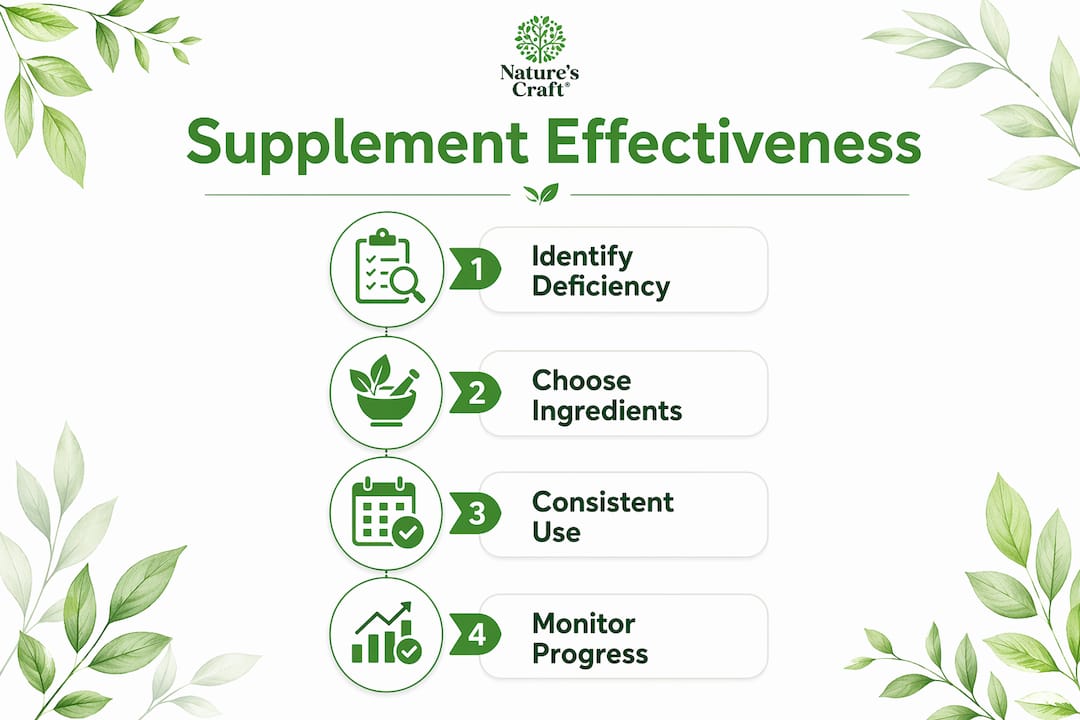
Using beard supplements correctly starts before you buy anything. Guessing at deficiencies wastes money and introduces unnecessary risk. A targeted approach based on your actual biology is far more effective.
-
Get a blood panel first. Ask your doctor to test vitamin D, iron, ferritin, and zinc. Testing these levels before supplementation is the standard step recommended by hair health specialists. Normal results mean supplements will not improve your beard growth.
-
Supplement only confirmed deficiencies. If your vitamin D is low, correct it. If your ferritin is in range, skip the iron. Targeted correction works. Blanket supplementation does not.
-
Set a realistic timeline. Correcting a deficiency takes weeks, not days. Most men see changes in hair quality and growth rate after 8–12 weeks of consistent supplementation. Patience is not optional here.
-
Pair supplements with a grooming routine. Supplements support internal health. External care, including keeping skin clean, moisturized, and free of ingrown hairs, creates the best environment for follicles to perform. Check out men’s supplements for healthy aging for a broader look at how nutrition supports men’s health at every stage.
-
Avoid stacking unproven ingredients. Multi-ingredient beard supplements often combine effective nutrients with botanicals that have no evidence or that actively interfere with DHT. Simpler formulas targeting known deficiencies are safer and more effective.
-
Consult a healthcare provider for persistent concerns. If your beard growth is significantly below what you expect given your age and family history, a hormonal evaluation is more useful than any supplement.
What else actually works for beard growth?
Topical minoxidil is the only widely supported treatment for increasing beard density beyond what your genetics currently produce. Originally developed for scalp hair loss, minoxidil works by extending the anagen (active growth) phase of hair follicles and increasing blood flow to the follicle. Clinical trials show minoxidil 5% improves beard density by approximately 11.16 hairs/cm² after 12 weeks of use. That is a measurable, documented result.
The commitment required is real. Topical regimens require 12 weeks to show density improvements, and stopping treatment causes gradual loss of the gains. Minoxidil is not a permanent fix. It is an ongoing maintenance treatment. The cost is relatively low, with 5% minoxidil available for roughly $15–$25 for a six-month supply.
Other products worth understanding:
- Beard oils and balms condition existing hair and skin, reducing breakage and improving appearance. They do not stimulate new follicle growth.
- Derma rollers (microneedling) are sometimes used alongside minoxidil to improve absorption. Evidence is emerging but not yet definitive for beard use specifically.
- Lifestyle factors including sleep quality, stress management, and adequate protein intake all support the hormonal environment that beard growth depends on.
The honest summary: no supplement replaces the hormonal and genetic foundation of beard growth. Minoxidil addresses the growth phase directly. Supplements address deficiencies. Grooming products address appearance. Each tool has a specific, limited role.
Key Takeaways
Beard growth supplements work only by correcting nutritional deficiencies, not by overriding genetics, and topical minoxidil remains the only clinically proven method to increase beard density beyond your genetic baseline.
| Point | Details |
|---|---|
| Supplements correct deficiencies | Vitamins like D, iron, and zinc help only when blood tests confirm a deficiency. |
| Biotin lacks evidence | No consistent benefit exists for biotin in healthy, well-nourished men. |
| Saw palmetto blocks DHT | This common ingredient inhibits the hormone most responsible for beard growth. |
| Minoxidil has clinical backing | Topical 5% minoxidil increases beard density by roughly 11.16 hairs/cm² in 12 weeks. |
| Test before you supplement | A blood panel for vitamin D, iron, and ferritin is the right starting point. |
What I’ve learned after years of watching men spend on the wrong products
The pattern I see most often is this: a man in his early 20s buys a “beard growth formula,” takes it for 30 days, sees no change, and concludes supplements don’t work. He’s not wrong, but he’s also not asking the right question. The question isn’t whether supplements work in general. It’s whether he has a deficiency that a supplement can correct.
Most men aged 18–35 eating a reasonably balanced diet are not deficient in biotin. They are not deficient in the exotic botanicals filling most beard supplement labels. What some of them are deficient in is vitamin D, especially if they live in northern states or spend most of their time indoors. That deficiency is worth correcting, and it may improve hair health as a side effect. But it won’t give you a beard your follicles were never programmed to grow.
The part that frustrates me most is the saw palmetto problem. Men buy a product marketed specifically for beard growth, and it contains an ingredient that blocks the hormone driving beard growth. That’s not a minor oversight. Read ingredient labels the way you’d read a contract. If you want to understand how testosterone support supplements interact with hormonal health, that knowledge matters before you choose any product.
My honest recommendation: get bloodwork done, correct what’s actually low, give it 12 weeks, and manage your expectations. If you want to go further, talk to a dermatologist about minoxidil. That’s the evidence-based path. Everything else is mostly marketing.
— SuperNatural
Shopnaturescraft’s approach to men’s nutritional health
Shopnaturescraft has been formulating clean, targeted supplements since 2013, with a focus on addressing real nutritional gaps rather than making inflated claims. For men focused on overall health, including the nutritional foundation that supports hair and skin, the full vitamins and supplements catalog covers a wide range of options in capsule, gummy, and drop formats.

If you’ve confirmed a deficiency through bloodwork and want a supplement you can trust, Shopnaturescraft offers products built with quality ingredients and transparent labeling. When you know what your body actually needs, choosing the right supplement becomes straightforward. Start with the facts about your own health, then find the product that fits.
FAQ
Do beard growth supplements actually work?
Beard growth supplements work only when they correct a confirmed nutritional deficiency such as low vitamin D, iron, or zinc. They provide no benefit in men with adequate nutrient levels.
Is biotin good for beard growth?
Biotin has no proven benefit for beard growth in healthy men. A systematic review of 10 studies found no consistent evidence supporting biotin supplementation for hair growth without a confirmed deficiency.
Can saw palmetto hurt beard growth?
Yes. Saw palmetto blocks 5-alpha reductase, the enzyme that produces DHT, which is the primary hormone responsible for converting vellus hairs into thick terminal beard hairs.
What is the most effective treatment for beard density?
Topical minoxidil 5% is the most clinically supported option, with studies showing an improvement of approximately 11.16 hairs/cm² after 12 weeks of consistent use.
How long does it take for beard supplements to show results?
When correcting a genuine deficiency, most men notice changes in hair quality and growth rate after 8–12 weeks of consistent supplementation. Results depend entirely on the severity of the deficiency being addressed.

