

Why third-party tested supplements are worth your attention
Third-party tested supplements are products independently verified by an organization that has no financial stake in the outcome. That independence is what makes the certification meaningful. When a supplement carries a recognized seal, it means an outside lab confirmed that what’s on the label is actually in the bottle, at the stated dose, and free from harmful contaminants.
The supplement industry in the United States operates under a post-market regulatory model, which means products reach store shelves before any government agency tests them. Third-party certification fills that gap directly. Here’s what a rigorous certification program typically screens for:
- Label accuracy: Confirms that ingredients and dosages match what’s printed on the packaging
- Toxic metals: Screens for lead, mercury, arsenic, cadmium, and chromium (VI)
- Pathogens: Tests for Salmonella, E. coli, and Staph contamination
- Pesticide residues: Especially relevant for botanical and herbal supplements
- Mycotoxins: Mold-derived toxins that can accumulate in plant-based ingredients
-
GMO and toxicology reviews: Covered under standards like
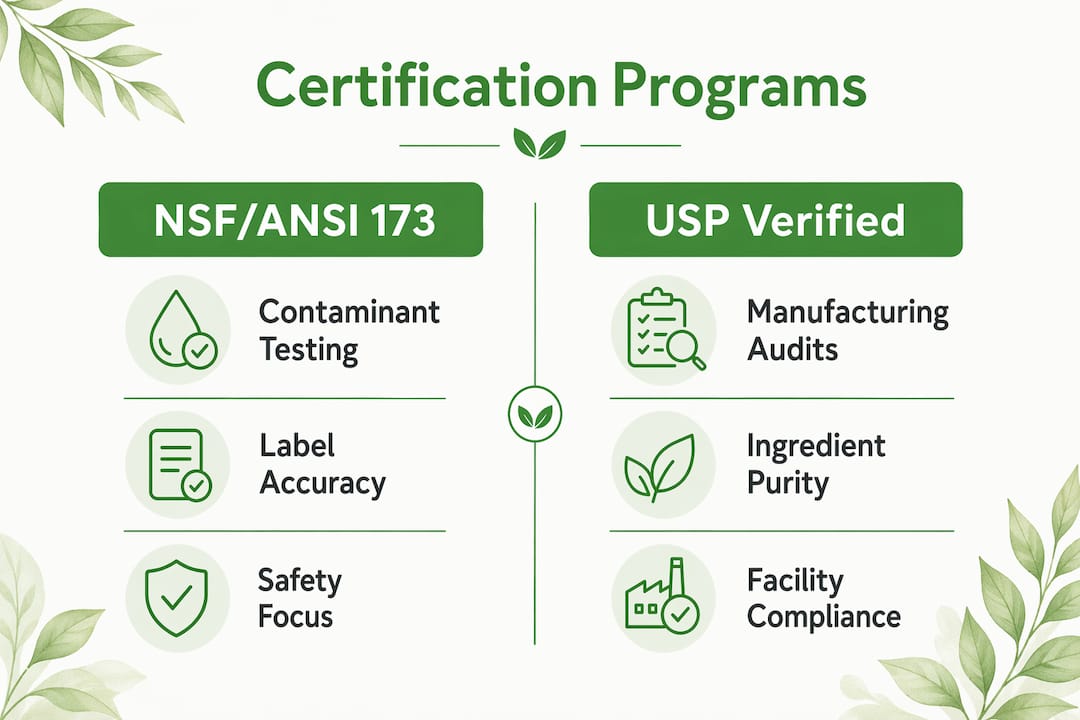
The USP Verification Program and NSF/ANSI 173 are the two most recognized standards in the US market. Both require manufacturers to meet current good manufacturing practice (cGMP) guidelines, not just pass a one-time lab test.
Table of Contents
- Major US certification programs you should recognize
- How US supplement regulations relate to third-party testing
- How to identify and verify certified supplements on any label
- Do certifications actually affect how well a supplement works?
- Reading ingredient lists alongside certification seals
- Why certifications matter differently depending on who you are
- What Nature’s Craft’s approach tells you about supplement quality
- Shopnaturescraft supplements: quality you can verify
- Key Takeaways
- FAQ
Major US certification programs you should recognize
Not all certification seals carry equal weight. Understanding what each program actually tests for helps you make smarter choices at the shelf or online.
| Certification | Testing Focus | What It Covers | Label Mark |
|---|---|---|---|
| NSF/ANSI 173 | Contaminants, label accuracy, cGMP | Toxic metals, pathogens, pesticides, GMO review | NSF Certified seal |
| USP Verified | Label accuracy, purity, facility audits | Ingredient identity, potency, off-the-shelf testing | USP Verified Mark |
| NSF Certified for Sport | Banned substance screening | Steroids, stimulants, diuretics, masking agents | Certified for Sport seal |
| Certified Gluten-Free | Gluten content | Verifies gluten below 10 ppm threshold | Certified Gluten-Free seal |
| USDA Organic | Agricultural standards | Pesticide use, synthetic additives, farming practices | USDA Organic seal |
NSF/ANSI 173 is the primary US dietary supplement certification standard. It covers toxic metal screening, pathogen testing, pesticide residue analysis, and a full toxicology review. Retailers increasingly require this certification before stocking a brand, which signals a real manufacturer commitment beyond minimum compliance.

USP Verified goes further on the facility side. The program requires on-site manufacturing audits, documentation reviews, laboratory testing for label accuracy and purity, plus ongoing off-the-shelf testing. The USP Verified Mark appears widely on dietary supplement packages, reflecting its extensive reach across the industry.
Certified Gluten-Free and USDA Organic address specific ingredient concerns rather than broad safety screening. Certified Gluten-Free verifies gluten content below 10 parts per million, which matters for people with celiac disease or gluten sensitivity. USDA Organic confirms that agricultural ingredients meet federal organic farming standards, covering pesticide use and synthetic additive restrictions.
How US supplement regulations relate to third-party testing
The FDA regulates dietary supplements under 21 CFR Part 111, the cGMP rule for dietary supplements. What that regulation does not do is require pre-market approval or government testing before a product reaches consumers.
Here’s what the current regulatory framework actually requires:
- Manufacturers must conduct at least one appropriate test to verify the identity of each dietary ingredient
- Products must be packaged and labeled according to a master manufacturing record
- The FDA does not test supplements before they go to market; enforcement happens mainly through inspections and post-market surveillance
- The FDA does not maintain a comprehensive list of all supplements currently on the market
- Manufacturers bear the primary responsibility for product safety and label accuracy
That regulatory gap is real, and third-party certification is the most practical way to close it for consumers. When a brand voluntarily pursues NSF or USP certification, it is choosing a standard that exceeds what the law requires.
How to identify and verify certified supplements on any label
Spotting a certification seal is the first step. Trusting it is a separate question.
- Look for recognized seals on the front or back panel: NSF, USP Verified, Certified for Sport, Certified Gluten-Free, or USDA Organic
- Cross-reference the seal online: NSF maintains a searchable product database at nsf.org; USP has a verified products listing at usp.org. Always verify certification status through the certifier’s official directory
- Watch for expired or counterfeit claims: A seal printed on packaging does not guarantee current certification. Certifications require renewal, and some brands display outdated marks
- Check the lot number or product name against the certifier’s database to confirm the specific product version is covered, not just the brand name
- Review manufacturer transparency: Reputable brands publish their testing documentation or link to certifier records on their website
Pro Tip: Use the NSF or USP mobile-friendly product search tools directly on your phone while shopping. Typing the product name takes under a minute and confirms whether the certification is active right now.
For buying supplements online safely, the same verification steps apply. Marketplace listings can display outdated or misrepresented seals, so checking the certifier’s database is especially useful when purchasing through third-party retailers.
Do certifications actually affect how well a supplement works?
Third-party certification confirms that a supplement contains what it claims, at the dose stated, without harmful contaminants. That is a meaningful foundation for efficacy, but it is not a clinical effectiveness guarantee.
Bioavailability, the rate at which your body absorbs and uses an ingredient, depends on factors like ingredient form, particle size, and delivery mechanism. A certified supplement with magnesium glycinate will absorb differently than one using magnesium oxide, even if both pass every purity test. Certification tells you the dose is accurate and the product is clean. Whether that dose and ingredient form are the right choice for your health goal is a separate question worth discussing with a healthcare provider.
What certification does protect is the reliability of your results over time. If a supplement consistently delivers the stated dose of vitamin D3 or omega-3s, you can actually track how your body responds. Without that consistency, you are essentially running an experiment with an unknown variable.
Reading ingredient lists alongside certification seals
A certification seal and a clean ingredient list work together. Neither tells the full story alone.
When you read a supplement label, look at the Supplement Facts panel first. Check the serving size, the form of each ingredient (magnesium glycinate vs. magnesium oxide, for example), and whether the listed amounts align with clinically studied doses. Then check the Other Ingredients section for fillers, artificial colors, or allergens that may not be relevant to the certification scope.

Certified Gluten-Free and USDA Organic seals speak directly to ingredient sourcing and processing standards, so they add context the Supplement Facts panel alone does not provide. An NSF or USP seal confirms the amounts listed are accurate, which makes the Supplement Facts panel actually trustworthy rather than aspirational. For a deeper look at identifying high-quality supplements, ingredient form and dose accuracy are the two factors that matter most alongside any certification.
Why certifications matter differently depending on who you are
Your reason for taking supplements shapes which certification matters most.
Athletes face the highest stakes. Standard certifications like NSF/ANSI 173 do not screen for every substance banned by sports governing bodies. NSF Certified for Sport adds expanded screening for steroids, stimulants, diuretics, and masking agents, aligning with requirements from professional leagues and collegiate athletic programs. For any competitive athlete, that distinction is not optional.
People with food sensitivities should prioritize Certified Gluten-Free or allergen-specific certifications alongside standard purity seals. The cGMP framework requires manufacturers to prevent cross-contamination, but a dedicated gluten-free certification provides a tested, verified threshold.
Parents choosing supplements for children benefit most from USP Verified or NSF certification because both programs confirm dose accuracy, which is especially important when weight-based dosing applies. Healthcare practitioners consistently rank verified quality seals as a top factor when recommending supplements to patients, with the USP Verified Mark frequently cited as a preferred indicator of reliability.
Older adults and people managing chronic conditions often take multiple supplements alongside prescription medications. Purity verification reduces the risk of undisclosed contaminants that could interact with medications or worsen existing conditions.
What Nature’s Craft’s approach tells you about supplement quality
Nature’s Craft has been producing supplements since 2013 with a stated mission of pure, clean formulations across every product category. That long-term commitment to quality reflects what the best third-party tested supplement brands share: a willingness to go beyond the minimum regulatory floor.
Healthcare professionals consistently favor supplements backed by independent quality seals when advising patients, because those seals represent a verified, repeatable standard rather than a manufacturer’s self-assessment. The USP Verified Mark, in particular, is frequently cited by practitioners as a preferred signal of reliability. When a brand pursues that level of verification, it is making a public commitment that its products can withstand outside scrutiny.
Nature’s Craft’s range spans capsules, gummies, and drops, covering health concerns from immune support to joint health. The breadth of that portfolio, maintained under consistent quality standards, is what makes it a reference point for consumers learning how to find reputable supplement brands in the US market.
Shopnaturescraft supplements: quality you can verify
Nature’s Craft products are built around the same principles this article covers: accurate labels, clean ingredients, and formulations you can trust. Whether you’re looking for men’s multivitamin gummies with verified potency or kids’ multivitamins formulated with dose accuracy in mind, Shopnaturescraft offers a range that reflects over a decade of quality-focused production.
The difference between a supplement that works and one that doesn’t often comes down to whether the dose on the label is real. Shopnaturescraft’s product line is designed with that standard at the center. Browse the full range at shopnaturescraft.com and find the right supplement for your wellness goals today.
Key Takeaways
Third-party certification is the most reliable way to confirm a supplement’s label accuracy, purity, and safety before you buy.
| Point | Details |
|---|---|
| FDA does not pre-approve supplements | The FDA enforces cGMP compliance post-market, so third-party testing is your primary safety layer. |
| NSF and USP lead US certification | NSF/ANSI 173 and USP Verified are the most rigorous and widely recognized programs in the US market. |
| Athletes need Certified for Sport | Standard certifications don’t screen for banned substances; NSF Certified for Sport does. |
| Always verify seals online | Cross-check any certification seal against the certifier’s official product directory to confirm it’s current. |
| Shopnaturescraft | Nature’s Craft has produced clean, quality-focused supplements since 2013, with a range spanning gummies, capsules, and drops. |
FAQ
How do I tell if a supplement is third-party tested?
Look for a recognized seal on the packaging (NSF, USP Verified, Certified for Sport) and confirm it by searching the certifier’s official online product directory. A printed seal alone is not enough; active certification must appear in the certifier’s database.
Are third-party supplement certifications legitimate?
Yes, programs like NSF/ANSI 173 and USP Verified are rigorous, independent standards that require lab testing, facility audits, and ongoing compliance checks. They are not self-reported; an outside organization conducts and verifies all testing.
What is the most trustworthy certification for supplement quality?
NSF/ANSI 173 and USP Verified are the two most respected programs in the US market. For athletes, NSF Certified for Sport adds banned substance screening that standard certifications do not include.
Does third-party certification mean a supplement will work for me?
Certification confirms label accuracy, ingredient purity, and cGMP-compliant manufacturing. It does not guarantee clinical effectiveness or that a specific ingredient form will work for your individual health needs.
Where can I find third-party tested supplements I can trust?
Shopnaturescraft offers a range of supplements produced under consistent quality standards since 2013, covering capsules, gummies, and drops across multiple health categories.

