


If you’re an older adult, follow a vegan or vegetarian diet, have had GI surgery, or take metformin or proton pump inhibitors long-term, you have a real reason to consider a B12 supplement or at least get tested. The standard adult RDA is 2.4 mcg, but absorption declines with age and certain health conditions, making food sources alone unreliable for many people.
Who should consider supplementation or testing:
- Older adults (65+): Stomach acid production drops with age, reducing the body’s ability to extract B12 from food. Up to 20% of adults over 50 may have borderline deficiency.
- Vegans and strict vegetarians: B12 is found almost exclusively in animal products. Without fortified foods or supplements, deficiency is nearly certain over time.
- People with GI surgery: Gastrectomy and bariatric procedures reduce intrinsic factor production and stomach acid, both critical for B12 absorption.
- Those with malabsorption conditions: Celiac disease and Crohn’s disease impair nutrient uptake in the small intestine.
- Chronic metformin or PPI users: Both medications reduce B12 absorption and can deplete stores over months to years.
- People with pernicious anemia: This autoimmune condition destroys the stomach cells that produce intrinsic factor, making oral supplements insufficient for many.
Table of Contents
- What does vitamin B12 actually do in your body?
- Who is at higher risk of B12 deficiency?
- Signs and symptoms of B12 deficiency, grouped by system
- Food sources versus supplements: what provides how much B12?
- How much B12 do you need, and what dose should you take?
- Testing and diagnosis: which blood tests matter
- Safety, side effects, and what high B12 actually means
- Key Takeaways
- The case for being proactive, not reactive, about B12
- Shopnaturescraft makes it easy to start with clean B12
- Useful sources
- FAQ
What does vitamin B12 actually do in your body?
Vitamin B12 is a water-soluble vitamin essential for three core functions: maintaining the myelin sheath around nerve fibers, forming healthy red blood cells, and synthesizing DNA. Without adequate B12, nerve signals slow or misfire, red blood cells grow abnormally large and carry oxygen poorly, and cell replication becomes error-prone.
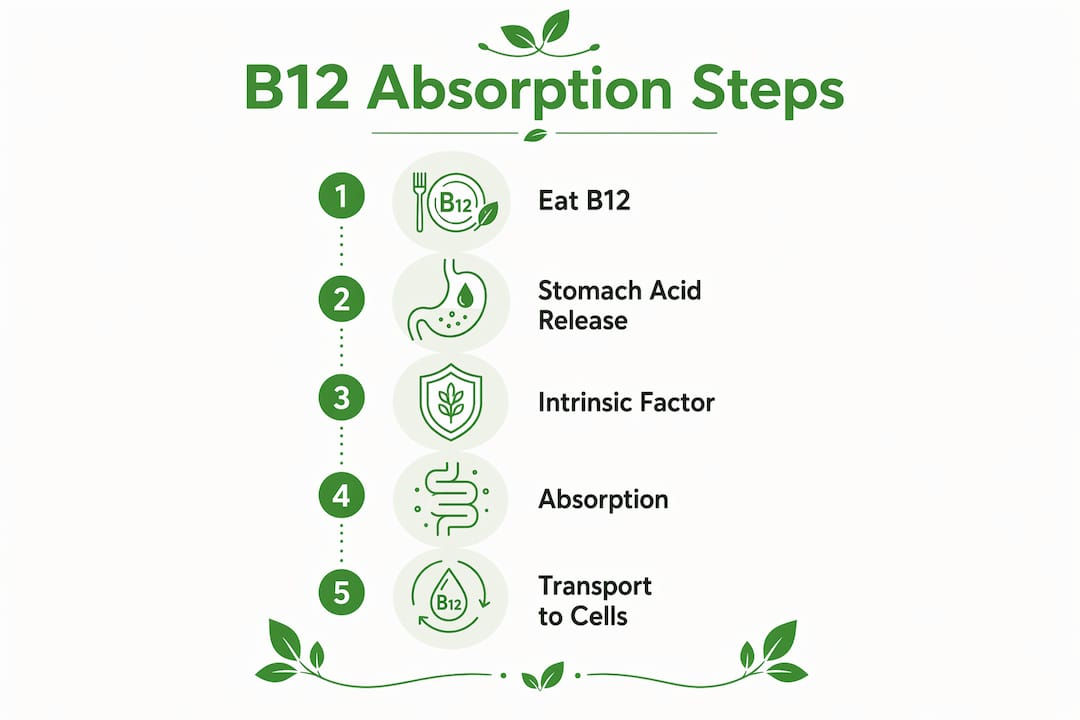
Absorption follows a specific chain. You eat B12 bound to protein in food. Stomach acid frees it. A protein called intrinsic factor, produced by cells in the stomach lining, binds the freed B12. That complex travels to the distal ileum, where it’s absorbed into the bloodstream. Break any link in that chain and deficiency follows, regardless of how much B12 you eat.
Neurological damage can occur even without anemia, which surprises many people. The nerve and blood cell pathways are independent, so you can have serious neurologic symptoms while your red blood cell count still looks normal. That’s one reason why relying on anemia alone to screen for deficiency misses a significant number of cases.
Who is at higher risk of B12 deficiency?
Knowing your risk category is the most practical first step before deciding whether to supplement or test.
- Adults over 50: Atrophic gastritis and reduced stomach acid are common with age, impairing the release of B12 from food. Clinical gerontology experts recommend proactive supplementation or periodic testing for adults over 65.
- Vegans and vegetarians: Plant foods contain no B12 unless fortified. Deficiency can develop within a few years on a strict plant-based diet without supplementation.
- Post-GI surgery patients: Gastrectomy, sleeve gastrectomy, and gastric bypass all reduce intrinsic factor and acid output. Monitoring after bariatric surgery is standard clinical practice.
- Celiac and Crohn’s disease: Both conditions damage the intestinal lining where B12 is absorbed, making supplementation or monitoring necessary even when diet includes animal products.
- Long-term metformin users: Metformin interferes with B12 absorption in the ileum. Clinicians often monitor B12 annually in patients on long-term metformin therapy.
- Chronic PPI users: Proton pump inhibitors suppress the stomach acid needed to free food-bound B12. Long-term use can quietly deplete stores.
- Pernicious anemia: Autoimmune destruction of intrinsic factor-producing cells means oral supplements often aren’t enough. Injections or very high-dose oral therapy may be required.
- Infants of deficient mothers: Breastfed infants rely entirely on their mother’s B12 status. A deficient mother can produce milk with inadequate B12, putting the infant at neurological risk.
If you fall into any of these groups, discussing testing with your clinician makes sense, especially before or during pregnancy, after starting a new long-term medication, or when symptoms appear.
Signs and symptoms of B12 deficiency, grouped by system
Symptoms often develop slowly because the liver stores enough B12 for 1–5 years. By the time symptoms are obvious, deficiency may be well established.
Hematologic:
- Unexplained fatigue and weakness
- Pale or slightly yellow skin
- Shortness of breath or heart palpitations
- Megaloblastic anemia (large, poorly functioning red blood cells)
Neurologic:
- Tingling or numbness in hands and feet
- Difficulty with balance and coordination
- Muscle weakness
- In severe cases, gait disturbance
Cognitive and psychiatric:
- Memory problems and confusion
- Depression or anxiety
- In advanced cases, dementia-like symptoms
GI and other:
- Sore, red, or swollen tongue (glossitis)
- Loss of appetite
- Mouth ulcers
Pro Tip: Seek medical attention promptly if you experience rapidly progressive numbness, sudden difficulty walking, or acute cognitive changes. Neurological damage from B12 deficiency can become irreversible if treatment is delayed too long.
Neurological symptoms can appear before any blood abnormality shows up on a standard CBC. If you have tingling, balance issues, or unexplained cognitive changes, don’t wait for anemia to develop before asking your clinician about B12 testing.

Food sources versus supplements: what provides how much B12?
Most people who eat animal products regularly get enough B12 from food. The challenge is absorption, not just intake.
| Food Source | Serving | Approximate B12 (mcg) |
|---|---|---|
| Beef (ground) | — | ~2.4 mcg |
| Milk | 1 cup | — |
| Egg | 1 large | — |
| Fortified cereal | 1 serving | — |
| Fortified plant milk | 1 cup | — |
| Nutritional yeast (fortified) | 1 tbsp | ~2.4 mcg (varies by brand) |
Sources: NIH ODS, Harvard Health. Fortified food values vary by product.
Supplemental B12 has one key advantage over food-bound B12: it’s already free form. You don’t need stomach acid to extract it, which is why supplements work even for people with reduced acid production. Supplement forms include cyanocobalamin, methylcobalamin, adenosylcobalamin, and hydroxycobalamin, available in several delivery formats:
- Oral tablets/capsules: Convenient and widely available; rely on some intrinsic factor for full absorption at standard doses.
- High-dose oral (500–2,000 mcg): At very high doses, passive diffusion absorbs a small percentage without intrinsic factor, enough to correct deficiency in many patients.
- Sublingual: Dissolves under the tongue; popular but research has not confirmed superior absorption over standard oral tablets for most people.
- Intramuscular injection: Bypasses the GI tract entirely; preferred when intrinsic factor is absent or absorption is severely impaired.
- Nasal gel/spray: A prescription option that delivers B12 through nasal mucosa; useful for those who cannot tolerate injections.
How much B12 do you need, and what dose should you take?
The standard adult RDA is 2.4 mcg daily. Older adults may need a practical intake of 10–12 mcg because absorption efficiency declines with age, meaning you need more coming in to get the same amount absorbed.
Common supplement dose ranges:
- Multivitamin: Typically 2.4–6 mcg per serving, suitable for general maintenance in healthy adults.
- Standalone maintenance supplement: 250–500 mcg daily is a common range for older adults or those at mild risk.
- High-dose oral therapy: 1,000 mcg daily is frequently recommended for borderline deficiency or when MMA is elevated.
- Clinical loading doses: 1,000–2,000 mcg daily for active deficiency, sometimes for weeks before stepping down to maintenance.
Why do clinicians use doses hundreds of times the RDA? Even though intrinsic factor-mediated absorption saturates at low doses, passive diffusion absorbs roughly 1% of any oral dose without intrinsic factor. At 1,000 mcg, that passive route delivers about 10 mcg, enough to restore status over time.
Pro Tip: Clinicians generally choose high-dose oral therapy when intrinsic factor is partially intact and deficiency is moderate. Intramuscular injections are preferred when intrinsic factor is absent (pernicious anemia), absorption is severely impaired, or rapid correction is needed for serious neurological symptoms.

Hematologic markers typically improve within days to weeks of starting treatment. Neurological recovery takes longer, often months, and some deficits may not fully reverse if treatment was significantly delayed.
Testing and diagnosis: which blood tests matter
Testing is recommended when you have symptoms, belong to a risk group, are planning pregnancy, or have been on long-term metformin or PPI therapy.
- Serum B12: The standard first test. Useful but imperfect. A low result confirms deficiency; a low-normal result doesn’t rule it out.
- Methylmalonic acid (MMA): More sensitive than serum B12 alone. MMA rises when cells are actually B12-deficient at the functional level. Clinicians often order MMA when serum B12 is low-normal but symptoms suggest deficiency.
- Homocysteine: Elevated homocysteine supports B12 (or folate) deficiency but is less specific than MMA.
- Complete blood count (CBC): Checks for megaloblastic anemia. Large red blood cells (high MCV) are a classic sign, but neurological deficiency can exist without any CBC abnormality.
A combined strategy using serum B12 with MMA and CBC gives the clearest picture. An elevated MMA alongside a low or low-normal serum B12 strongly supports deficiency even when the serum B12 number alone looks acceptable.
Pro Tip: Bring a full medication list to your appointment. Metformin, PPIs, and bile acid sequestrants all affect B12 absorption or can influence how results are interpreted. Your clinician needs that context to read your labs accurately.
Safety, side effects, and what high B12 actually means
B12 has no established tolerable upper intake level (UL) because excess is excreted in urine. Short-term risk from supplementation is low. That said, clinicians recommend targeted supplementation rather than indiscriminate high-dose use, particularly for pregnant or nursing women and anyone on interacting medications.
Safety and side effects:
- Minor side effects (nausea, mild diarrhea) are occasionally reported at high doses but are uncommon.
- No documented toxicity from oral B12 at typical supplement doses.
- Cyanocobalamin may warrant caution in people with borderline kidney problems; methylcobalamin is often preferred in that context.
- Pregnant and nursing women should consult their clinician before starting high-dose therapy.
Medications that affect B12 status:
- Metformin: Reduces ileal absorption; annual monitoring is reasonable for long-term users.
- Proton pump inhibitors and H2 blockers: Suppress stomach acid needed to free food-bound B12.
- Bile acid sequestrants (e.g., cholestyramine): Can reduce B12 absorption.
What if your B12 is unexpectedly high?
Elevated serum B12 in the context of Chronic Myeloid Leukemia (CML) and other myeloproliferative neoplasms typically reflects increased haptocorrin secretion from proliferating white blood cells, not excess supplementation. Research shows that B12 levels in CML patients tend to be elevated and decrease following treatment, suggesting they track disease burden rather than dietary or supplemental intake. Clinicians evaluating unexpectedly high B12 in a patient not on high-dose supplements should consider hematologic workup rather than attributing the elevation to vitamins.
If you’re taking a standard supplement and your B12 comes back very high, discuss it with your clinician. The cause is usually the supplement itself, but ruling out an underlying condition is the right call.
This article is general health information, not medical advice. Confirm current guidelines and your personal situation with a qualified clinician or your primary care provider.
Key Takeaways
Adults who are older, follow a plant-based diet, have GI conditions, or take metformin or PPIs long-term have the clearest evidence-based reasons to take a B12 supplement or get tested.
| Point | Details |
|---|---|
| RDA and older adult needs | The standard adult RDA is 2.4 mcg; older adults may need a higher practical intake due to reduced absorption. |
| Neurological risk is real | B12 deficiency can cause nerve damage and cognitive changes even without anemia; early testing matters. |
| High-dose oral therapy works | 1,000 mcg oral doses correct deficiency in many patients via passive diffusion, even without full intrinsic factor. |
| MMA is the better test | Methylmalonic acid is more sensitive than serum B12 alone for detecting functional deficiency. |
| Shopnaturescraft B12 options | Shopnaturescraft offers methylcobalamin and capsule formats for adults who want a clean, lab-verified supplement. |
The case for being proactive, not reactive, about B12
Most B12 articles tell you to “eat more liver and eggs.” That advice suits a healthy 30-year-old with no medications but misses the point for many adults who actually need to consider this.
The real issue is absorption, not just intake. You can eat a B12-rich diet and still be functionally deficient if your stomach acid is low, your intrinsic factor is compromised, or your medication is quietly blocking uptake in your ileum. That’s why the food-first approach, while sensible as a starting point, is not a complete answer for everyone.
What I find most underappreciated is the neurological timeline. Hematologic markers respond within weeks of treatment. Nerve damage can take months to recover, and some of it never fully does. That asymmetry argues strongly for testing before symptoms become severe, not after. If you’re in a risk group, a simple blood panel now is far less costly than managing irreversible neuropathy later.
Shopnaturescraft makes it easy to start with clean B12
You’ve done the research. Now the practical question is which format fits your life. Shopnaturescraft has offered clean, non-GMO, lab-verified supplements since 2013, and B12 is one of the most straightforward choices in the lineup.

The Methyl B12 product uses methylcobalamin, the form many clinicians and researchers prefer for people with kidney concerns or those who want the naturally occurring cobalamin form. If you prefer capsules alongside other daily nutrients, the capsule collection gives you flexible options without unnecessary fillers. Every product is made with the same commitment to purity that has defined Nature’s Craft from the start.
Before starting high-dose B12 therapy or if you have serious symptoms, talk to your clinician first. For maintenance support or general wellness, browse the full range and find the format that works for you.
Useful sources
- NIH Office of Dietary Supplements: Vitamin B12 Consumer Fact Sheet — RDA values, food sources, deficiency symptoms, and supplement guidance.
- NIH ODS: Vitamin B12 Health Professional Fact Sheet — Clinical dosing, absorption mechanisms, and drug interactions.
- Harvard Health: Should you take a vitamin B12 supplement? — Clinician-sourced guidance on testing and supplementation for older adults.
- Harvard Health: Vitamin B12 deficiency A to Z — Risk groups, medication interactions, and MMA testing guidance.
- Cleveland Clinic: Vitamin B12 Deficiency Symptoms, Causes and Treatment — Treatment options and neurological recovery timelines.
- Mayo Clinic: Vitamin B12 — RDA reference and practical supplement guidance.
- PMC: Elevated Vitamin B12 in Myeloproliferative Neoplasms — Research on hypercobalaminemia as a disease biomarker in CML and related conditions.
FAQ
Is it safe to take B12 every day?
Yes, for most adults. B12 has no established upper intake limit because excess is excreted in urine, and daily supplementation at standard doses carries very low risk. Pregnant or nursing women and those on interacting medications should check with their clinician before starting high-dose therapy.
What are the signs that you need B12?
Common signs include unexplained fatigue, muscle weakness, pale skin, sore tongue, tingling or numbness in the hands or feet, and cognitive changes such as memory loss or confusion. Neurological symptoms can appear before anemia develops, so don’t wait for a low red blood cell count to prompt testing.
Why is B12 high in CML?
In Chronic Myeloid Leukemia, elevated serum B12 reflects increased haptocorrin secretion from proliferating white blood cells, not excess supplementation. B12 levels in CML patients can exceed 1,000 pg/mL and tend to fall after treatment, tracking disease burden rather than dietary intake.
What happens if I take B12 and don’t need it?
Very little, in most cases. Because B12 is water-soluble, your body excretes what it doesn’t use. There is no documented toxicity at typical supplement doses. That said, targeted supplementation based on your actual status is preferable to taking high doses without a clear reason.

