


Supplement timing is defined as the practice of taking specific nutrients at specific times to maximize their absorption and effectiveness in the body. Why supplement timing matters comes down to biology: your digestive system, circadian rhythms, and nutrient interactions all influence how much of a supplement you actually absorb. Fat-soluble vitamins like A, D, E, and K require dietary fat to enter your bloodstream. Iron absorbs the best on an empty stomach but competes directly with calcium. Getting the timing right does not require a complicated schedule. It requires understanding a few key principles and building them into a routine you can actually stick to.
Why supplement timing matters for absorption
The most direct reason timing affects results is absorption. Your gut does not treat all nutrients equally, and the presence or absence of food changes everything for certain supplements.
Fat-soluble vitamins are the clearest example. Vitamins A, D, E, and K dissolve in fat, not water. Without dietary fat in your stomach, your small intestine cannot form the micelles needed to carry these vitamins into your bloodstream. Taking vitamin D with a high-fat meal increases serum levels by roughly 50%. That is not a minor difference. It means half your vitamin D dose could be wasted if you take it on an empty stomach in the morning.

Iron works the opposite way. Iron absorbs best on an empty stomach, ideally 30 minutes before or 2 hours after a meal. Pairing it with vitamin C increases absorption further and reduces nausea. The tradeoff is real: an empty stomach maximizes iron uptake, but some people experience GI discomfort.
Here is where tolerability enters the picture. Many people fear that taking supplements with food reduces their effectiveness. The evidence says otherwise for most nutrients. Food reduces side effects and improves long-term adherence, which matters far more than squeezing out a marginal absorption gain. A supplement you take consistently with breakfast beats one you skip because it upsets your stomach.
Key supplements and their food requirements:
- Fat-soluble vitamins (A, D, E, K): Take with a meal containing healthy fats like avocado, olive oil, or nuts.
- Iron: Take on an empty stomach with a vitamin C source. If nausea occurs, take with a small, low-calcium snack.
- Magnesium: Take with food to reduce the risk of loose stools.
- Probiotics: Take before breakfast so they reach the gut lining before stomach acid peaks.
- Water-soluble vitamins (B vitamins, vitamin C): B vitamins and vitamin C do not require food and can be taken any time, though morning is most practical.
Pro Tip: If you take vitamin D, pair it with your largest meal of the day, not just any meal. The fat content of that meal is what drives absorption.
How do mineral interactions affect supplement timing?
Minerals compete for the same absorption pathways in your gut. Taking the wrong ones together does not just reduce their effectiveness slightly. It can cut absorption dramatically.
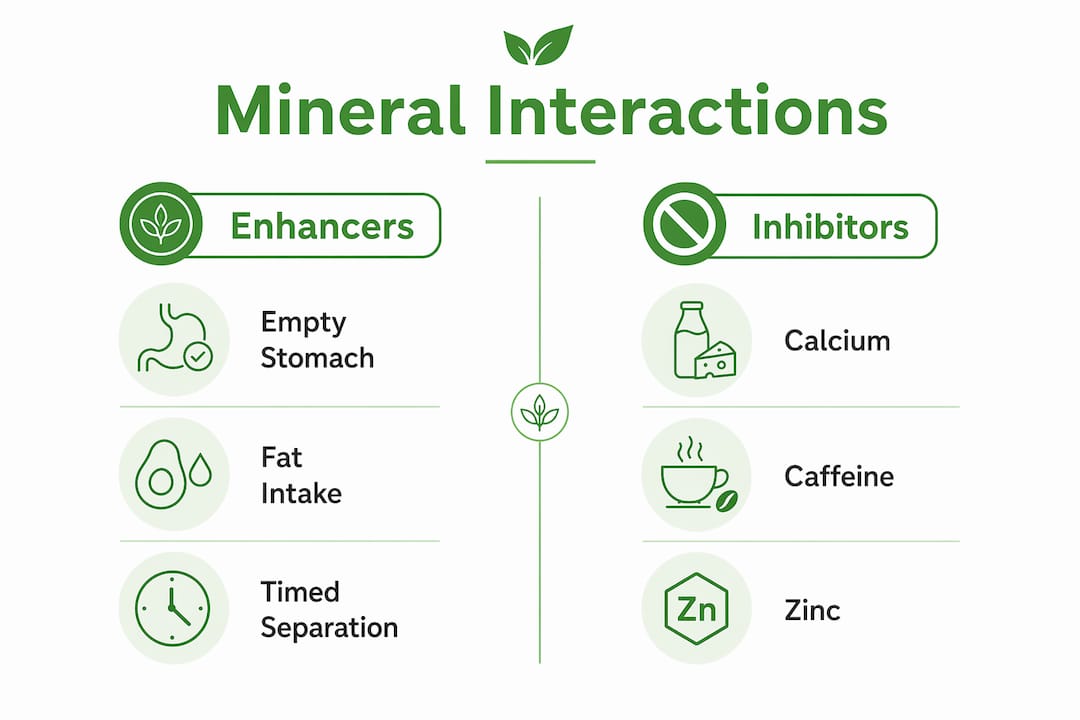
Calcium and iron share the same transport proteins in the small intestine. Calcium reduces iron absorption by up to 50% when taken at the same time. That is a significant loss, especially for people managing iron-deficiency anemia. The fix is simple: separate calcium and iron by at least 2 hours. Take iron in the morning and calcium with dinner, or vice versa.
Zinc and copper have a similar rivalry. High zinc intake suppresses copper absorption over time. If you take both, spacing them by a few hours reduces the competition. Zinc absorbs best midday with a small snack, which also helps prevent the nausea zinc can cause on an empty stomach.
Caffeine is a less obvious disruptor. Caffeine impairs iron absorption when consumed at the same time. If you take iron with your morning coffee, you are likely losing a meaningful portion of that dose. Separate iron from coffee or tea by 1–2 hours.
| Mineral pair | Conflict | Recommended spacing |
|---|---|---|
| Calcium and iron | Compete for same transporters | 2+ hours apart |
| Zinc and copper | High zinc suppresses copper | 2–3 hours apart |
| Iron and caffeine | Caffeine blocks iron uptake | 1–2 hours apart |
Pro Tip: Build a simple two-window system. Take iron and B vitamins in the morning, then take calcium and magnesium in the evening. This one habit eliminates most mineral conflicts.
Does supplement timing affect energy and sleep?
The effects of supplement timing extend beyond absorption. Certain nutrients directly influence your energy levels and sleep quality, which means taking them at the wrong time of day can work against you.
B vitamins are the clearest example of an energizing supplement. They support cellular energy production through the Krebs cycle and activate neurotransmitters linked to alertness. B vitamins taken in the morning support daytime energy and avoid the sleep disruption that evening doses can cause. Taking a B-complex at 9 PM is a common and avoidable mistake.
Magnesium glycinate works in the opposite direction. It activates the parasympathetic nervous system and supports GABA activity, both of which promote relaxation. Taking magnesium glycinate in the evening, about 30–60 minutes before bed, aligns with your body’s natural wind-down process and supports deeper sleep.
Vitamin D timing also matters for sleep. Vitamin D influences melatonin production, and morning vitamin D intake avoids potential interference with your body’s nighttime melatonin signal. Most people already take vitamin D with breakfast, which makes this an easy win.
Timing recommendations by effect on energy and sleep:
- Morning (energy support): B-complex vitamins, vitamin C, vitamin D, iron
- Evening (sleep and recovery): Magnesium glycinate, zinc (if tolerated at night), calcium
- Before breakfast (gut health): Probiotics, to maximize survival through stomach acid
Your personal tolerance matters here. Some people feel no energy boost from morning B vitamins. Others find evening magnesium makes no difference to their sleep. Use these guidelines as a starting point, then adjust based on what you actually notice.
Why consistency beats perfect timing every time
The most important truth about supplement timing is this: routine adherence outweighs rigid timing precision for the vast majority of supplements. Missing a dose because your schedule was off by two hours is far more costly than taking a supplement at a slightly suboptimal time.
The internet is full of highly specific timing protocols that imply you need a spreadsheet to supplement correctly. Most of that complexity is unnecessary. Scientific evidence supports precise timing for only a handful of nutrients, primarily iron, fat-soluble vitamins, and minerals with known interactions. For everything else, daily consistency delivers the majority of the benefit.
Building a sustainable routine means anchoring your supplements to existing habits. This approach is called habit stacking, and it works because you are not creating a new behavior from scratch. You are attaching a new action to something you already do automatically.
A practical four-step approach to building your routine:
- Identify your anchor habits. Breakfast, lunch, and bedtime are the three most reliable anchors for most people.
- Assign supplements to anchors by effect. Energizing supplements go with morning meals. Calming supplements go with your evening routine.
- Separate conflicting minerals. Use the morning and evening split to keep calcium away from iron.
- Adjust for tolerability. If a supplement causes discomfort at a specific time, shift it. Adherence always wins over theoretical precision.
Pro Tip: Keep your supplements visible. A pill organizer next to your coffee maker or on your nightstand removes the decision entirely and makes daily consistency automatic.
Overly complex timing schedules reduce adherence. If your supplement routine feels like a part-time job, simplify it. The quality of your supplements and the consistency of your intake matter far more than hitting a precise 30-minute window.
Key Takeaways
Supplement timing matters most for fat-soluble vitamins, iron, and minerals with known interactions; for everything else, daily consistency is the single most important factor.
| Point | Details |
|---|---|
| Fat-soluble vitamins need fat | Take vitamins A, D, E, and K with a fat-containing meal to maximize absorption. |
| Separate calcium and iron | Taking them together cuts iron absorption by up to 50%; space them 2+ hours apart. |
| Time supplements by energy effect | Take B vitamins in the morning and magnesium glycinate in the evening for best results. |
| Caffeine blocks iron | Separate iron from coffee or tea by 1–2 hours to protect absorption. |
| Consistency beats precision | A daily habit at a good time outperforms a perfect schedule you cannot maintain. |
What I have learned from years of watching people supplement wrong
The biggest mistake I see is not poor timing. It is over-complicating a simple practice until it becomes unsustainable. People read about calcium-iron competition and immediately build a six-alarm supplement schedule. Two weeks later, they have abandoned it entirely.
The research is clear: timing is ingredient-specific and matters most for a short list of nutrients. For the rest, showing up every day is the strategy. I have seen people transform their energy and sleep simply by moving their B vitamins to breakfast and their magnesium to bedtime. Two changes. No spreadsheet required.
The other thing I push back on hard is the fear that taking supplements with food “ruins” them. That fear causes people to take iron on an empty stomach, feel sick, and stop taking it. A slightly lower absorption rate with food is almost always better than zero absorption from a skipped dose. Tolerability is a health outcome too.
My practical advice: start with the morning and evening split, separate your minerals, and take fat-soluble vitamins with your biggest meal. Then leave it alone and let consistency do the work. The people who benefit most from supplementation are not the ones with the most precise schedules. They are the ones who never miss a day.
— SuperNatural
Shopnaturescraft supplements built for real routines
Shopnaturescraft has been crafting pure, clean supplements since 2013, and the product range reflects exactly what good timing requires: the right forms, the right formats, and the right ingredients to fit into your daily life without friction.

Whether you need fat-soluble vitamin drops designed to pair with meals, multivitamin gummies that make morning routines easier, or targeted minerals for your evening wind-down, Shopnaturescraft covers every stage of your wellness routine. Every product is made with quality ingredients and formulated to support real, consistent use. Browse the full range at Shopnaturescraft and find the supplements that fit your schedule.
FAQ
Why does supplement timing matter for fat-soluble vitamins?
Fat-soluble vitamins A, D, E, and K require dietary fat to be absorbed. Taking them with a fat-containing meal can increase serum levels by roughly 50% compared to taking them on an empty stomach.
Can I take all my supplements at once?
Taking all supplements at once is not recommended when your routine includes iron and calcium. These two minerals compete for absorption and should be separated by at least 2 hours.
When is the best time to take magnesium?
Magnesium glycinate is best taken in the evening, about 30–60 minutes before bed. Its calming effect on the nervous system supports relaxation and sleep quality.
Does coffee affect supplement absorption?
Caffeine impairs iron absorption when consumed at the same time. Separate iron from coffee or tea by 1–2 hours to avoid losing a meaningful portion of your dose.
Is timing or consistency more important for supplements?
Consistency is more important for most supplements. Daily intake at a reasonable time delivers the majority of supplementation benefits, while overly rigid timing schedules often reduce long-term adherence.

