


Chia seeds are instantly recognizable in a kitchen.
They're tiny, crunchy when dry, gel-like after soaking, and easy to scatter over breakfast or blend into a smoothie.
A chia seed oil capsule looks nothing like that.
Yet both begin with the same plant: Salvia hispanica.
Following what happens between those two forms reveals an important nutritional distinction. When chia becomes an oil supplement, some of the seed's most interesting components become concentrated—while other familiar parts of whole chia don't come along for the ride.

It begins with the seed
Whole chia seeds are foods.
Their nutritional profile includes fat, fiber, protein, carbohydrates, and minerals. That's why adding whole chia to breakfast isn't nutritionally equivalent to swallowing an oil capsule.
One of the most notable components inside the seed is its fat.
Chia is particularly known as a plant source of alpha-linolenic acid (ALA), an essential omega-3 fatty acid.
“Essential” has a specific nutritional meaning here: the human body cannot synthesize ALA on its own, so it has to come from food.
Next, the oil changes the equation
Extract the lipid portion of the seed and the nutritional profile becomes much more focused.
The fiber that makes soaked chia thicken isn't what an oil supplement is designed to deliver.
Neither is the complete protein profile of the whole seed.
Instead, chia seed oil concentrates the seed's fatty components.
This is why reading “chia” on two packages doesn't mean the products are nutritionally interchangeable.
A bag of seeds belongs primarily to the food conversation.
A bottle of chia seed oil belongs primarily to the dietary-fat conversation.
Inside the oil are several kinds of fatty acids
Omega-3 gets most of the attention, but it isn't alone.
The current Nature’s Craft Chia Seed Oil label identifies its chia seed extract as providing 85–95% total fatty acids.
That profile includes:
Omega-3 alpha-linolenic acid (ALA)
An essential polyunsaturated fatty acid found in several plant foods.
Omega-6 linoleic acid
Another essential polyunsaturated fatty acid that must be obtained through the diet.
Omega-9 oleic acid
A monounsaturated fatty acid also found in foods such as olive oil and avocados.
The extract additionally contains other naturally occurring saturated fatty acids.
That mixture—not fiber—is the nutritional reason for turning chia into an oil supplement.
Then the oil meets the capsule
Nature’s Craft packages 500 mg of chia seed extract into each liquid capsule.
The current bottle contains 120 capsules, with one capsule constituting a labeled serving.
There is an easy misconception worth clearing up here.
Because chia comes from a plant, it's tempting to assume every chia supplement is vegan.
The current Nature’s Craft label lists bovine gelatin among its other ingredients, along with astaxanthin, spice extract, non-GMO tocopherols, ascorbyl palmitate, and citric acid.
So the source of the active ingredient and the composition of the finished capsule are two separate things.
For anyone following a vegetarian or vegan diet, that's a label detail worth checking.
At mealtime, the capsule enters digestion
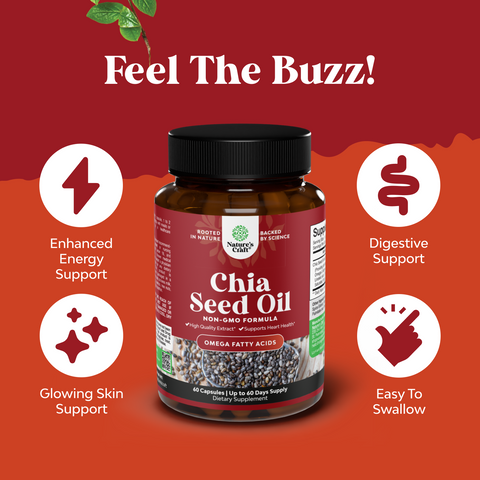
Nature’s Craft suggests taking one capsule one to two times daily, preferably with meals, or as directed by a healthcare professional.
Once consumed, dietary fats go through the body's normal digestive and absorptive processes.
They don't skip digestion simply because they're enclosed in a capsule.
Bile and digestive enzymes help the body process fats before their components can be absorbed and transported.
From there, fatty acids participate in normal biological processes according to their individual roles.
ALA has another chapter after absorption
Alpha-linolenic acid deserves a little more attention because “omega-3” can sound like a single nutrient.
It isn't.
ALA is the principal plant-derived omega-3 discussed with chia.
EPA and DHA are different omega-3 fatty acids, commonly associated with marine sources.
The human body can convert ALA into EPA and subsequently DHA, but this conversion is limited. That's one reason chia seed oil shouldn't automatically be described as nutritionally identical to fish oil or algae-derived DHA/EPA.
All belong to the broader omega-3 conversation.
They don't occupy exactly the same page.
The shopping side tells another story
Understanding what happens as a chia seed becomes an oil explains the nutrition.
Choosing among actual chia oil capsules raises different questions—whether the capsule is vegan, how the oil is described, what a serving provides, and what those milligram numbers really represent.
That side of the subject is explored here:
Chia Seed Oil Capsules Sound Simple—Until You Start Comparing Them
https://medium.com/@HealthJourneyDaily/chia-seed-oil-capsules-sound-simple-until-you-start-comparing-them-4dba46380b02
By the end, the seed has become something very specific
The journey from chia seed to chia oil capsule isn't simply a change in packaging.
It changes what part of chia nutrition is being emphasized.
Whole chia gives you the broader food.
Chia seed oil focuses on the lipid fraction.
Nature’s Craft Chia Seed Oil takes that second approach, providing a concentrated chia seed extract whose label identifies omega-3 ALA, omega-6 linoleic acid, and omega-9 oleic acid among its naturally occurring fatty acids.
Neither form needs to replace the other.
They're simply different ways of using the same seed—and understanding that difference makes the label considerably easier to read.

