


You’ve seen the promises on labels: “turn back the clock,” “restore youthful skin,” “slow cellular aging.” Anti aging supplements are a multi-billion dollar market, and if you’re between 30 and 60, you’ve probably wondered which ones are actually worth your time. The answer is more nuanced than most product pages let on. This guide breaks down what anti aging supplements are, which ingredients have real clinical evidence behind them, and how to build a supplement routine that genuinely supports your skin health, energy, and long-term wellness.
Table of Contents
- Key takeaways
- What are anti aging supplements and how do they work
- Do anti aging supplements work? What the science says
- Safety considerations you should not skip
- How to choose and use anti aging supplements
- My honest take on anti aging supplements
- Support your aging goals with Shopnaturescraft
- FAQ
Key takeaways
| Point | Details |
|---|---|
| Supplements support, not replace | Healthy sleep, nutrition, and exercise remain the primary drivers of healthy aging. |
| Clinical evidence varies | Some ingredients like CoQ10 and synbiotics show measurable skin and cellular benefits; others are still unproven in humans. |
| Safety matters | Excess intake of vitamins and minerals can cause toxicity, so always check Tolerable Upper Intake Levels. |
| Quality is non-negotiable | Third-party tested supplements from reputable brands reduce the risk of contamination and label inaccuracies. |
| Personalization wins | Your supplement choices should reflect your individual nutrition gaps, health goals, and lifestyle. |
What are anti aging supplements and how do they work
Anti aging supplements are products, typically capsules, powders, or gummies, formulated to slow, reduce, or partially reverse the cellular and physiological changes associated with aging. They work through several different mechanisms depending on the ingredient. Antioxidants neutralize free radicals that damage cells. Vitamins support enzymatic and hormonal processes that decline with age. Botanicals like turmeric reduce inflammation, which accelerates tissue breakdown over time.
The key categories you’ll encounter include:
- Antioxidants: CoQ10, resveratrol, vitamin C, and vitamin E protect cells from oxidative stress. CoQ10 supplements also support mitochondrial energy production, which slows with age.
- Structural support compounds: Collagen peptides and biotin support skin elasticity, hair thickness, and nail integrity.
- NAD+ precursors: Nicotinamide riboside (NR) and nicotinamide mononucleotide (NMN) aim to restore cellular energy metabolism.
- Vitamins and minerals: Vitamin D, vitamin C, and zinc play roles in immune function, collagen synthesis, and DNA repair.
- Botanicals: Turmeric, green tea extract, and adaptogens provide anti-inflammatory and cellular protective effects.
- Synbiotics: Combinations of probiotics and prebiotics that support gut health, which increasingly shows links to skin appearance and immune aging.
A recent clinical trial found that an antioxidant-rich synbiotic supplement improved skin elasticity by 14% and reduced wrinkle severity by 5% over just 8 weeks in a group of 36 women. That’s a meaningful result, and it illustrates what targeted supplementation can realistically achieve.
Pro Tip: Look for supplements that disclose their ingredient sourcing and carry third-party certifications like NSF, USP, or Informed Sport. A clean label without these markers is a yellow flag, not a green one.
Do anti aging supplements work? What the science says
This is the question everyone wants answered directly. The short answer is: some do, for specific outcomes, with specific populations. The longer answer requires a bit of critical thinking.
A 2026 study of 958 older adults found that daily multivitamin-multimineral supplementation produced a statistically significant reduction in the pace of biological aging as measured by epigenetic clocks. The difference was between 0.113 and 0.214 fewer years of aging per year compared to placebo. That’s modest but measurable.

Here’s how select ingredients compare in terms of human clinical evidence:
| Ingredient | Primary benefit | Evidence level |
|---|---|---|
| Multivitamin-multimineral | Slows epigenetic aging pace | Strong (RCT, 958 adults) |
| Synbiotic (antioxidant-rich) | Improves skin elasticity and reduces wrinkles | Moderate (clinical trial, 36 women) |
| Sirtuin-targeting ingredients | Reduces predicted skin age by ~4 years | Moderate (multiethnic study, 12 weeks) |
| Vitamin D | Supports cellular aging pathways | Strong (multiple mechanisms) |
| Resveratrol | Antioxidant, cellular protection | Mixed (strong in preclinical, limited in humans) |
A study using a validated age prediction model showed that a skincare regimen with sirtuin-targeting ingredients decreased predicted skin age by an average of 4 years after 12 weeks. Sirtuins are proteins that regulate cellular stress response and longevity pathways.
The important caveat here is that many longevity supplements show impressive results in preclinical models but fail to replicate those results in human trials. Astaxanthin is one well-known example that generated excitement in animal studies but did not extend human lifespan in trials. Rigorous scientific validation across multiple independent studies is the real gold standard before you spend money on an ingredient.
“Supplements complement but do not replace primary healthy habits. Consumer expectations should be shaped around filling nutritional gaps, not achieving miraculous transformations.”
Pro Tip: When reading anti aging supplement reviews, check whether the study was conducted in humans or animals, whether it was randomized and controlled, and who funded it. Industry-funded studies frequently favor positive outcomes.
Safety considerations you should not skip
Anti aging supplements are not automatically safe because they are natural. Excess intake of certain nutrients causes real harm, and this is one area where people frequently underestimate risk.
Common toxicity risks include:
- Vitamin A: High doses cause liver toxicity and, in pregnancy, birth defects.
- Vitamin D: Excess leads to hypercalcemia, which causes nausea, weakness, and kidney damage.
- Vitamin B6: Long-term high doses produce peripheral neuropathy, a form of nerve damage.
- Iron: Overload damages organs and is especially dangerous for men and postmenopausal women who do not need iron supplementation.
- Zinc: Too much zinc depletes copper, which disrupts immune function and red blood cell production.
- Selenium: A narrow margin exists between effective and toxic doses.
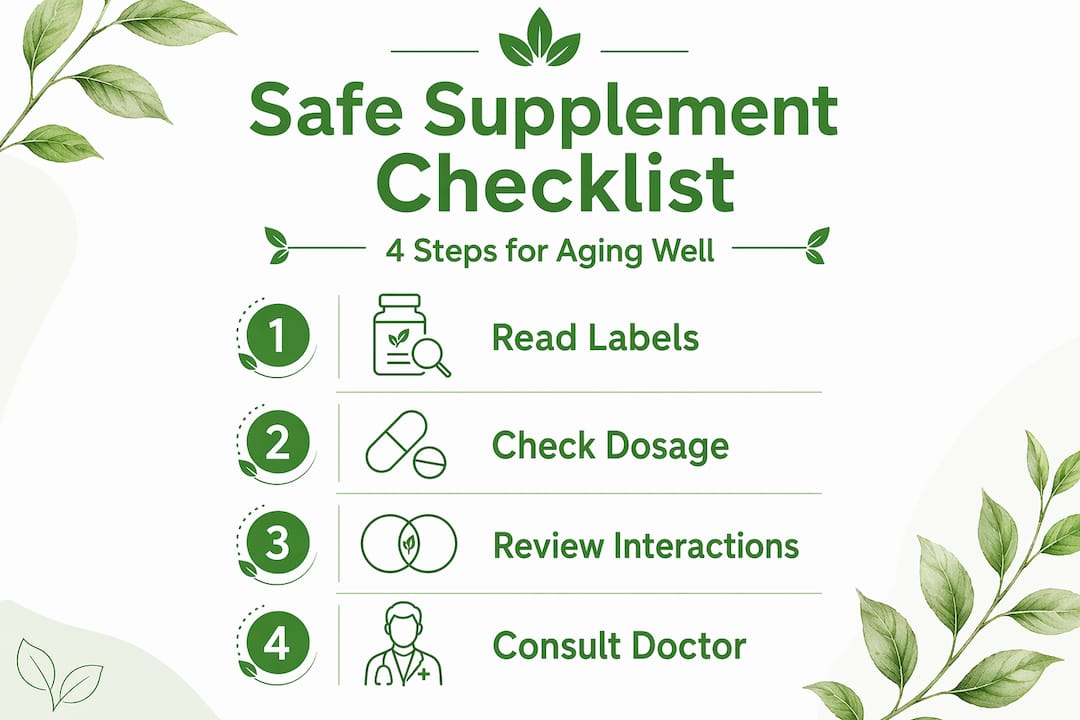
These supplement toxicity risks are documented and preventable. The key step is checking whether a supplement exceeds the Tolerable Upper Intake Level (UL) for each nutrient, particularly if you are already getting nutrients through food or other supplements.
Drug interactions are another concern. Vitamin K affects blood thinners like warfarin. St. John’s Wort, a popular botanical, interferes with dozens of medications including antidepressants and birth control. Professional guidance from a physician or registered dietitian before starting a new supplement routine is not just good advice. For people taking prescription medications, it can be genuinely critical. Blood tests can identify deficiencies before you supplement, so you’re addressing actual gaps rather than guessing.
How to choose and use anti aging supplements
Selecting the best anti aging supplements for your needs comes down to matching ingredients to your personal health goals and lifestyle. Here is a practical framework:
-
Identify your gaps first. Get basic bloodwork done to check vitamin D, B12, iron, and zinc levels before buying anything. Supplementing nutrients you already have in adequate amounts offers little benefit and adds unnecessary cost.
-
Prioritize evidence-backed ingredients. Stick to supplements with human clinical data. Simple, well-studied interventions like omega-3 fatty acids, creatine, vitamin D, and magnesium consistently outperform trendy molecules in rigorous research.
-
Choose verified quality. Look for supplements with third-party testing certificates. Nature’s Craft products, for example, are formulated with clean, quality-verified ingredients so you know what you’re actually taking.
-
Build your foundation first. No supplement overrides poor sleep, a nutrient-poor diet, or a sedentary lifestyle. Experts consistently emphasize exercise, sleep, stress management, and whole-food nutrition as the true primary drivers of healthy aging.
-
Add targeted support strategically. Once your lifestyle basics are solid, consider a focused anti aging stack. A practical starting point might include a high-quality multivitamin, vitamin D3 with K2, omega-3s, CoQ10 if you are over 40, and a collagen or biotin product for skin and hair support. Biotin is one of the most practical and well-tolerated options for skin, hair, and nail health.
-
Support your sleep. Magnesium supports deep, restorative sleep, which is when cellular repair happens. If sleep quality is an issue, magnesium is frequently the most impactful supplement you can add.
-
Reassess every 3 to 6 months. Your needs change. Retest key biomarkers and adjust accordingly rather than taking the same stack indefinitely.
Pro Tip: Vitamin D plays a role in a wide range of molecular aging pathways, yet deficiency is extremely common, especially in people over 40 who spend limited time outdoors. It is often the highest-impact single supplement you can add.
My honest take on anti aging supplements
I’ve spent years reading the research on this topic, and the pattern I keep seeing is this: the people who benefit most from anti aging supplements are the ones who treat them as finishing touches on an already solid lifestyle, not as shortcuts.
The supplement industry is genuinely good at creating excitement around molecules that look promising in a lab dish or in mice. What I’ve learned is that that excitement rarely survives contact with a well-designed human clinical trial. Resveratrol was going to change aging science. So was astaxanthin. The human data just didn’t hold up at the level the headlines implied.
What I do think works, and what I’d tell anyone I care about: affordable, evidence-backed interventions like omega-3s, creatine, vitamin D, and magnesium have the most consistent human data behind them. They’re not glamorous. They don’t come with dramatic before-and-after photos. But the research is there, and it’s repeatable.
My strongest advice is to stop chasing the newest molecule and start getting the basics right. A clean diet, regular resistance training, seven to nine hours of sleep, and a targeted supplement stack based on your actual bloodwork will outperform any trendy supplement protocol every time.
Support your aging goals with Shopnaturescraft
If you’re ready to build a supplement routine grounded in quality and real ingredients, Shopnaturescraft has been formulating clean, trusted wellness products since 2013. Every product is made with the goal of crafting perfection in every bottle, using ingredients selected for potency and purity.
For skin and hair vitality, the Biotin Supplement is a practical, well-tolerated starting point. If sleep quality is affecting your recovery and energy, Magnesium Sleeplex offers a targeted magnesium formula designed for restful nights. For anti-inflammatory botanical support, the Turmeric Gummies are an easy and enjoyable daily addition. Browse the full range at Shopnaturescraft to find the right fit for your wellness goals. Your body does the work. The right supplements help support it.
FAQ
What are anti aging supplements, exactly?
Anti aging supplements are vitamins, minerals, botanicals, and other compounds formulated to support cellular health, skin appearance, and physical vitality as you age. They work by reducing oxidative stress, supporting collagen production, and filling nutritional gaps that become more common with age.
Do anti aging supplements actually work?
Some do, for specific outcomes. A 2026 clinical trial showed that daily multivitamins measurably slowed biological aging. Results vary by ingredient, dosage, and individual health status, so evidence-backed selection matters.
What are the top anti aging vitamins to consider?
Vitamin D, vitamin C, and B vitamins are among the most well-supported for healthy aging. Vitamin D in particular affects multiple molecular aging pathways and is commonly deficient in adults over 40.
Are anti aging supplements safe to take daily?
Most are safe at recommended doses, but exceeding Tolerable Upper Intake Levels for fat-soluble vitamins and minerals can cause toxicity. Always check labels and consult a healthcare provider if you take prescription medications, as interactions are possible.
How long does it take to see results from anti aging supplements?
Timelines vary by ingredient. The synbiotic study showing improved skin elasticity saw results in 8 weeks. Epigenetic aging changes measured in multivitamin studies were tracked over years. Realistic expectation is 8 to 12 weeks for noticeable skin changes, with cellular benefits accruing over longer periods.

