


Adaptogens are natural plant compounds that help your body resist physical and mental stress by regulating the hypothalamic-pituitary-adrenal (HPA) axis. Understanding how women benefit from adaptogens starts with one key fact: women’s stress response systems are biologically distinct from men’s, making targeted adaptogen use especially effective. Clinical trials published in 2025 and 2026 show that ashwagandha (Withania somnifera) reduces cortisol by nearly 29% in adults under chronic stress. That single finding explains why adaptogens have moved from traditional Ayurvedic medicine into mainstream women’s wellness.
How women benefit from adaptogens: what the science says
The clinical evidence for adaptogens in women’s health is stronger than most people realize. Three categories of research stand out: stress and anxiety reduction, reproductive health support, and safety profiling across diverse female populations.
Ashwagandha and stress reduction
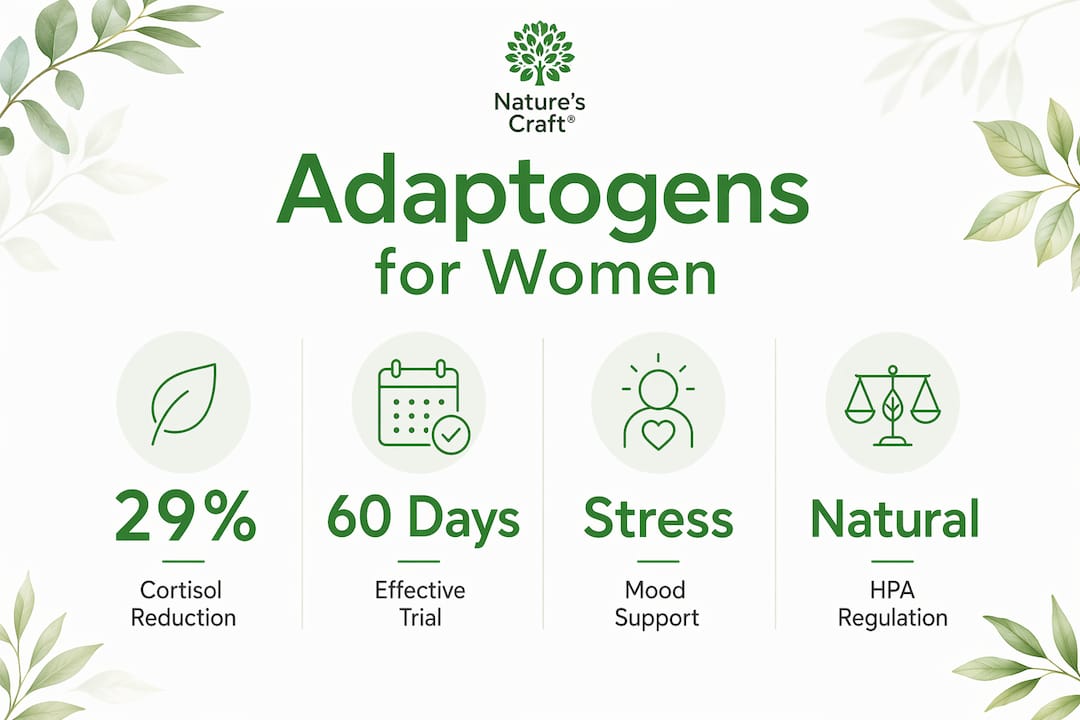
A Phase III randomized, placebo-controlled trial using 300 mg twice daily for 60 days found that HAM-A anxiety scores dropped 26.94%, GAD-7 scores fell 50.77%, and cortisol declined 28.99%. Those numbers matter because they come from a controlled clinical setting, not a wellness blog. The reductions are clinically meaningful, not just statistically significant.
Shatavari and reproductive health
Shatavari (Asparagus racemosus) is the adaptogen most studied for female-specific concerns. A 12-week randomized, double-blind, placebo-controlled trial in women with polycystic ovarian syndrome (PCOS) found that Shatavari improved endometrial thickness significantly (p=0.028) and reduced perceived stress scores by an average of 6.64 points. Improved endometrial thickness signals better uterine receptivity, which directly supports reproductive outcomes.
“Shatavari may improve follicular development, oocyte quality, and menstrual regularity through phytoestrogen activity and antioxidant effects, with RCT data showing significant follicular count decrease and endometrial thickness increase without major hormonal shifts.”
Safety profile across women
A comprehensive safety review analyzing 51 natural adaptogenic products found generally favorable safety profiles. Side effects were mild to moderate and mostly limited to gastrointestinal or dermatological issues. No serious adverse events appeared in the majority of evaluated cohorts. That safety record makes adaptogens a realistic option for long-term use in healthy, non-pregnant women.
Key benefits documented across the clinical literature include:
- Reduced anxiety and perceived stress in women with chronic stress loads
- Lower cortisol levels after consistent supplementation over 8–12 weeks
- Improved menstrual regularity and follicular health in women with PCOS
- Favorable safety profiles with no serious adverse events in most cohorts
How do adaptogens support women’s hormonal balance and mental well-being?
Adaptogens work through your neuroendocrine system, not through direct hormonal supplementation. That distinction matters more than most supplement labels suggest.
HPA axis regulation and cortisol control
The HPA axis controls your body’s stress response by releasing cortisol when you face a threat. Chronic stress keeps cortisol elevated, which disrupts sleep, mood, immune function, and reproductive hormones. Adaptogens like ashwagandha modulate HPA axis activity, bringing cortisol back toward baseline without suppressing your stress response entirely. Think of it as recalibrating a thermostat rather than turning off the heat.
What adaptogens do not do in women
A meta-analysis confirmed that ashwagandha does not significantly raise testosterone in women, unlike the effect seen in men. This is reassuring. Women seeking hormonal balance support through adaptogens get cortisol reduction and HPA regulation without unwanted androgenic effects. The benefit profile is genuinely female-specific.
Neurochemical effects on mood and sleep
Some adaptogen formulas work through GABAergic pathways, increasing the brain’s calming neurotransmitter activity for more immediate sleep and anxiety relief. Others support longer-term serotonin regulation, which stabilizes mood over weeks. Research comparing two adaptogen formulations found differential effects on mood, sleep, and stress management, confirming that not all adaptogens work the same way. Choosing the right formula depends on whether you need fast relief or sustained balance.
| Effect type | Mechanism | Timeframe |
|---|---|---|
| Immediate calm | GABAergic modulation | Days to 1–2 weeks |
| Cortisol reduction | HPA axis regulation | 4–8 weeks |
| Mood stabilization | Serotonin pathway support | 6–12 weeks |
| Reproductive support | Phytoestrogen and antioxidant activity | 8–12 weeks |
Pro Tip: If you struggle with sleep disruption alongside stress, look for adaptogen blends that combine ashwagandha with herbs known for GABAergic activity. You get both short-term sleep support and long-term cortisol control.
What are the best adaptogens for women and how should they be used safely?
Not every adaptogen suits every woman. Your health goal determines which plant to prioritize and how to use it correctly.
Top adaptogens for women’s health
-
Ashwagandha (Withania somnifera): The most clinically studied adaptogen for stress and anxiety in women. Look for standardized root extracts with a consistent withanolide concentration. Leaf extracts are less effective. Typical dose is 300–600 mg daily, taken consistently for at least 8 weeks.
-
Shatavari (Asparagus racemosus): The primary adaptogen for reproductive health. Clinical trials used standardized root extract over 12 weeks. Best suited for women managing PCOS symptoms, menstrual irregularity, or perimenopause.
-
Rhodiola rosea: Particularly effective for mental fatigue and burnout. Rhodiola works faster than ashwagandha for acute stress, making it useful during high-pressure periods at work or during seasonal stress. Learn more about Rhodiola’s clinical evidence for stress and fatigue relief.
-
Holy basil (Ocimum tenuiflorum): Supports blood sugar regulation alongside stress reduction. A good option for women whose stress response includes blood sugar swings or cortisol-driven cravings.
Dosing, timing, and what to expect
Adaptogens require several weeks of consistent intake to modulate neuroendocrine systems adequately. Acute or occasional use produces minimal benefit. Plan for a minimum 8-week trial before evaluating results. Most women notice improved sleep quality and reduced anxiety within 3–4 weeks, with cortisol-related benefits becoming measurable by week 8.
Safety considerations every woman should know
Pregnant and breastfeeding women should avoid adaptogens or use them only under strict medical supervision. Safety data during pregnancy is insufficient to establish a safe dose. Women on thyroid medication should consult a doctor before using ashwagandha, as it can influence thyroid hormone levels. Mild gastrointestinal discomfort is the most common side effect and typically resolves within the first week.
Pro Tip: Always choose supplements that use standardized root extracts and display the active compound concentration on the label. A product that lists “ashwagandha extract” without specifying withanolide percentage gives you no guarantee of therapeutic potency.
How can women integrate adaptogens into their daily wellness routine?
Consistency is the single most important factor in getting results from adaptogens. The neuroendocrine changes that reduce cortisol and stabilize mood build gradually over weeks. A sporadic approach produces little benefit.
Practical steps for building a sustainable adaptogen routine:
- Take adaptogens at the same time each day. Morning dosing with ashwagandha suits most women because it sets a calmer cortisol baseline for the day. Evening dosing works better if your primary goal is sleep quality.
- Pair with protein or healthy fat. Fat-soluble compounds in adaptogen extracts absorb better with food. A small meal or a tablespoon of nut butter is enough.
- Track your stress and sleep for the first 4 weeks. A simple daily rating from 1–10 for stress level and sleep quality gives you objective data to assess whether the formula is working.
- Combine with basic sleep hygiene. Adaptogens support your stress system but do not replace sleep. Consistent sleep and wake times amplify the cortisol-lowering effects significantly.
- Reassess at 8 and 12 weeks. If you see no change after 12 weeks, consider switching botanicals or consulting a healthcare provider to rule out underlying hormonal issues.
Women managing perimenopausal symptoms can explore perimenopause-specific formulas that combine adaptogens with additional hormonal support ingredients. The combination approach often produces better results than a single herb alone.
Key takeaways
Women benefit most from adaptogens through consistent HPA axis regulation, which reduces cortisol, stabilizes mood, and supports reproductive health over an 8–12 week period.
| Point | Details |
|---|---|
| Cortisol reduction is the core benefit | Ashwagandha reduces cortisol by nearly 29% in clinical trials over 60 days. |
| Reproductive health responds to Shatavari | A 12-week RCT showed improved endometrial thickness and reduced stress in women with PCOS. |
| Adaptogens do not raise testosterone in women | Meta-analysis confirms no significant testosterone change, making them safe for female hormonal balance. |
| Consistency over 8–12 weeks is required | Neuroendocrine changes build gradually; occasional use produces minimal measurable benefit. |
| Pregnant women should avoid unsupervised use | Safety data during pregnancy is insufficient; always consult a doctor before starting. |
Why I think most women start adaptogens the wrong way
Most women come to adaptogens expecting fast results, the same way they expect a painkiller to work within an hour. That expectation sets them up to quit too early. The research is clear: gender-specific clinical trials show that dosing strategies need to account for where a woman is in her hormonal cycle and her baseline stress load. A 28-year-old managing work stress has different needs than a 50-year-old navigating perimenopause.
The second mistake I see is chasing the most popular herb rather than the most appropriate one. Ashwagandha dominates the conversation, but Shatavari is the better starting point for women whose primary concern is reproductive health or menstrual irregularity. Rhodiola is the smarter pick for women dealing with cognitive fatigue and burnout rather than chronic anxiety.
Quality sourcing is non-negotiable. A product without a standardized extract concentration on the label is not worth buying, regardless of how appealing the marketing sounds. The clinical results that make adaptogens worth discussing all come from standardized, root-based extracts at specific concentrations.
The most promising direction in this field is personalized adaptogen protocols based on hormonal phase and stress phenotype. That research is still developing, but it confirms what practitioners already know: one formula does not work for every woman. Start with the herb that matches your primary symptom, give it 12 weeks, and adjust from there.
— SuperNatural
Shopnaturescraft adaptogen supplements for women
Shopnaturescraft has been formulating clean, standardized supplements since 2013, with a product line built around the same quality principles the clinical research demands.
The Adaptogen Blend from Shopnaturescraft combines multiple botanicals for sustained neuroendocrine support, making it a practical starting point for women new to adaptogens. For women managing perimenopausal or menopausal symptoms, the Menopause Support formula pairs adaptogenic herbs with targeted hormonal support ingredients. Every product uses standardized extracts and clearly labeled active compound concentrations. Browse the full range of natural supplements at Shopnaturescraft to find the formula that fits your current health goals.
FAQ
What are adaptogens and why do women use them?
Adaptogens are plant-based compounds that help the body regulate its stress response through the HPA axis. Women use them primarily to reduce cortisol, support hormonal balance, and improve mood and sleep quality.
How long does it take for adaptogens to work in women?
Most women notice improved sleep and reduced anxiety within 3–4 weeks, with measurable cortisol reduction typically occurring by week 8 of consistent daily use.
Can adaptogens help with PCOS symptoms?
Clinical trial data shows that standardized Shatavari root extract improves endometrial thickness and reduces perceived stress in women with PCOS after 12 weeks of use.
Do adaptogens affect women’s hormones the same way they affect men’s?
No. Meta-analysis confirms that ashwagandha does not significantly raise testosterone in women, unlike the effect seen in men, making it safe for female hormonal balance without androgenic side effects.
Are adaptogens safe during pregnancy?
Pregnant and breastfeeding women should avoid adaptogens or use them only under strict medical supervision, as current safety data is insufficient to establish a safe dose during pregnancy.

