

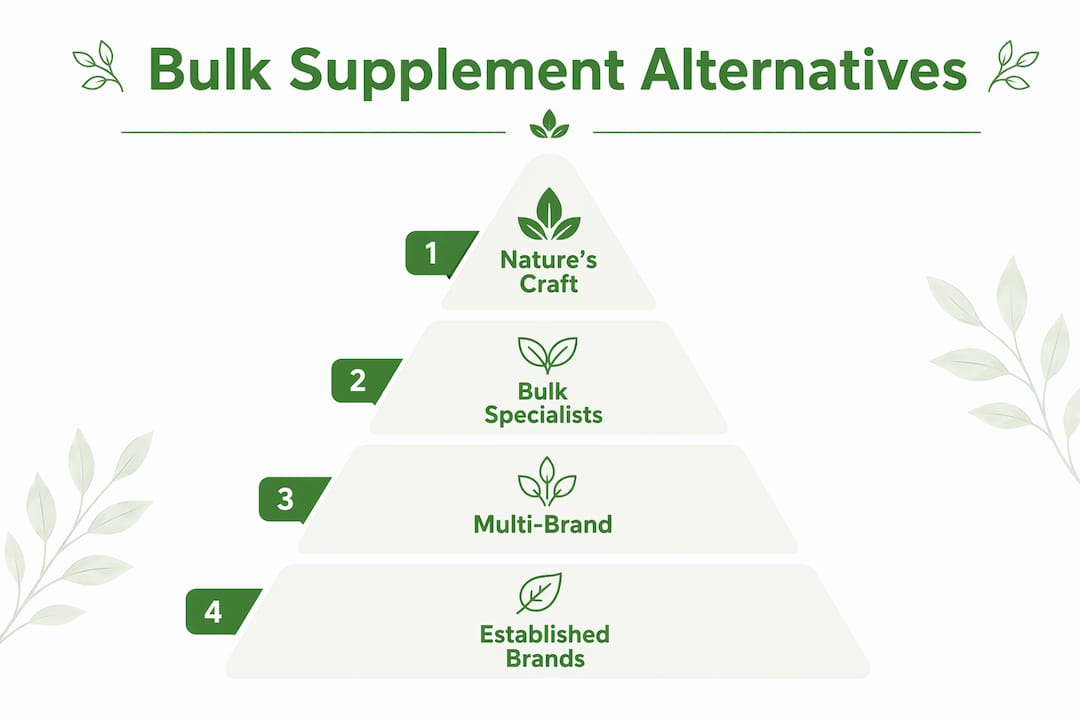
For shoppers who want a branded, lab-verified option, Nature’s Craft is the recommended direct alternative to BulkSupplements.com. If you’re comparing bulksupplements.com alternatives more broadly, three categories cover most shopper needs: branded direct-to-consumer (DTC) sellers like Nature’s Craft, bulk-ingredient specialists for the lowest per-gram cost, and multi-brand marketplaces for the widest product variety.
Before you click “buy” on any site, check three things immediately: batch-specific Certificates of Analysis (COAs), NSF or GMP manufacturing certifications, and independent testing references such as ConsumerLab summaries. Those three signals separate trustworthy sellers from ones that rely on marketing language alone.
| Seller Category | Best For | Key Trust Signal |
|---|---|---|
| Nature’s Craft (branded DTC) | Lab-verified finished formats | Lab-verified ingredients, clear labeling |
| Bulk-ingredient specialists | Lowest per-gram cost | COA on request; verify before buying |
| Multi-brand marketplaces | Widest variety | User reviews; COA access varies by seller |
| Established branded manufacturers | Quality assurance, finished formulas | Public batch testing portals (sometimes) |
Table of Contents
- How do the top alternatives to BulkSupplements.com compare?
- Which alternative is right for your buying style?
- How to choose the right bulk-supplement website
- What do lab tests, COAs, and regulatory claims actually mean?
- What do user reviews say about these sellers?
- What payment options and financing do supplement sites offer?
- Loyalty programs and rewards beyond subscriptions
- Key Takeaways
- Why Nature’s Craft makes sense for most buyers
- Nature’s Craft: a direct, lab-verified alternative worth trying
- Useful sources for your own verification
- FAQ
How do the top alternatives to BulkSupplements.com compare?
The table below maps each seller category against the dimensions that matter most when you’re switching from BulkSupplements.com.

| Dimension | Nature’s Craft (Branded DTC) | Bulk-Ingredient Specialists | Multi-Brand Marketplaces | Established Branded Manufacturers |
|---|---|---|---|---|
| Best for | Finished formats, transparency | Lowest unit cost, DIY stacking | Variety, convenience | Quality assurance, finished formulas |
| Pack sizes | Single-serve to multi-pack | Grams to kilograms | Varies by seller | Single-serve to mid-size |
| Price shape | Per-serving; mid-range | Per-100g; lowest | Mixed | Per-serving; premium |
| COA access | Lab-verified; accessible | On request; variable | Inconsistent | Public portals (select brands) |
| Manufacturing certs | GMP; non-GMO, lab-verified | NSF GMP (facility-level) | Varies | NSF/USP (facility + some products) |
| Shipping threshold | Listed on site | Often free above a minimum | Varies by platform | Varies |
| Subscription/discount | Available | Rare | Platform-dependent | Brand-specific |
| Made-in-USA/sourcing | U.S. manufacturing; non-GMO ingredients | U.S. packaging; global ingredient sourcing common | Varies | U.S. manufacturing common |
| Returns & service | Clear policy; responsive | Mixed responsiveness | Platform-governed | Brand-specific |

A few things stand out in this comparison. Bulk-ingredient specialists can offer very low per-100g prices, but the low-cost model typically reflects minimal branding and packaging overheads rather than a higher testing standard. Established branded manufacturers sometimes publish public batch-testing portals, but their prices reflect that investment. Nature’s Craft sits in the middle: finished consumer formats at accessible prices with transparent labeling and lab-verified ingredients.
Pro Tip: Always compare price per 100g or per serving, not sticker price. A 1 kg bag looks cheap until you add shipping and factor in a COA that arrives three days after your order ships.
Which alternative is right for your buying style?
Nature’s Craft: recommended branded DTC option
Nature’s Craft sells a broad range of finished dietary supplements including capsules, gummies, softgels, and liquid drops. Products address liver support, brain health, heart health, digestive health, thyroid support, weight management, immunity, and more, all made with non-GMO, lab-verified ingredients.
- Pros: Finished consumer formats (no measuring or mixing); non-GMO, lab-verified ingredients; clear labeling; accessible customer service; transparent shipping and return policies
- Cons: Higher per-gram cost than raw bulk powders; smaller pack sizes than bulk-ingredient specialists
- Who should buy: Shoppers who want a ready-to-use supplement with clear quality documentation and don’t need kilogram quantities
Buying trigger: You want a finished product you can trust without requesting a COA before every order.
Bulk-ingredient specialists
These sellers, including the category BulkSupplements.com itself represents, focus on raw single-ingredient powders and capsules in large quantities. BulkSupplements.com, for example, was founded in 2013 under Hard Eight Nutrition LLC and ships over 8,000 orders a day from its Henderson, Nevada facility, offering a broad catalog of supplement products.
- Pros: Very low per-100g pricing; large pack sizes (grams to kilograms); wide ingredient catalog
- Cons: COAs typically available on request rather than publicly posted; mixed COA responsiveness reported; recall history worth checking; customer service quality varies
- Who should buy: DIY stackers and formulators who know exactly what they need and are comfortable requesting and interpreting COAs
Buying trigger: You’re building a custom stack and price-per-gram is your primary filter.
Multi-brand marketplaces
Platforms that aggregate many supplement brands under one roof, such as iHerb, give you access to hundreds of brands and thousands of SKUs in one checkout. User reviews are abundant, and you can compare products side by side.
- Pros: Enormous variety; user reviews help surface popular products; convenient one-stop shopping
- Cons: COA availability is inconsistent across sellers; quality varies widely by brand; you’re often buying from third-party sellers with different standards
- Who should buy: Shoppers who want to browse widely and rely on community reviews before committing to a brand
Buying trigger: You haven’t settled on a brand yet and want to read reviews across many options.
Established branded manufacturers
Companies like NOW Foods and Myprotein operate as vertically integrated manufacturers with dedicated quality labs and established testing protocols. NOW Foods, founded in 1968, tests materials and finished products for purity, potency, and contaminants and holds third-party cGMP certification.
- Pros: Established lab infrastructure; some brands publish public batch-testing portals; broad finished-product ranges
- Cons: Higher prices; smaller bulk sizes; less flexibility for custom quantities
- Who should buy: Shoppers who prioritize brand reputation and are willing to pay a premium for documented quality assurance
Buying trigger: You want a household-name brand with decades of quality history and don’t need bulk quantities.
How to choose the right bulk-supplement website
Start with your own priority. Three buyer types need different paths:
- Cost-sensitive buyers: Go to bulk-ingredient specialists. Request a COA before ordering. Compare price per 100g, not pack price, and include shipping in your math.
- Verification-sensitive buyers: Choose branded DTC sellers or established manufacturers with public COA portals. Check NSF and GMP listings for both the facility and the specific product.
- Convenience-first buyers: Use a multi-brand marketplace or a branded DTC seller with a clear return policy and fast shipping.
Once you know your priority, run through this checklist before placing any order:
- Batch-specific COA: Is it publicly posted, or do you have to request it? Public is better.
- Manufacturing certifications: Look for NSF GMP, USP, or cGMP. Confirm whether the listing covers the facility or the specific product.
- Customer service channels: Is there a phone number, email, or live chat? Test it before you need it.
- Return and refund policy: Is it clearly written, and does it cover opened products?
- Shipping thresholds and times: Calculate the true cost including shipping before comparing prices.
- Subscription or loyalty savings: Some sellers offer 10–15% off on auto-ship; factor that in.
- Payment options: Credit card, PayPal, and buy-now-pay-later options vary by seller.
Red flags to watch for: no COA access at all, vague country-of-origin language, a history of compliance notices or recalls in public records, and ingredient lists that don’t match the COA you receive. You can cross-reference reputable supplement brands using publicly available databases before you buy.
Pro Tip: When requesting a COA, ask for the lab name, ISO/IEC 17025 accreditation status, testing date, and lot number. Then match that lot number to your package label. A mismatch is a red flag worth acting on.
What do lab tests, COAs, and regulatory claims actually mean?
Here’s the most important thing to understand: “FDA-registered” does not mean FDA-approved. The FDA is clear that facility registration identifies a manufacturing location in the agency’s database. It says nothing about whether a specific product has been reviewed or endorsed by the FDA. Dietary supplements are not approved by the FDA before they go to market.
GMP and NSF certifications are more meaningful, but they have limits too. An NSF GMP listing covers facility processes such as packaging, labeling, and quality unit operations. Only a subset of finished products from a given facility may carry NSF product certification. Always search NSF’s database for both the company and the specific product you’re buying.
Independent testing tells a more complete story. ConsumerLab and similar organizations test finished products for potency, heavy metals, and microbial contamination. Their results have shown that product-level accuracy varies across suppliers and product categories, including some bulk suppliers. Passing a facility audit is not the same as passing a product-level potency test.
Batch-specific COAs are the gold standard for buyers. A public COA portal lets you verify a specific lot before you order. COA-on-request is acceptable but slower. When you receive a COA, look for potency results, heavy metals panel, and microbial testing. Confirm the lab name and accreditation, and match the lot number on the COA to the lot number on your package.
Pro Tip: For minerals and botanicals, where label accuracy has historically been less consistent, request the lot COA before ordering and cross-reference the potency result against ConsumerLab’s published limits for that ingredient.
What do user reviews say about these sellers?
Reputation across multiple platforms gives you a fuller picture than any single review site. For bulk-ingredient specialists, reviews on Amazon and the brand’s own site often highlight low prices and fast shipping as strengths. Negative reviews tend to cluster around customer service responsiveness and COA access delays. Independent reviewers have noted that some bulk suppliers carry both strong verification signals (NSF GMP facility listings, select NSF product certifications) and transparency gaps (COAs primarily on request, mixed response times).
For branded DTC sellers and established manufacturers, reviews on platforms like Trustpilot and the BBB tend to focus on product effectiveness, label accuracy, and return experience. Nature’s Craft receives positive feedback for its finished-product formats and accessible customer service. For any seller, check the BBB for complaint patterns, not just the star rating. A high volume of unresolved complaints about shipping or refunds is a more useful signal than an average score.
What payment options and financing do supplement sites offer?
Most reputable supplement websites accept major credit cards (Visa, Mastercard, American Express) and PayPal. Buy-now-pay-later services like Shop Pay Installments, Afterpay, and Klarna are increasingly common on DTC supplement storefronts, letting you split a larger order into interest-free installments. Some bulk-ingredient specialists offer net-30 or net-60 terms for business buyers purchasing at volume.
Nature’s Craft supports standard credit card payments and PayPal through its storefront. If you’re buying for a business or placing a large order, check whether the seller offers volume pricing or invoice-based terms before you check out.
Loyalty programs and rewards beyond subscriptions
Subscription discounts (typically 10–15% off per order) are the most common savings mechanism across supplement sellers. Beyond that, a growing number of DTC brands offer points-based loyalty programs where purchases, reviews, and referrals earn credits toward future orders. Some established manufacturers run tiered programs that unlock free shipping, early access to new products, or exclusive bundles at higher spend levels.
Multi-brand marketplaces often have their own rewards ecosystems. iHerb’s Rewards program, for example, lets customers earn credits on purchases and referrals. For shoppers consolidating their supplement buying to one or two sellers, these programs can meaningfully reduce the annual cost of a supplement routine. Nature’s Craft offers bundle options through its bundles page for shoppers who want to stock up across product categories at a better per-unit value.
Key Takeaways
Choosing the right bulk-supplement website comes down to matching your priorities to the seller category that delivers on them: Nature’s Craft for finished, lab-verified formats; bulk-ingredient specialists for the lowest per-gram cost with careful COA verification; and marketplaces or established manufacturers for variety or brand reputation.
| Point | Details |
|---|---|
| Nature’s Craft as DTC alternative | Recommended for shoppers who want finished, lab-verified formats with transparent labeling and accessible service. |
| Bulk specialists for cost | Offer the lowest per-gram pricing but require you to request and verify batch-specific COAs before ordering. |
| COA verification is non-negotiable | Always check for a batch-specific COA from a named, accredited lab; public portals are stronger than COA-on-request. |
| Factor in true cost | Include shipping thresholds and subscription savings in your price comparison, not just the sticker price per pack. |
| Shopnaturescraft for finished formats | Nature’s Craft at shopnaturescraft.com offers lab-verified capsules, gummies, and softgels with clear policies. |
Why Nature’s Craft makes sense for most buyers
Most shoppers switching from BulkSupplements.com aren’t actually looking for raw bulk powder. They want a supplement that works, arrives quickly, and comes with enough documentation that they don’t have to do lab research before every reorder. That’s the gap Nature’s Craft fills.
The argument for bulk-ingredient specialists is real: if you’re a DIY formulator or an athlete who goes through a kilogram of creatine every month, the per-gram savings are worth the extra verification work. But for the majority of supplement buyers, a finished capsule or gummy with clear labeling, lab-verified ingredients, and a straightforward return policy is a better daily experience than a bag of powder and a COA request form.
What often gets overlooked is the hidden cost of poor transparency. A slightly cheaper bulk product that requires three emails to get a COA, has a vague return policy, and ships from a facility with a recall history isn’t actually cheaper when you account for your time and risk. Nature’s Craft’s model, finished formats with non-GMO, lab-verified ingredients and accessible customer service, removes most of that friction. For shoppers who genuinely need the lowest per-gram cost, the comparative matrix above is the right starting point.
Nature’s Craft: a direct, lab-verified alternative worth trying
If you’ve been shopping BulkSupplements.com for raw ingredients and want a finished-product alternative with clearer quality documentation, Nature’s Craft is worth a close look. The brand offers capsules, gummies, softgels, and liquid drops across a wide range of health categories, all made with non-GMO, lab-verified ingredients and backed by transparent labeling.
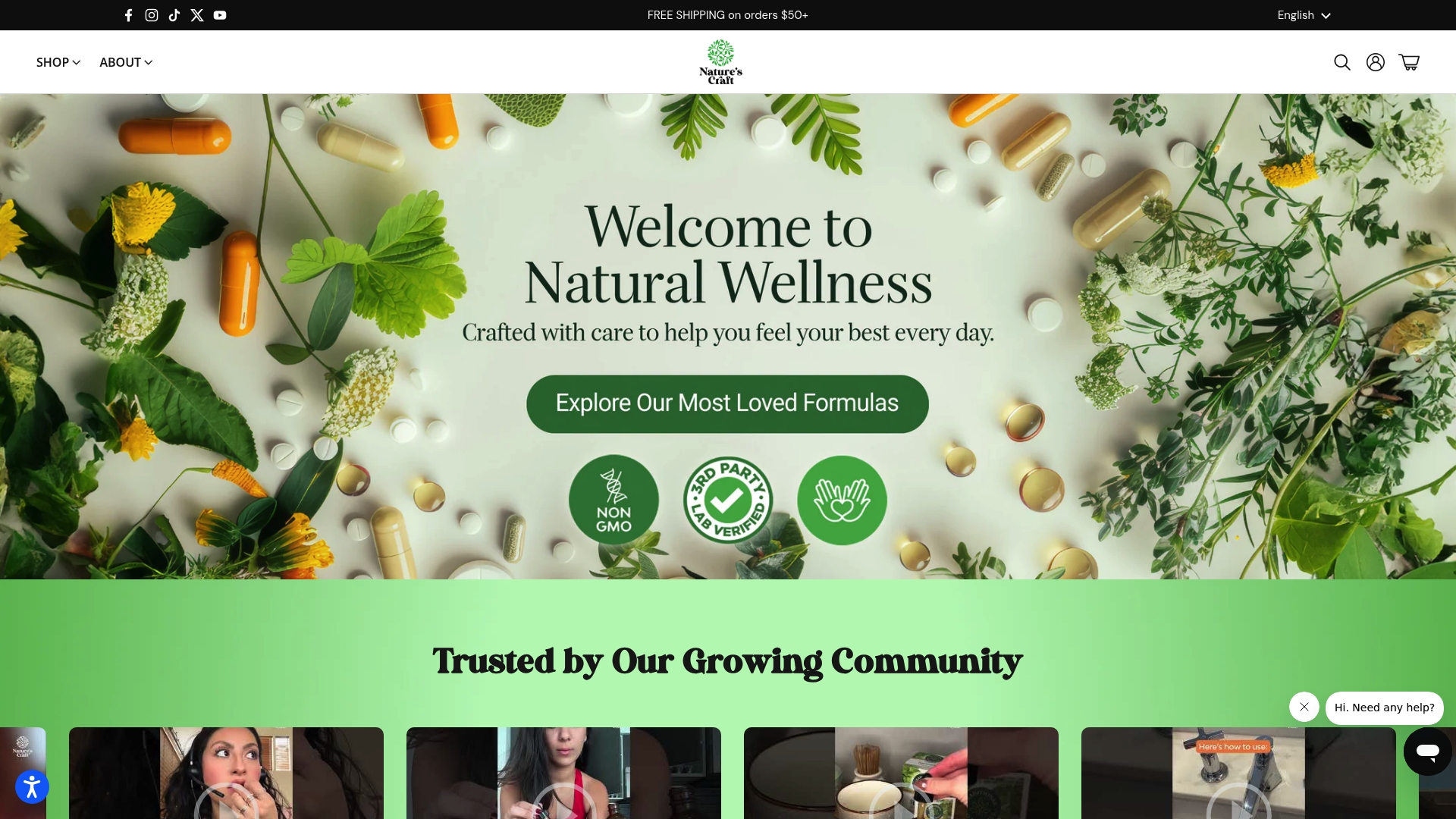
Whether you’re looking for heart health support, a daily capsule routine, or a gummy format that’s easier to stick with, the storefront covers a broad range of health concerns. Shipping policies and return terms are clearly listed, so you know what you’re getting before you check out. Visit Nature’s Craft to browse the full product range and find the format that fits your routine.
Useful sources for your own verification
These sources can help you check certifications, read independent test results, and understand what supplement labels actually mean.
- FDA: “It’s Really Not FDA-Approved” — Official FDA guidance explaining the difference between facility registration and product approval.
- NSF Certified Listings — Search for facility and product-level NSF certifications by company name.
- ConsumerLab: BulkSupplements.com Test Summaries — Independent product testing results and accuracy flags for specific SKUs.
- CTL Testing: Certificate of Analysis Guide — Explains what a COA should contain and how to interpret results.
- PMC: Dietary Supplement Quality and Adulteration — Peer-reviewed research on product-level accuracy variation across supplement suppliers.
- How to Choose Third-Party Tested Supplements — Practical guide to evaluating lab reports and what to ask sellers.
- Buying Supplements Online Safely — A broader safety checklist covering checkout, returns, and fraud avoidance.
- Identifying High Quality Supplements: A Buyer’s Guide — Covers label reading, safety signals, and quality verification for U.S. buyers.
FAQ
Is BulkSupplements.com a legitimate company?
Yes. BulkSupplements.com operates as Hard Eight Nutrition LLC, founded in 2013 and based in Henderson, Nevada, with an FDA-registered manufacturing facility. However, “FDA-registered” means the facility is listed in the FDA’s database, not that its products are FDA-approved.
What makes a supplement website trustworthy?
The strongest signals are publicly posted batch-specific COAs from an accredited third-party lab, NSF or GMP manufacturing certifications, and a clear return policy. Independent testing from organizations like ConsumerLab adds an additional layer of verification.
How are bulk supplement sites able to charge lower prices?
Lower prices at bulk-ingredient specialists typically reflect a no-frills model: minimal branding, large-quantity sales, and lower packaging overhead, not necessarily higher testing standards. Always verify COA access before assuming lower price equals equivalent quality.
Are bulk supplements made in the USA?
Many bulk suppliers manufacture and package in the U.S., but raw ingredients are often sourced internationally. “Made in USA” on packaging usually refers to the manufacturing or packaging location, not the origin of every ingredient. Check the seller’s sourcing disclosure for specifics.
Where can I find a finished-product alternative to BulkSupplements.com?
Nature’s Craft at shopnaturescraft.com offers lab-verified capsules, gummies, softgels, and liquid drops across a wide range of health categories, with transparent labeling and clear shipping and return policies.

