


Açaí entered mainstream wellness culture with an unusually impressive résumé.
The berry became associated with antioxidants, vibrant smoothie bowls, Amazonian superfoods, metabolism, cleansing, energy, and eventually weight management.
Some of those ideas begin with something measurable about the fruit.
Others make a much bigger leap.
Knowing where that line falls is useful—especially when a whole food becomes concentrated into a dietary supplement.
Start with the purple
The dark purple appearance of ripe açaí isn't merely cosmetic.
Açaí contains plant compounds called polyphenols, including anthocyanins—the pigments responsible for many of the red, blue, and purple colors found throughout the plant world.
These compounds have antioxidant activity.
In everyday terms, antioxidants can interact with reactive molecules known as free radicals. The body produces free radicals naturally, and environmental exposures can contribute additional oxidative stress.
This is one of the better-grounded reasons açaí has attracted nutritional research.
It is also much narrower than many of the promises that eventually became attached to the berry.
Antioxidant activity isn't a synonym for weight loss
This is where wellness language can become slippery.
A plant can contain antioxidants.
Researchers can study how its compounds behave in cells or in humans.
Neither fact automatically establishes that consuming a capsule will cause someone to lose body fat.
The reference article behind this topic presents açaí supplements for numerous purposes, including weight management, metabolism, immunity, cardiovascular health, digestion, skin, and cognition.
Those claims shouldn't all be treated as equally established.
Human research on açaí remains much more limited than its enormous wellness reputation might suggest. Reviews of the scientific literature have examined potential metabolic and antioxidant effects, but that is not equivalent to demonstrating a reliable weight-loss effect from açaí supplements.
That difference is easy to lose once “superfood” becomes marketing shorthand.
What changes when the fruit becomes a capsule?
A fresh fruit, a frozen açaí purée, a powder, and an extract aren't identical products.
That seems obvious, but it matters.
Whole foods bring their complete food matrix with them. Extracts concentrate selected material into a much smaller serving.
Nature’s Craft Acai Berry uses an açaí fruit 4:1 extract, providing 600 mg per capsule.
The “4:1” designation tells us that this is an extract rather than simply 600 mg of ground whole fruit.
It also means comparisons with products using different extraction ratios or whole-fruit powders deserve more care than simply lining up the milligram numbers.
Looking closely at Nature’s Craft Acai Berry
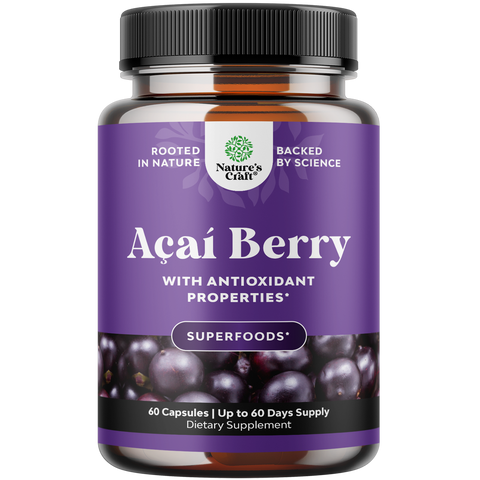
Nature’s Craft keeps this particular Supplement Facts panel simple.
The active ingredient is:
Açaí Berry (Euterpe oleracea) — 4:1 Extract (Fruit): 600 mg per capsule.
The bottle contains 60 capsules.
Nature’s Craft recommends one capsule one to two times daily, preferably with meals, or as directed by a healthcare professional.
The other listed ingredients are bovine gelatin, microcrystalline cellulose, vegetable magnesium stearate, and silicon dioxide.
This makes it a relatively uncomplicated way to add a concentrated açaí extract to a supplement regimen.
What it doesn't do is make the larger questions about weight management disappear.
The part a capsule cannot replace
Successful long-term weight management is bigger than any individual botanical.
Food intake matters.
Physical activity matters.
Sleep can influence appetite and eating behavior.
Medications, medical conditions, hormones, age, genetics, and individual circumstances can matter too.
That's why it is more useful to think of a dietary supplement as an optional addition to an overall wellness plan—not the mechanism around which the entire plan revolves.
Nature’s Craft itself places Acai Berry within its Weight Management collection.
But being sold in that category shouldn't be interpreted as evidence that swallowing açaí capsules by themselves will produce a particular amount of weight loss.
Those are two separate statements.
Curious about how actual açaí products compare?
There is another side to this topic: labels.
Extraction ratios, capsule materials, serving sizes, bottle counts, and equivalent-strength claims can make superficially similar açaí supplements surprisingly difficult to compare.
I explored that shopping problem separately here:
What Açaí Supplements Can—and Can’t—Promise About Weight Management
https://medium.com/@itsmeissa/what-a%C3%A7a%C3%AD-supplements-can-and-cant-promise-about-weight-management-5bdc61b4bc61
What the research can reasonably tell us
Açaí deserves scientific interest.
Its polyphenols and anthocyanins make it relevant to antioxidant research, and investigators continue examining possible effects involving oxidative stress and metabolic markers. A critical review of açaí research describes promising biological properties while also emphasizing the need for stronger clinical evidence.
That may sound less exciting than calling a berry a “fat burner.”
It's also more useful.
Nutrition science rarely reduces a complex outcome such as body weight to one ingredient.
Açaí doesn't need exaggerated promises to be an interesting fruit.
A better expectation for the bottle
Nature’s Craft Acai Berry provides something specific and measurable: 600 mg of 4:1 açaí fruit extract in each capsule, with straightforward directions for use.
Beyond that, expectations deserve restraint.
The berry contains compounds worth studying. Its antioxidant profile is genuinely interesting. And a concentrated extract gives consumers another way to include açaí-derived material without relying on fresh fruit availability.
None of those statements requires promising dramatic changes on the scale.
Sometimes evidence makes a wellness story less spectacular.
It can also make it much more trustworthy.

