


Your gut does far more than digest food, and if you’re a woman, that connection runs even deeper. A women’s gut health supplement is specifically designed to support the unique relationship between your digestive system, hormones, vaginal microbiome, and immune function. Many women deal with bloating, irregular digestion, recurring infections, or mood shifts tied to their cycle without realizing that the gut microbiome sits at the center of all of it. This guide breaks down exactly what these supplements contain, how they work in the female body, and how to build a routine that actually delivers results.
Table of Contents
- Key takeaways
- What women’s gut health supplements actually are
- How women’s biology changes the equation
- Choosing the right supplement: strains, doses, and forms
- Building a gut health routine that sticks
- My take on women’s gut health supplementation
- Support your gut health with Shopnaturescraft
- FAQ
Key takeaways
| Point | Details |
|---|---|
| Women’s gut health is uniquely complex | Hormones, vaginal microbiome, and mood are all directly connected to your gut bacteria. |
| Strain selection matters more than quantity | Choosing the right probiotic strains like Lactobacillus and Bifidobacterium outperforms chasing high CFU counts. |
| Consistency is non-negotiable | Taking supplements for 12 or more weeks consistently is what drives real, measurable changes. |
| Supplements complement a healthy lifestyle | Diet, fiber intake, sleep, and stress management all amplify the benefits of gut health supplements. |
| Product quality requires careful vetting | Look for truthful labeling, verified strains, and proper storage guidelines before committing to any product. |
What women’s gut health supplements actually are
The term gets used loosely, so it helps to get specific. A women’s gut health supplement is any product formulated to support the digestive tract and microbiome with ingredients shown to benefit the unique health profile of women. That includes probiotics, prebiotics, digestive enzymes, and compounds like L-glutamine.
Here is what each ingredient category does:
- Probiotics are live beneficial bacteria. The most studied strains for women include Lactobacillus acidophilus, Lactobacillus rhamnosus, and Bifidobacterium longum. These strains support digestion, compete with harmful bacteria, and directly influence vaginal and immune health.
- Prebiotics are non-digestible fibers that feed your existing good bacteria. Common examples are fructooligosaccharides (FOS) and xylooligosaccharides (XOS). Without prebiotics, probiotics have less to work with.
- Digestive enzymes help break down proteins, fats, and carbohydrates more efficiently, reducing bloating and discomfort after meals.
- L-glutamine is an amino acid that supports the integrity of the gut lining, which matters for women who deal with leaky gut or chronic inflammation.
According to current research, women’s supplements often combine these ingredients to address digestive, vaginal, and immune health together, with common dosages ranging from 1 to 50 billion CFUs depending on the health goal. Real benefits typically take at least 12 weeks of consistent use, so patience is part of the process.
Pro Tip: Take your probiotic supplement with a meal rather than on an empty stomach. Food buffers stomach acid, giving more bacteria a chance to survive the trip to your intestines.
How women’s biology changes the equation
This is where women’s digestive health solutions differ meaningfully from general gut health products. Your biology introduces variables that do not apply to men, and understanding them helps you choose more effectively.

The gut-brain axis and serotonin
Your gut produces roughly 95% of your body’s serotonin, the neurotransmitter that regulates mood, sleep, and appetite. When your gut microbiome is out of balance, serotonin production is affected. For women, this becomes especially noticeable during hormonal shifts like PMS, perimenopause, or postpartum recovery, when mood-related symptoms often spike.
The gut-to-vaginal microbiome connection
One of the most compelling and underreported mechanisms in women’s health is the gut-to-vaginal pathway. Oral Lactobacillus supplementation can colonize vaginal mucosa, directly supporting the Lactobacillus dominance that defines a healthy vaginal microbiome. Studies document measurable reductions in bacterial vaginosis recurrence and urinary tract infection frequency among women who take targeted oral probiotics. This is a benefit men simply do not have access to from the same supplement.
Hormonal influence on digestion
The table below summarizes key biological interactions that make women’s gut health uniquely complex:
| Factor | How it affects gut health | Supplement role |
|---|---|---|
| Estrogen fluctuations | Alter gut motility and microbiome composition | Probiotics help stabilize microbial balance |
| Progesterone changes | Slow digestion, increasing bloating and constipation risk | Enzymes and prebiotics support regularity |
| Serotonin production | Gut-produced serotonin affects mood during cycles | Microbiome support may ease mood-related symptoms |
| Vaginal microbiome | Dependent on Lactobacillus dominance from the gut | Oral probiotics migrate to support vaginal health |
Pro Tip: If you notice digestive symptoms like bloating or constipation worsen at specific points in your cycle, track them alongside your supplement intake. Patterns often reveal where targeted support helps most.
Choosing the right supplement: strains, doses, and forms
Knowing what to look for on a label is half the battle. The benefits of gut health supplements for women depend far more on strain specificity than on raw CFU numbers.
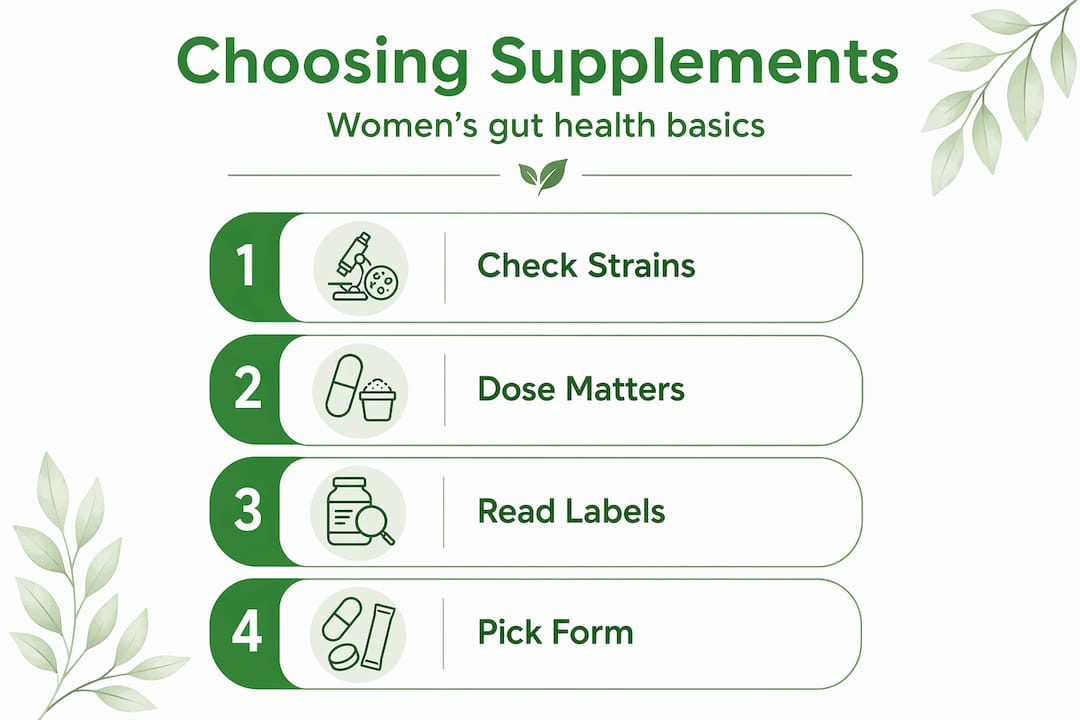
Strains worth knowing by name
Not all probiotics behave the same way. Here are the strains with the strongest evidence for women’s health:
- Lactobacillus acidophilus LA-5: supports vaginal microbiome and digestive comfort
- Lactobacillus rhamnosus GR-1 and Lactobacillus reuteri RC-14: specifically studied for reducing UTI and bacterial vaginosis recurrence
- Bifidobacterium longum: linked to reduced anxiety, better bowel regularity, and immune response
- Bifidobacterium lactis: supports gut barrier function and healthy transit time
Research confirms that strain quality and purpose matter more than chasing a high CFU count. A product with 5 billion CFUs of a clinically studied strain will outperform 50 billion CFUs of a poorly researched blend.
Supplement forms compared
| Form | Pros | Cons |
|---|---|---|
| Capsules | Precise dosing, often enteric-coated for survival | Less convenient for some routines |
| Gummies | Easy to take, enjoyable format | May contain added sugars; check strain viability |
| Fermented foods | Natural food matrix, diverse strains | Harder to standardize dosage |
| Powders | Versatile, easy to mix into food or drinks | Variable shelf stability |
One more thing to check: the label. The FDA classifies probiotic supplements as dietary supplements requiring truthful labeling and disclaimers, but no pre-market approval is required. That means quality control falls on you as the consumer. Look for products that list strains by full scientific name, guarantee CFUs at the end of shelf life (not just at manufacturing), and store products according to label recommendations.
Building a gut health routine that sticks
Choosing the right supplement is step one. Using it well is step two, and that is where most people lose traction. Here is a practical approach to building a women’s gut health supplement routine that actually holds:
-
Start with food first. Women need 25 grams of fiber daily, yet most Americans fall well short of that. Fiber feeds beneficial gut bacteria and produces short-chain fatty acids that support immune and metabolic health. Add legumes, vegetables, seeds, and whole grains before reaching for a fiber supplement.
-
Take your probiotic consistently and with meals. Taking supplements with food improves bacterial survival through stomach acid. Morning is a practical time for most women, but what matters most is picking a time you can stick to daily.
-
Layer in prebiotics. Fiber from food and prebiotic supplements work together. FOS and XOS are especially useful if your diet lacks variety in plant-based foods.
-
Manage stress actively. The gut-brain axis is a two-way street. Chronic stress degrades microbial diversity and increases intestinal permeability. Sleep, exercise, and stress reduction practices directly support your supplement’s effectiveness.
-
Give it time. Real microbiome changes take at least 12 weeks of consistent supplementation. Experts confirm that supplements work best alongside diet and lifestyle improvements, not as a replacement for them.
-
Know when to see a doctor. Persistent bloating, cramping, irregular bowel habits, or recurring infections deserve a professional evaluation. Supplements support health; they are not a diagnosis or a treatment.
My take on women’s gut health supplementation
I have followed this space for years, and the thing I keep coming back to is this: consistency beats novelty every single time. The supplement market loves a new strain, a new delivery system, a new reason to upgrade your routine. But the research does not support constant switching. What works is showing up every day with the same quality product and giving your microbiome the time it needs to respond.
The misconception I see most often is the idea that more bacteria means better results. It does not. I have seen women spend significantly more money on products with enormous CFU counts while ignoring whether the strains in the bottle have any clinical evidence behind them at all. That gap between marketing and science is where most people get lost.
What I genuinely believe is that women are underserved by generic gut health products. The female-specific probiotic mechanisms, especially the gut-to-vaginal microbiome pathway, are not a niche concern. They are core biology. When you choose a supplement built around that understanding, you are not just improving digestion. You are supporting your hormonal balance, your mood, and your resistance to infections that affect your quality of life every month.
The best advice I can give you is to stop looking for a quick fix and start treating your gut like the long-term investment it is.
— SuperNatural
Support your gut health with Shopnaturescraft
If you are ready to move from information to action, Shopnaturescraft has products built specifically for women’s digestive wellness. Since 2013, Nature’s Craft has been committed to pure, clean formulations with no unnecessary fillers and every ingredient earning its place.
Start with the digestive health collection, which features targeted probiotics, enzymes, and gut support supplements designed with women’s needs in mind. If you want to support vaginal and urinary health alongside your gut routine, the cranberry gummies work synergistically with probiotic supplements to protect against UTIs. For women looking to hit their daily fiber goals without overhauling their diet, fiber gummies offer a straightforward and enjoyable way to feed your microbiome every day. And if hormonal balance is part of your wellness picture, hormone balance gummies round out a complete daily routine. Nature’s Craft has something for every stage of your wellness journey.
FAQ
What is a women’s gut health supplement?
A women’s gut health supplement is a product containing probiotics, prebiotics, digestive enzymes, or other compounds formulated to support the female digestive system, vaginal microbiome, hormonal balance, and immune function together.
How do gut health supplements work for women?
Probiotics introduce beneficial bacteria to the gut, while prebiotics feed existing bacteria. Together they improve microbial balance, support digestion, and in women, oral probiotics can migrate to the vaginal mucosa to support Lactobacillus dominance and reduce infection risk.
What are the best probiotic strains for women’s gut health?
The most evidence-backed strains for women include Lactobacillus rhamnosus GR-1, Lactobacillus reuteri RC-14 for vaginal and urinary health, and Bifidobacterium longum for mood support and gut regularity.
How long before you see results from gut health supplements?
Most research points to 12 or more weeks of consistent daily use before meaningful microbiome changes occur. Taking your supplement with meals and maintaining a fiber-rich diet accelerates results.
Can supplements replace a healthy diet for gut health?
No. Healthcare experts consistently confirm that supplements complement rather than replace a diet rich in fiber, fermented foods, and whole plants. Think of them as a meaningful addition to solid nutrition habits, not a workaround for poor ones.

