


Creatine is often discussed as though it were a quick dose of workout fuel.
Take it before training. Get more energy. Use it up. Repeat.
That mental model is appealing because it resembles something everyone understands: filling a gas tank before a drive.
But creatine is better understood through a different analogy.
Think of a rechargeable battery.
A battery becomes useful when it maintains a charge over time. You don't expect plugging it in for a few seconds before using it to accomplish much. In the same way, creatine supplementation makes more sense when viewed as a consistent nutritional strategy rather than something that suddenly switches on before one workout.
That difference in expectations can influence everything from how people shop for creatine to how consistently they actually use it.

The “Pre-Worko![]() ut” Association Can Be Misleading
ut” Association Can Be Misleading
Walk through a sports nutrition aisle and you'll often find creatine surrounded by brightly packaged pre-workout products.
That placement creates an immediate association:
Workout product = take immediately before exercising.
Our brains are exceptionally good at making these connections.
If an energy drink is consumed before exercise and a pre-workout powder is consumed before exercise, it's natural to assume creatine follows exactly the same pattern.
But creatine has a different role.
Creatine helps support the body's phosphocreatine stores, which participate in rapidly regenerating ATP—the molecule cells use as an immediate source of energy.
That makes creatine particularly relevant to repeated, short-duration, high-intensity activity such as resistance training and sprinting.
The important distinction is that the benefit is tied to maintaining creatine availability in muscle, not creating a temporary stimulant-like surge.
Your Muscles Already Have a Creatine System
Creatine isn't something the supplement industry invented.
The human body naturally contains creatine, with most of it stored in skeletal muscle.
The body can synthesize creatine from amino acids, and smaller amounts can also come from foods—particularly meat and fish.
Inside muscle cells, some creatine exists as phosphocreatine.
When muscles need energy rapidly, phosphocreatine helps regenerate ATP from ADP.
Think of ATP as immediately spendable cellular energy.
During demanding activity, that supply is used quickly. The phosphocreatine system helps replenish it for another short burst of activity.
That is why creatine has become so closely associated with strength and high-intensity exercise.
Why the Battery Analogy Changes Consumer Expectations
Supplements are easier to sell when people expect to feel something immediately.
Caffeine provides an obvious example.
Drink coffee and you may notice its effects fairly quickly.
That experience teaches consumers to judge other performance supplements the same way:
“Did I feel it today?”
Creatine doesn't fit neatly into that expectation.
A better mental model looks like this:
| Gas-Tank Thinking | Rechargeable-Battery Thinking |
|---|---|
| Take it only when needed | Think about consistency |
| Expect an immediate effect | Support stores over time |
| Judge it workout by workout | Evaluate it as part of a training routine |
| Treat timing as everything | Make regular use the priority |
The analogy isn't biologically perfect—no analogy is—but it corrects one of the most common misunderstandings surrounding creatine.
Why People Keep Asking About Timing
Supplement timing feels important because it gives consumers something concrete to optimize.
Before training?
After training?
With breakfast?
At night?
People naturally want the "perfect" answer.
But sometimes optimizing a minor detail distracts from the bigger behavioral challenge:
remembering to take the supplement consistently.
For many people, the easiest schedule may simply be the one they'll actually maintain.
That could mean taking creatine alongside an established meal or workout routine, depending on the product directions.
Consistency isn't exciting marketing.
It is, however, much easier to build a long-term habit around.
Then There’s the Creatine Form Question
Once consumers move past timing, another decision appears.
Which creatine?
Creatine monohydrate is by far the most familiar form, but the supplement market also includes forms such as creatine hydrochloride (HCl), creatine pyruvate, and others.
Nature's Craft takes a multi-form approach with Creatine Tri-Phase.
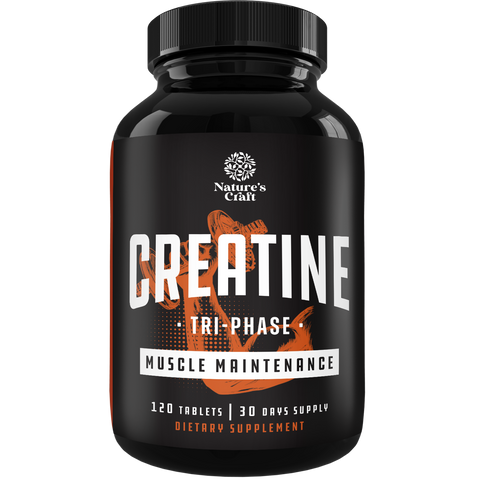
Rather than offering only one creatine source, the product combines multiple forms in a tablet-based formula designed for active adults.
That makes the product particularly interesting for an article about consumer expectations because it challenges another common assumption:
Creatine always means a scoop of white monohydrate powder.
It doesn't have to.
Nature’s Craft Creatine Tri-Phase Takes a Different Route
Nature's Craft Creatine Tri-Phase is a tablet supplement formulated for men and women interested in adding creatine to their training routine.
According to the official Nature's Craft product page, the formula uses creatine monohydrate alongside additional creatine forms, including HCl and pyruvate. Nature's Craft positions the product around muscle, training, and recovery support.
The tablet format also changes the practical experience.
There is no tub to scoop from and no powder to measure, which may appeal to people who prefer tablets or want something easier to carry.
Benefits of Nature’s Craft Creatine Tri-Phase

Nature's Craft Creatine Tri-Phase is designed to:
- Support muscle performance as part of a consistent strength or exercise program.
- Support workout energy and training capacity through creatine's role in rapid cellular energy production.
- Support muscle growth and recovery goals when combined with appropriate resistance training and nutrition.
- Provide multiple forms of creatine rather than relying on a single-form formula.
- Offer a tablet alternative to traditional creatine powders, which may be useful for people who prefer not to measure or mix a powder.
The official Nature's Craft listing currently offers 120- and 240-tablet options and identifies the product as a high-strength Tri-Phase creatine formula.
Why Convenience May Matter More Than People Admit
Consumers often say ingredients and potency drive their supplement decisions.
In practice, convenience matters too.
Imagine two routines.
Routine A: Find the tub, find the scoop, measure the powder, mix it into a drink, wash the shaker.
Routine B: Take the labeled tablet serving.
Someone who enjoys powders may have no problem with Routine A.
Someone who travels frequently or dislikes mixing powders may strongly prefer Routine B.
Neither preference determines which person is more serious about fitness.
It simply shows why format deserves a place in supplement decisions.
A theoretically ideal product that someone constantly forgets to use may be less practical for that person than a format that fits effortlessly into an existing routine.
The “More Must Be Better” Trap Shows Up Here Too
Creatine's popularity creates another predictable consumer behavior.
Once an ingredient becomes associated with performance, it's tempting to assume increasing the amount must continuously increase the benefit.
That isn't a sensible way to approach supplementation.
Product directions exist for a reason, and more isn't automatically better.
Nature's Craft provides specific use directions for Creatine Tri-Phase on its product page. Those directions—not gym anecdotes, social media challenges, or assumptions based on another creatine product—should guide how the specific supplement is used.
The company also advises consumers to follow supplement-panel directions and consult a healthcare professional when determining what's appropriate for their individual circumstances.
Frequently Asked Questions
Is creatine basically a pre-workout?
No. Creatine and stimulant-style pre-workouts serve different purposes. Creatine supports the body's creatine and phosphocreatine system involved in rapid ATP regeneration, so it is better understood as part of a consistent nutritional and training routine rather than an immediate stimulant.
What is Nature’s Craft Creatine Tri-Phase?
Nature's Craft Creatine Tri-Phase is a tablet-based creatine supplement formulated with multiple forms of creatine. The official Nature's Craft listing identifies creatine monohydrate, HCl, and pyruvate within the product description.
What are the main benefits of Nature’s Craft Creatine Tri-Phase?
Nature's Craft positions Creatine Tri-Phase for workout, muscle, and recovery support. Creatine itself is widely used in sports nutrition because of its role in rapid cellular energy availability during high-intensity activity.
Why would someone choose creatine tablets instead of powder?
Convenience and personal preference are major reasons. Tablets eliminate measuring and mixing, while some people prefer the flexibility of powders. The better format is generally the one that fits the person's routine and can be used according to its directions.
Does taking more creatine mean better results?
Not necessarily. More should not be assumed to be better. Follow the serving instructions for the specific product, and consult a healthcare professional when individual circumstances or other supplements and medications need to be considered.
Consistency Is Less Exciting Than a Shortcut—and That’s the Point
The appeal of the gas-tank idea is obvious.
Put something in.
Get something out.
Immediately.
But many wellness habits don't work according to that logic.
Creatine makes more sense when the goal shifts from finding the perfect moment to building a routine that can actually be maintained.
Nature's Craft Creatine Tri-Phase fits that philosophy by combining multiple creatine forms in a tablet format designed to become part of an established training routine.
The more useful question, then, may not be:
“When can I take creatine to feel it?”
It may simply be:
“How can I make creatine a consistent part of the training and nutrition routine I'm already following?”
A Different Way to Picture Creatine
The rechargeable-battery analogy offers another way to understand why consistency deserves more attention than chasing an immediate sensation.
MyWellnessEra explores that idea further in an educational article about how expectations can shape the way people think about creatine supplementation.
Creatine Isn’t Like Filling a Gas Tank—It’s More Like Charging a Rechargeable Battery

