

Saw palmetto has an unusual place in the supplement world.
Today, many people associate it almost exclusively with men's prostate supplements. Search its history, however, and a much broader story appears—one that begins with a small palm native to the southeastern United States, passes through traditional food and wellness practices, enters nineteenth-century American medicine, and eventually finds its way into modern supplements created specifically for women.
That history makes Nature’s Craft Women’s Saw Palmetto 500mg particularly interesting.
Its formula isn't simply a men's saw palmetto supplement with different packaging. Nature's Craft combines 500 mg of saw palmetto extract with maca root and biotin in a product positioned primarily around women's hair wellness, with additional emphasis on urinary wellness and daily vitality.
To understand why that combination exists today, it helps to go back to where the saw palmetto story began.
Long Before Capsules, There Were Berries
Saw palmetto, botanically known as Serenoa repens, is a small palm native to the southeastern United States and the West Indies. Its berries have a long history of use.
Historical accounts describe Indigenous peoples in Florida using the fruit in several ways, including as food and within traditional wellness practices. Later records describe preparations made from whole fruit, teas, aqueous extracts, and tinctures—quite different from the concentrated extracts found in today's supplement aisle.
That's an important distinction.
Modern saw palmetto capsules may trace their botanical ingredient back to the same plant, but the way that plant is prepared and consumed has changed substantially over time.
The 1800s Brought Saw Palmetto Into a New Era
Saw palmetto gradually moved from regional traditional use into broader American herbal and medical interest.
Historical reviews trace formal medical attention to the late nineteenth century, including an 1877 presentation to the Georgia Pharmaceutical Association that helped introduce saw palmetto to the American medical profession.
As interest spread, the berry began appearing in preparations associated with urinary and reproductive wellness.
Interestingly, historical records weren't limited entirely to men. Sources also document traditional use for urinary concerns in both men and women and describe historical applications connected with women's urogenital wellness.
That part of the history is often overshadowed by what happened next.
How Saw Palmetto Became Known as a “Men’s Ingredient”
During the twentieth century, saw palmetto became strongly associated with prostate wellness.
Research increasingly concentrated on its use for urinary symptoms associated with benign prostatic hyperplasia (BPH), and men's prostate formulas became one of the most recognizable places consumers encountered the ingredient.
That association became so strong that today many shoppers understandably assume:
Saw palmetto = men's supplement.
Modern evidence, however, requires some nuance. NCCIH notes that rigorous research does not support saw palmetto as an effective treatment for urinary symptoms associated with BPH, and a recent Cochrane review similarly found little to no difference in urinary symptoms compared with placebo in the studied male population.
That doesn't erase the botanical's history.
It does remind us that traditional use, modern supplement positioning, and established clinical evidence are three different things.
Then the Hair Conversation Began Growing
Saw palmetto eventually found another audience.
Hair wellness supplements began incorporating the botanical, including formulas marketed specifically toward women.
Part of the scientific interest involves saw palmetto's interaction with 5-alpha-reductase, an enzyme involved in converting testosterone to dihydrotestosterone (DHT). DHT is one of several factors involved in androgen-related hair biology.
Research into botanical approaches for women's hair loss continues, and recent scientific reviews include saw palmetto among the plant-derived ingredients being investigated. The evidence is still developing and should not be interpreted as proof that a dietary supplement will treat hair-loss disorders.
That distinction is particularly important for women experiencing sudden, severe, or unexplained hair loss, which can have many possible causes and deserves appropriate medical evaluation.
Four Products, One Pattern
The Medium article connected to today's topic looks at the modern marketplace rather than the history.
ReviveAndThrive compares four women's saw palmetto supplements and describes a pattern that became apparent while evaluating the formulas.
Four Women’s Saw Palmetto Supplements I Compared—and One Pattern Kept Appearing

That comparison offers a useful modern counterpoint to the history here: saw palmetto may be an old botanical, but the way brands formulate it specifically for women is a much newer chapter.
Nature’s Craft Adds Maca Root to the Story
Nature’s Craft Women’s Saw Palmetto 500mg isn't a single-ingredient saw palmetto capsule.
The official product description confirms that the formula combines 500 mg of saw palmetto extract with maca root and biotin.
Maca introduces an entirely different botanical tradition.
Native to the Andes, maca has become a familiar ingredient in modern women's wellness supplements. Its inclusion broadens the formula beyond saw palmetto alone and aligns with Nature's Craft's positioning around women's daily vitality as well as hair-focused wellness.
This is a modern formulation strategy: taking a botanical with a long history and pairing it with complementary ingredients selected for today's specific wellness audience.
Biotin Connects the Botanical Formula to Modern Beauty Nutrition
The third highlighted component is biotin.
Unlike saw palmetto and maca, biotin isn't an herbal ingredient. It's a water-soluble B vitamin.
Biotin has become one of the most recognizable nutrients in modern hair, skin, and nail supplements, so its inclusion changes the character of the formula again.
Nature’s Craft Women’s Saw Palmetto therefore brings together three quite different components:
| Formula Component | Its Place in the Story |
|---|---|
| Saw Palmetto Extract — 500 mg | Historic North American botanical now used in modern women's hair-wellness formulas |
| Maca Root | Andean botanical incorporated into contemporary women's wellness supplements |
| Biotin | Essential B vitamin widely recognized in modern beauty nutrition |
This is very different from the traditional whole berries, teas, and tinctures described in historical accounts.
It shows just how far saw palmetto supplementation has evolved.
Nature’s Craft Women’s Saw Palmetto 500mg Represents the Modern Chapter
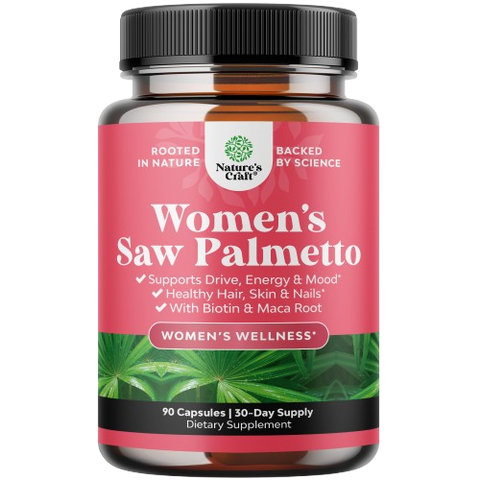
The exact product featured here is Nature’s Craft Women’s Saw Palmetto 500mg, a 90-capsule formula currently listed in Nature’s Craft's Women's Health, Capsules, and Best Sellers collections.
Nature's Craft directs adults to take three capsules daily, preferably with a meal, or as directed by a healthcare professional.
Benefits of Nature’s Craft Women’s Saw Palmetto 500mg
Based on Nature's Craft's official product positioning, the formula is designed to:
- Support healthy-looking, fuller hair from within through a women's formula built around saw palmetto extract, maca root, and biotin.
- Support women's hair thickness and appearance as part of an overall beauty and wellness routine.
- Provide 500 mg of saw palmetto extract within the complete formula.
- Combine botanical and nutritional ingredients rather than relying on saw palmetto alone.
- Complement women's urinary wellness and daily vitality, reflecting some of the broader traditional associations of saw palmetto.
Nature’s Craft identifies the product as vegan and states that its supplements are carefully blended under strict manufacturing practices and undergo third-party quality testing.
The official page also advises people who are pregnant, nursing, or taking hormone-related medications to consult a healthcare professional before use.
An Old Botanical With a Very Modern Audience
Saw palmetto's journey isn't a straight line.
It began with berries from a palm native to the southeastern United States.
It became part of traditional food and wellness practices.
By the nineteenth century, it had entered broader American herbal medicine.
During the twentieth century, prostate research made it overwhelmingly familiar as a men's supplement ingredient.
And today, formulations such as Nature’s Craft Women’s Saw Palmetto 500mg represent another chapter—one centered on women's hair and everyday wellness.
That evolution is worth remembering because supplement ingredients rarely have one fixed identity.
How they're used changes.
How they're formulated changes.
What science tells us changes.
Nature’s Craft's current formula brings saw palmetto together with maca root and biotin for a distinctly modern women's wellness product, while the history behind its central botanical stretches back far beyond the supplement aisle.

