


Focus Pep is an over-the-counter stimulant-style dietary supplement made by Addrena LLC, marketed for focus, energy, and study performance. It may suit adults who want a caffeine-based cognitive boost without a prescription, but it is not right for everyone, especially those sensitive to stimulants or taking medications.
Quick TL;DR:
- What it is: An OTC nootropic tablet with a proprietary blend verified on the NIH Dietary Supplement Label Database (DSLD), containing caffeine, guarana, bitter orange, and several cognitive support ingredients.
- Who it may help: Adults seeking a short-term energy and alertness lift for studying or work, with no stimulant sensitivities or conflicting medications.
- Main safety caution: The proprietary blend format hides per-ingredient doses, and the stimulant combination (caffeine plus bitter orange) carries real interaction risks with MAO inhibitors and other stimulants.
- Where to buy: Available at Amazon and Walmart, typically priced at $29.99 for a 60-tablet bottle from Addrena / Addrena LLC.
Table of Contents
- What does the Focus Pep label actually say?
- Breaking down the Focus Pep blend ingredient by ingredient
- How strong is the evidence for Focus Pep’s claims?
- Safety, side effects, and drug interactions you should know
- Dosage, bottle size, price, and where to buy Focus Pep
- What customers actually report about Focus Pep
- Is Focus Pep anything like Adderall or prescription stimulants?
- How to read nootropic labels and what dosing benchmarks actually mean
- Key Takeaways
- An honest look at what Focus Pep gets right and where it falls short
- Nature’s Craft supplements for shoppers who want full label transparency
- FAQ
What does the Focus Pep label actually say?
The official label record on the NIH DSLD is the most reliable source for Focus Pep’s Supplement Facts. Here is what one tablet delivers:
| Nutrient / Ingredient | Amount per Serving | % Daily Value |
|---|---|---|
| Niacin | 1.5 mg | 9% DV |
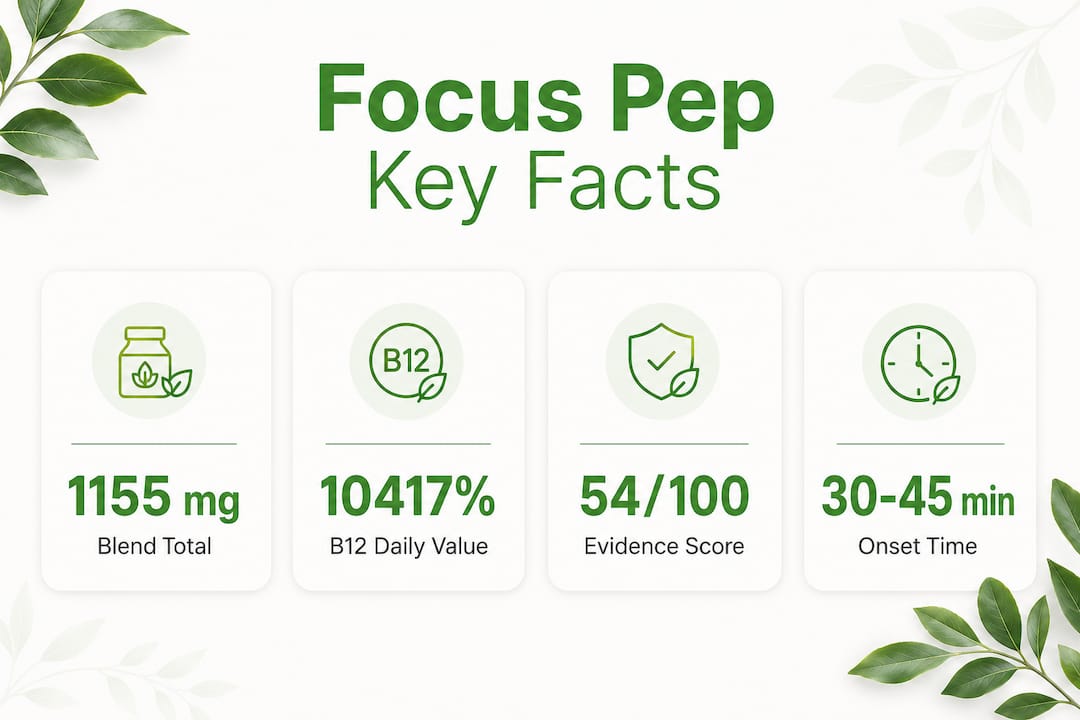
| Vitamin B12 | 250 mcg | 10,417% DV |
| Choline (as choline bitartrate) | 50 mg | 9% DV |
| Focus Pep Blend (proprietary) | 1,155.1 mg (proprietary blend of multiple ingredients) | † |
† Daily Value not established.
Manufacturer and label details:
- Brand / Manufacturer: Addrena / Addrena LLC
- Net contents: 60 tablets per bottle
- Serving size: 1 tablet (label suggests starting with half a tablet)
- Label warnings: Not for use by anyone under 18; not for pregnant or nursing women; consult a healthcare professional if you have a pre-existing medical condition; do not mix with other stimulants or MAO inhibitors; do not take within 4 hours of bedtime.
The Vitamin B12 figure stands out immediately: 10,417% of the Daily Value per tablet. B12 is water-soluble, so excess is excreted rather than stored, but that number can give a misleading impression of overall potency. The active work in this formula is done by the 1,155.1 mg proprietary blend, not the micronutrients. You can read more about B12 and cognitive clarity to understand what that nutrient actually contributes to focus.
Breaking down the Focus Pep blend ingredient by ingredient
The proprietary Focus Pep Blend total is 1,155.1 mg per tablet, but the label does not disclose how many milligrams of each ingredient it contains. Based on the NIH DSLD label and independent review analysis, the blend includes:
- Guarana seed extract: A natural caffeine source; adds to total stimulant load and may extend the energy curve beyond plain caffeine.
- Bitter orange (Citrus aurantium) extract: Contains synephrine, a stimulant compound. Combined with caffeine, it raises heart rate and blood pressure more than either ingredient alone.
- Caffeine anhydrous: The primary driver of alertness and concentration in most stimulant-style nootropics; well-studied at doses of 100–200 mg.
- Huperzine A: An acetylcholinesterase inhibitor that may support memory and learning at doses around 50–200 mcg; exact dose here is unknown.
- L-phenylalanine: An amino acid precursor to dopamine and norepinephrine; may support mood and motivation, though effects depend heavily on dose.
- L-theanine: Often paired with caffeine to smooth out jitteriness; typically effective at 100–200 mg alongside caffeine.
- Chocolate bean extract (Theobroma cacao): Contains theobromine and small amounts of caffeine; adds mild stimulant activity and mood support.
- Choline bitartrate: Supports acetylcholine production; the 50 mg listed outside the blend is low relative to doses used in cognitive research.
The stimulant trio of caffeine anhydrous, guarana, and bitter orange is almost certainly the functional core of this formula. Theanine, phenylalanine, and huperzine A are plausible cognitive supporters, but without per-ingredient disclosure, you cannot confirm whether they are present at meaningful doses.
Pro Tip: When evaluating any supplement with a proprietary blend, check whether the total blend weight is large enough to contain effective doses of all listed ingredients. A 1,155.1 mg blend split across eight or more ingredients means some components may be present at only trace levels.

How strong is the evidence for Focus Pep’s claims?
Focus Pep is marketed as an OTC stimulant for study, energy, and focus. The claims are plausible for the stimulant portion of the formula, but the picture gets murkier for the nootropic ingredients.
Caffeine has solid, well-replicated support for short-term alertness and concentration. Bitter orange/synephrine has moderate evidence for energy expenditure. L-theanine paired with caffeine has good support for reducing jitter while preserving alertness. Those three together form a credible stimulant-plus-smoothing stack, assuming they are present at effective doses.
The nootropic claims are harder to verify. Huperzine A, L-phenylalanine, and choline bitartrate all have research behind them, but dose matters enormously. Choline bitartrate at 50 mg is well below the amounts used in most cognitive trials. Huperzine A at an undisclosed dose could be anywhere from effective to negligible. The BrainReference review flags this directly, noting that the 1,155.1 mg proprietary blend obscures whether these ingredients are present at levels that would actually move the needle.
Independent analysis on Focus Pep’s formula: “The formula reads like a stimulant-driven performance stack. Caffeine, bitter orange, and guarana are likely the primary drivers of any perceived effect, while mood or nootropic components may be underdosed due to the proprietary blend format.” — BrainReference
The Supplement Ratings assigns Focus Pep a score of 54 out of 100, citing dosing transparency and limited evidence for some claims as the main drawbacks. That mid-range score reflects a product that likely works as a stimulant but falls short as a full-spectrum nootropic. For a broader look at what the science actually supports for cognitive supplements, the Nature’s Craft overview of cognitive function supplements is a useful reference.
Safety, side effects, and drug interactions you should know
Focus Pep carries a stimulant profile that demands real caution. The label warnings on NIH DSLD are explicit, and they are worth taking seriously.
Common side effects to expect or watch for:
- Increased heart rate and blood pressure (from caffeine plus synephrine)
- Jitteriness or anxiety, especially at full-tablet doses
- Sleep disruption if taken too late in the day (label says avoid within 4 hours of bedtime)
- Nausea or stomach discomfort, particularly on an empty stomach
- Headache during or after the stimulant window
Drug interaction categories to discuss with your doctor:
- MAO inhibitors: Combining synephrine or phenylalanine with MAOIs can cause dangerous blood pressure spikes.
- Other stimulants: Stacking Focus Pep with pre-workout supplements, energy drinks, or other caffeine sources multiplies stimulant load unpredictably.
- Antidepressants (SSRIs, SNRIs): L-phenylalanine may interact with serotonin-affecting medications.
- Blood pressure medications: The caffeine-plus-synephrine combination can counteract antihypertensive drugs.
The label is clear: not for anyone under 18, not for pregnant or nursing women, and not for people with cardiovascular conditions, thyroid disorders, or psychiatric conditions without medical clearance. If you are managing any of those conditions, check the heart health collection for gentler options and talk to your clinician first.
This article is general information, not medical advice. Consult a healthcare professional before starting any new supplement, especially if you take prescription medications.

Dosage, bottle size, price, and where to buy Focus Pep
The label recommends starting with half a tablet to assess your tolerance before moving to a full tablet. The maximum is 2 tablets per day, and you should not take it within 4 hours of bedtime.
Bottle contents and price:
- 60 tablets per bottle
- The label suggests taking half a tablet to start, with a maximum of 2 tablets per day, so the bottle can last for varying durations depending on dose.
- Typical retail price is around $30 for a 60-tablet bottle.
Where to buy in the U.S.:
- Amazon: Listed as an OTC stimulant supplement; customer reviews and Q&A are available on the Amazon product page.
- Walmart: Available online at the standard $29.99 price point.
- Other online retailers: Various third-party supplement stores carry it.
Return policies: Return and money-back terms vary by retailer. Amazon’s standard return window applies to most supplement purchases, but opened bottles may not qualify for a full refund depending on the seller. Walmart’s online return policy similarly varies by seller type. Always check the specific seller’s return terms before purchasing, and buying supplements online safely is worth reviewing before you check out.
What customers actually report about Focus Pep
User reviews on Amazon and Walmart paint a consistent picture: this supplement works as a stimulant for most users, but individual tolerance varies widely.
What users commonly praise:
- Noticeable onset of energy and alertness, typically within 30–45 minutes of taking it
- Cleaner, more sustained focus compared to a single cup of coffee for some users
- Affordable price relative to other OTC nootropics
- Useful for study sessions, early morning work, or pre-workout energy
What users commonly complain about:
- Jitteriness or a “wired” feeling, especially at full-tablet doses
- Sleep disruption when taken in the afternoon
- Inconsistent strength across users; some feel very little at one tablet, others feel too much
- A few users report nausea, particularly on an empty stomach
The 30–45 minute onset window is the most consistently reported detail across reviews. Experienced users often settle on half a tablet to one tablet, building up only after confirming their tolerance. Some report taking 2 tablets after extended use, though the label caps it there.
Mixed experiences are normal with stimulant-style nootropics. Individual caffeine metabolism, body weight, and sensitivity to synephrine all affect how the same dose feels from one person to the next. That variability is worth keeping in mind before you decide on a dose.
Is Focus Pep anything like Adderall or prescription stimulants?
No. Focus Pep is not a prescription stimulant, and it is not a substitute for prescription ADHD medications. Here is how the two categories differ:
- Regulatory status: Focus Pep is a dietary supplement regulated by the FDA under DSHEA, not a controlled substance. Adderall is a Schedule II controlled substance requiring a prescription and a diagnosis.
- Active compounds: Prescription amphetamine-based medications contain pharmaceutical-grade amphetamine salts at precisely measured doses. Focus Pep contains botanical stimulants (caffeine, synephrine, guarana) with no disclosed per-ingredient amounts.
- Clinical evidence: Prescription ADHD medications have extensive clinical trial data for specific diagnoses. Focus Pep has no clinical trials; its ingredient-level evidence is indirect and dose-dependent.
- Dosing control: A prescription stimulant is dispensed at a specific, physician-determined dose. Focus Pep’s proprietary blend means you cannot know exactly how much of any stimulant you are taking per tablet.
- Medical oversight: Prescription stimulants are monitored by a prescribing clinician. OTC supplements are self-managed.
If you are considering Focus Pep as a replacement for a prescription medication, please talk to your doctor first. Stopping or substituting a prescribed medication without medical guidance can have serious consequences.
How to read nootropic labels and what dosing benchmarks actually mean
Understanding a few reference points helps you evaluate Focus Pep’s label, or any nootropic label, more clearly.
Practical dosing benchmarks from cognitive research:
- Caffeine: 100–200 mg is the well-studied range for alertness and reaction time. Most standard cups of coffee contain roughly 80–100 mg.
- L-theanine: 100–200 mg paired with caffeine is the commonly studied ratio for reducing jitter while preserving focus.
- Choline bitartrate: Research trials often use 500–1,000 mg or more. The 50 mg in Focus Pep’s listed choline is well below that range.
- Huperzine A: Effective doses in studies typically fall between 50–200 mcg. Because it is inside the proprietary blend, the actual amount is unknown.
- Bitter orange (synephrine): Studies use a wide range; the concern is less about efficacy and more about cardiovascular safety when combined with caffeine.
Pro Tip: When comparing nootropic labels, look for three things: (1) per-ingredient mg values rather than a single blend total, (2) the specific form of each nutrient (choline bitartrate vs. CDP-choline or alpha-GPC, for example), and (3) whether the %DV figures reflect genuinely active ingredients or just high-dose water-soluble vitamins like B12.
If you want stronger choline support, look for products listing CDP-choline or alpha-GPC at 250–600 mg per serving. If you want stimulant-free cognitive support, look for labels that feature bacopa monnieri, lion’s mane mushroom, or phosphatidylserine at disclosed doses. The guide to natural ingredients in supplements covers how to interpret botanical extracts and what standardization percentages mean on a label.
Key Takeaways
Focus Pep is a stimulant-driven OTC nootropic with a 1,155.1 mg proprietary blend; it may deliver short-term energy and alertness, but the hidden per-ingredient doses and stimulant combination make it unsuitable for everyone.
| Point | Details |
|---|---|
| Stimulant-first formula | Caffeine, guarana, and bitter orange are the likely primary drivers; nootropic ingredients may be underdosed. |
| Proprietary blend limits transparency | The 1,155.1 mg blend total hides per-ingredient amounts, making dose-to-effect assessment difficult. |
| Safety cautions are real | Avoid if under 18, pregnant, on MAO inhibitors, or sensitive to stimulants; do not take within 4 hours of bedtime. |
| Price and availability | $29.99 for 60 tablets at Amazon and Walmart; start with half a tablet to assess your tolerance. |
| Shopnaturescraft alternative | Shopnaturescraft offers lab-verified supplements with fully disclosed ingredient amounts for shoppers who want transparent labeling. |
An honest look at what Focus Pep gets right and where it falls short
The supplement market is full of products that dress up a caffeine-and-synephrine stack with a long ingredient list and a nootropic label. Focus Pep is reasonably honest about what it is: an OTC stimulant supplement. The marketing copy does not pretend it is a pharmaceutical, and the price is fair for what you get.
What bothers me about this category is the proprietary blend convention. A 1,155.1 mg blend split across eight or more ingredients is not inherently deceptive, but it does leave you guessing about whether the theanine is at 200 mg (where it smooths out caffeine) or 20 mg (where it does almost nothing). That uncertainty matters most for ingredients that have narrow effective dose windows, like huperzine A. You could be getting a genuinely useful amount, or you could be getting a label decoration.
The very high B12 percentage, 10,417% of the Daily Value, is a good example of a number that looks impressive but tells you little about cognitive performance. B12 supports energy metabolism and nerve function, and it is worth understanding what it actually contributes, but it is not the reason anyone feels focused 40 minutes after taking this tablet. The stimulants are doing that work.
For shoppers who want to increase focus and improve mental clarity without the guesswork, the better move is to look for products that list every ingredient with its exact milligram amount. That standard is not universal in the supplement industry, but it is achievable, and it is what separates a product you can evaluate from one you are just trusting.
Nature’s Craft supplements for shoppers who want full label transparency
If you have read this far and the proprietary blend format gives you pause, Shopnaturescraft is worth a look. Every product in the Nature’s Craft line is made with non-GMO, lab-verified ingredients, and the label shows you exactly what you are getting per serving, no hidden blend totals.

Nature’s Craft carries a full range of capsule-format supplements covering brain health, energy, and overall wellness, all with the kind of ingredient transparency that makes it easy to compare what you are buying against the research benchmarks covered above. If you are building a focus and energy stack and want to know precisely what is in each capsule, that is the practical advantage of choosing a brand that publishes its full Supplement Facts without proprietary blend shortcuts. Browse the Nature’s Craft storefront to find the right fit for your wellness goals.
FAQ
What is Focus Pep?
Focus Pep is an over-the-counter dietary supplement made by Addrena LLC, formulated with a 1,155.1 mg proprietary blend of stimulant and nootropic ingredients including caffeine, guarana, bitter orange, and huperzine A, intended to support focus and energy.
What is the Joe Rogan focus pill?
The supplement most commonly associated with that reference is Alpha Brain by Onnit, not Focus Pep. Focus Pep is a separate OTC stimulant-style nootropic made by Addrena LLC.
Is there an over-the-counter Adderall at Walmart?
No OTC supplement is equivalent to Adderall. Focus Pep is available at Walmart and is marketed for focus and energy, but it contains botanical stimulants, not amphetamine salts, and it is not a substitute for prescription ADHD medication.
What pill helps you stay focused without a prescription?
OTC options like Focus Pep use caffeine, guarana, and bitter orange to support short-term alertness. Effectiveness varies by individual tolerance, and stimulant-sensitive users may find gentler, fully disclosed formulas more suitable.
How long does it take for Focus Pep to work?
Customer reviews consistently report a noticeable onset of energy and alertness within 30–45 minutes of taking the tablet, though individual response varies based on caffeine sensitivity and whether it is taken with food.

