


A knee has an unusual assignment.
It needs enough freedom to bend while walking, climbing stairs, sitting down, or getting out of a car.
At the same time, it needs enough stability to support the body while all of that movement happens.
Shoulders, hips, ankles, fingers, and other joints perform their own versions of the same balancing act.
Move without becoming unstable. Carry load without becoming rigid. Absorb force and still be ready for whatever comes next.
Joint wellness exists somewhere inside that balance.
Movement Requires More Than Two Bones
A joint isn't simply the point where bones meet.
Cartilage helps create smooth surfaces at the ends of bones. Ligaments connect bone to bone. Tendons connect muscle to bone. Muscles generate and control movement, while synovial fluid contributes to lubrication within many joints.
All of those structures have different jobs.
Strong muscles can help control movement around a joint. Connective tissues help organize that movement. Cartilage contributes to smooth motion and the handling of mechanical forces.
The result is something we usually don't notice until movement becomes uncomfortable:
A joint is a coordinated system.
Flexibility Needs an Opposite
Flexibility usually sounds universally positive.
But imagine a knee that could move freely without enough control to keep it stable.
That wouldn't be useful flexibility.
The body continually balances mobility with stability.
A squat demonstrates both at once. The hips, knees, and ankles move through changing angles while muscles control the body's position and load.
Walking involves the same principle on a smaller scale with every step.
Even typing asks the joints of the fingers and wrists to repeat controlled movements hundreds or thousands of times.
The goal isn't maximum movement.
It's functional movement.
MSM Enters a Much Larger Picture
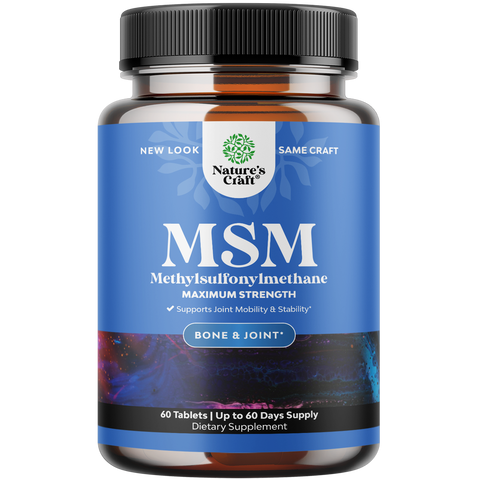
Nature’s Craft MSM takes a focused approach to joint supplementation.
The formula centers on 1,000 mg of methylsulfonylmethane (MSM), a sulfur-containing compound that has become familiar in supplements for joints and connective tissue. Nature’s Craft currently positions the product around joint support, mobility, and flexibility.
The suggested use is one tablet one to three times daily, preferably with meals, or as directed by a healthcare professional.
That's the nutritional part of the story.
The mechanical part remains much larger.
MSM doesn't replace muscle strength. It doesn't provide cartilage with immunity from wear. And it doesn't eliminate the need to understand why a joint hurts.
A supplement and a functioning joint occupy very different roles.
Strength Changes What Joints Have to Manage

Muscles deserve more attention in conversations about joint wellness.
They generate movement, but they also help control it.
Appropriate resistance training can build muscular strength. Regular physical activity helps maintain movement capacity. Gradually increasing activity gives the body time to adapt rather than suddenly asking joints and surrounding tissues to tolerate much larger workloads.
Recovery matters too.
So does nutrition.
Adequate protein, vitamins, minerals, and overall energy intake help support the tissues involved in movement.
That makes joint wellness less like finding one perfect ingredient and more like maintaining an entire movement system.
For anyone deciding between a focused MSM supplement and broader joint formulas, I Went Looking for a Joint Formula. The Shorter Ingredient List Kept My Attention. takes a closer look at those formulation choices.
https://medium.com/@HealthJourneyDaily/i-went-looking-for-a-joint-formula-the-shorter-ingredient-list-kept-my-attention-11e2062eb4f3
Comfort and Pain Aren't the Same Conversation
There is a point where shopping for joint support stops being the useful next step.
Persistent swelling, significant pain, warmth or redness around a joint, locking, instability, an injury, or a major change in mobility deserves appropriate evaluation.
Research on MSM also deserves realistic interpretation.
Some clinical trials have reported improvements in selected measures of knee discomfort or function, while systematic reviews have found the evidence mixed and insufficient for definitive conclusions.
That's why Nature’s Craft MSM is best understood as a joint-support supplement, not a treatment for arthritis or an unexplained joint problem.
The Balance Changes With Us
What joints are asked to do at 25 may look very different at 45 or 70.
Activity changes.
Muscle strength can change.
Old injuries may become relevant.
Occupation, training habits, body weight, recovery, and overall health all influence the forces joints manage every day.
For one person, supporting joint wellness may mean building strength.
For another, it may mean maintaining regular movement.
Someone recovering from an injury may need rehabilitation and professional guidance.
And someone choosing a supplement may prefer a focused ingredient such as Nature’s Craft MSM rather than a large multi-ingredient blend.
There isn't one action responsible for healthy movement.
There is an ongoing balance between mobility, stability, strength, recovery, and the nutritional support surrounding them.
That balance is what keeps movement useful.

