


Parents can spend a surprising amount of time researching children's supplements.
They compare ingredients. Read reviews. Look at serving sizes. Search for recommendations. Open ten browser tabs and eventually narrow the choices down to two or three products that all seem perfectly reasonable.
Then comes the part that's easy to overlook:
Will the child actually take it?
When choosing an omega-3 supplement for kids, the technically impressive option isn't always the most practical one. Taste, texture, format, and how easily the supplement fits into family life can influence whether that carefully researched bottle becomes a daily habit—or sits untouched in the cabinet.
That's where the psychology behind supplement choices gets interesting.
One Question That Can Simplify the Decision
There's another useful perspective on this exact decision from GlowUpJourney1.
In “Which Omega-3 Supplement for Kids Makes the Most Sense? It Depends on One Simple Question,” the author explores how one practical consideration can make choosing between children's omega-3 products much less complicated.
It's a useful follow-up for parents who want to think beyond simply asking which product looks best on paper.
Which Omega-3 Supplement for Kids Makes the Most Sense? It Depends on One Simple Question
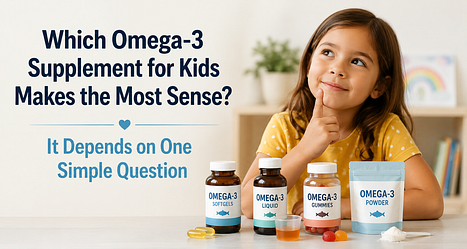
Parents Shop for the Ideal Routine. Kids Live in the Real One.
There's often a gap between the supplement routine parents imagine and what happens on a busy Tuesday morning.
The imagined version looks something like this:
Breakfast is ready.
Everyone sits down.
The child happily takes their supplement.
Nobody is late.
The real version might involve a missing shoe, an unfinished breakfast, a school bag that still needs packing, and a child suddenly announcing that they don't like the supplement they happily took yesterday.
That's why convenience isn't a superficial consideration when choosing children's supplements.
It's part of whether the routine works at all.
The “Best on Paper” Trap
Consumers naturally want to optimize their purchases.
If Product A looks slightly more impressive than Product B, there's a temptation to assume Product A must automatically be the better choice.
But children's supplements introduce another variable: acceptance.
A parent can select an excellent product, but if the child consistently refuses the taste, dislikes the texture, or struggles with the format, the theoretical advantage doesn't mean much in everyday life.
A more useful way to think about the decision is:
| The Shopping Question | The Everyday Question |
|---|---|
| Which formula looks strongest? | Which one fits our needs? |
| Which has the most impressive packaging? | Which format will my child accept? |
| Which has the most reviews? | Which can become part of our routine? |
| Which one would I choose? | Which one works for my child? |
That final distinction matters.
Parents purchase the supplement.
Children have to take it.
Why Omega-3s Get So Much Attention During Childhood
Omega-3 fatty acids are important components of a balanced diet. Two names you'll frequently encounter when researching omega-3 supplements are EPA and DHA.
DHA is particularly associated with the brain and eyes, while EPA and DHA are both commonly found in marine sources of omega-3s.
Food sources can include:
- Salmon
- Sardines
- Mackerel
- Trout
- Certain fortified foods
Some children enjoy fish regularly.
Others want absolutely nothing to do with it.
That difference alone helps explain why families may explore children's omega-3 supplements.
Taste Isn't a Minor Detail
Adults often tolerate supplements they don't particularly enjoy because they understand why they're taking them.
Children aren't always motivated that way.
Flavor, smell, mouthfeel, and aftertaste can strongly influence whether a supplement becomes part of the routine.
This is particularly relevant with fish-derived omega-3 products because some children may be sensitive to noticeable fishy flavors or aromas.
Choosing a child-friendly format isn't about making nutrition entertaining. It's about removing unnecessary friction from a habit parents are trying to establish.
Why Familiar Formats Often Win
There's a behavioral concept behind many successful routines: reducing the number of decisions required.
A child who already understands how to take a chewable or gummy supplement doesn't need to learn an entirely new routine.
Parents don't need to measure liquids.
There may be less negotiation.
And the habit can be attached to something that already happens every day, such as breakfast.
This is why supplement format can matter almost as much as what's inside it.
Where Nature's Craft Kids Omega-3 Gummies Fit
For families who have decided to include an omega-3 supplement in their child's routine, Nature's Craft Kids Omega-3 Gummies offer a child-friendly approach that removes some of the practical barriers associated with traditional fish oil supplements.
The gummy format is designed to make omega-3 supplementation easier to incorporate into everyday family life without requiring children to swallow conventional softgels.
Benefits of Nature's Craft Kids Omega-3 Gummies

Nature's Craft Kids Omega-3 Gummies are designed to:
- Provide omega-3 nutritional support in a kid-friendly format.
- Support healthy brain and overall development as part of balanced childhood nutrition.
- Offer an easier alternative for children who may struggle with traditional capsules or softgels.
- Make daily supplementation more manageable for busy households.
- Complement a varied diet that includes nutritious foods, physical activity, hydration, and healthy sleep.
The convenience matters because a supplement can't contribute much to a routine if taking it becomes a daily battle.
The Most Expensive Option Isn't Automatically the Most Useful
Price often acts as a psychological shortcut.
When consumers see two similar products and one costs significantly more, it's easy to assume the expensive one must be superior.
Sometimes higher prices reflect meaningful differences.
Sometimes they don't.
For children's supplements, practical value includes more than what's printed on the price tag.
Consider:
Will it be used consistently?
Does the serving format work for the child?
Does the formula align with the family's nutritional goals?
Will parents realistically repurchase it?
A supplement that checks those boxes may provide more practical value than a premium product a child refuses to take.
Let the Child's Routine Help Make the Decision
There is no universal children's supplement routine.
One child may happily swallow capsules.
Another may prefer gummies.
One eats salmon every week.
Another won't let fish anywhere near their plate.
That variability means parents don't necessarily need to find the product everyone else considers perfect.
They need to find the option that makes sense for their child.
When researching children's omega-3 supplements, nutritional quality still matters. But so do taste, format, convenience, and consistency.
Nature's Craft Kids Omega-3 Gummies bring those considerations together in a format designed specifically for children.
Sometimes making a smarter supplement decision isn't about researching another twenty products.
It's about asking one practical question:
Will this actually work in our everyday life?

