


A collagen supplement is a hydrolyzed protein product that supplies peptides to stimulate your body’s natural collagen production and support tissue integrity. These supplements, also called collagen peptides, are not native collagen protein. They are hydrolyzed gelatin fragments produced through enzymatic cleavage, which breaks large collagen molecules into small peptides roughly 2–5 kDa in size for optimal absorption. Your body uses these peptides as raw material to rebuild skin, joints, and connective tissue. The Cleveland Clinic recognizes collagen peptides as a well-studied supplement category with benefits spanning skin elasticity, hydration, and musculoskeletal support.
What is a collagen supplement, and how does it work?
Collagen is the most abundant protein in the human body. It forms the structural framework of your skin, cartilage, tendons, ligaments, and bones. Natural collagen production declines with age due to oxidative stress and lifestyle factors, which is why supplementation has become a widely studied strategy for maintaining tissue health.

A collagen supplement works by delivering short amino acid chains, primarily glycine, proline, and hydroxyproline, directly into your bloodstream after digestion. These peptides do not deposit collagen directly into your tissues. Instead, collagen peptides trigger natural synthesis by signaling fibroblasts and chondrocytes to ramp up their own collagen production. Think of it as sending your body a message to rebuild rather than handing it a finished product.
This mechanism explains why results take weeks to months to appear. Your body needs time to respond to the peptide signals and lay down new collagen fibers. Patience and consistency are the two non-negotiable requirements for seeing real results.
What are the different types of collagen and their sources?
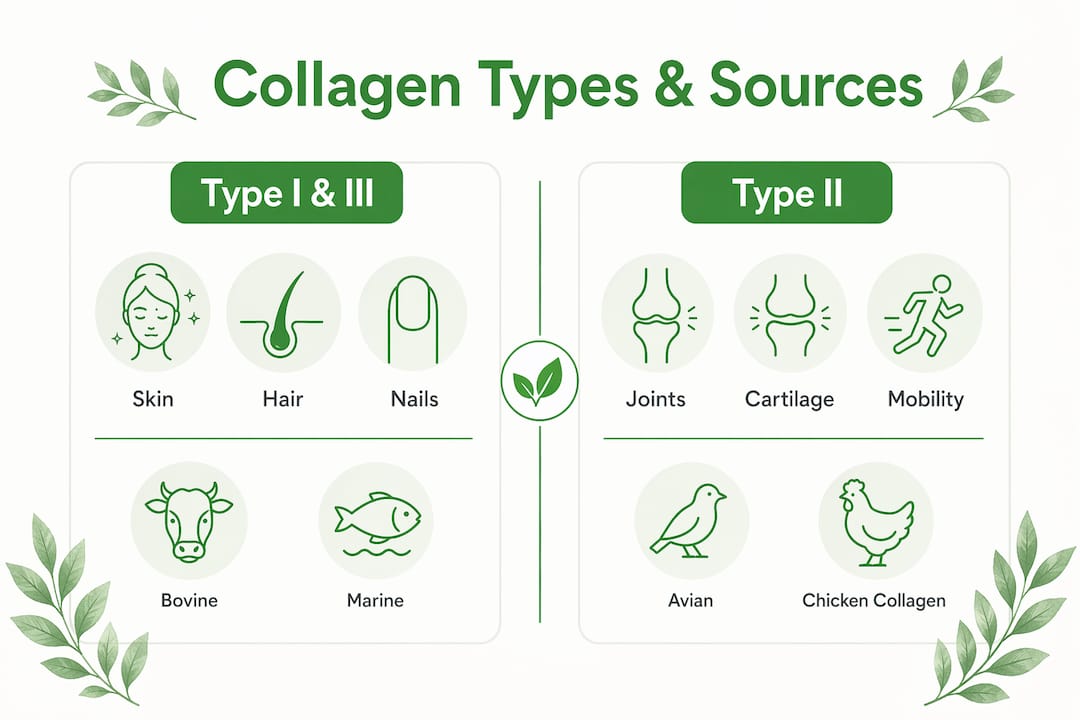
Not all collagen supplements are the same. The type of collagen and the source material determine what health goal the product best supports.
| Collagen Type | Primary Role | Common Source | Best For |
|---|---|---|---|
| Type I | Skin, hair, nails, tendons | Bovine, marine | Skin elasticity and hydration |
| Type II | Cartilage and joint cushioning | Avian (chicken) | Joint pain and osteoarthritis |
| Type III | Skin and blood vessel walls | Bovine | Skin firmness and wound healing |
| Multi-collagen | Broad tissue support | Bovine, marine, avian | General wellness |
Different sources provide distinct collagen types that target specific health issues. Bovine collagen is rich in Types I and III, making it a strong choice for skin and connective tissue. Marine collagen is also predominantly Type I and absorbs particularly well due to its smaller peptide size. Avian collagen, derived from chicken cartilage, is the primary source of Type II collagen, which directly supports joint health.
The manufacturing process matters too. Enzymatic hydrolysis breaks down raw collagen into peptides small enough for your gut to absorb efficiently. Products that skip this step or use lower-grade hydrolysis deliver less bioavailable collagen to your system.
Pro Tip: If your primary goal is joint support, look for a supplement that specifically lists Type II collagen from avian sources. If skin health is your focus, a marine or bovine Type I product is your best starting point. A multi collagen peptides formula covers both goals in one product.
What are the proven benefits of collagen supplements for skin and joint health?
The evidence base for collagen supplementation is stronger than most people realize. An umbrella review of 113 RCTs involving 7,983 patients, published in january 2026, found consistent associations between collagen supplementation and meaningful improvements in skin elasticity, hydration, and musculoskeletal outcomes. That scale of evidence, across more than 100 randomized controlled trials, places collagen among the better-studied supplements in the wellness category.
Skin health benefits
Collagen peptides stimulate fibroblast activity in the dermis. Fibroblasts are the cells responsible for producing new collagen and hyaluronic acid. When peptide signals reach these cells, they increase output of both compounds, which directly improves skin firmness and moisture retention. Clinical trials consistently show measurable improvements in skin elasticity after 8–12 weeks of daily supplementation.
Joint and musculoskeletal benefits
A 2025 clinical study found that 3,000 mg daily of low-molecular-weight collagen peptides for 180 days significantly reduced knee osteoarthritis joint pain compared to placebo, with a p-value of 0.00. That result signals a strong, statistically reliable effect. The mechanism involves collagen peptides stimulating chondrocyte activity, which increases Type II collagen and hyaluronic acid production inside joint cartilage.
Key benefits supported by clinical research include:
- Improved skin elasticity and reduced visible wrinkles
- Increased skin hydration and moisture retention
- Reduced joint pain in osteoarthritis, particularly in the knee
- Support for cartilage integrity and joint cushioning
- Improved muscle mass and recovery when combined with resistance training
- Stronger nail growth and reduced brittleness
These benefits do not happen overnight. Most clinical trials run for 8–24 weeks, which reflects the time your body needs to rebuild collagen structures. Consistent daily use is what separates people who see results from those who do not.
How to use collagen supplements effectively: dosage, timing, and co-factors
Getting the dose right is the most overlooked part of collagen supplementation. The Cleveland Clinic recommends daily doses of 2.5–5 grams for skin benefits and 10–20 grams for musculoskeletal support. Both ranges fall within the clinically established safe window of 2.5–15 grams per day. Higher doses for joint and muscle goals reflect the greater demand for amino acids in rebuilding cartilage and connective tissue.
Here is a practical framework for using collagen supplements effectively:
- Set your dose by goal. Use 2.5–5 g daily for skin, hair, and nail support. Use 10–20 g daily for joint pain, muscle recovery, or bone health.
- Take it consistently. Daily use for at least 8 weeks is the minimum threshold most clinical trials use to measure results. Sporadic use produces little measurable benefit.
- Pair it with vitamin C. Vitamin C, silica, and resveratrol are key co-factors that enhance collagen stability and synthesis. Vitamin C is required for the hydroxylation of proline, a step your body cannot skip when building new collagen fibers.
- Time it around meals or workouts. Taking collagen 30–60 minutes before exercise may improve its delivery to connective tissue. Taking it with a meal that includes vitamin C achieves the same co-factor benefit.
- Choose the right form. Powder dissolves easily in coffee, smoothies, or water. Capsules offer convenience for travel. Gummies provide a fixed dose with added palatability.
Pro Tip: The single biggest mistake people make is stopping too early. Collagen remodeling is a slow biological process. Commit to a minimum of 12 weeks before evaluating whether a product is working for you.
What should you know about collagen supplement safety and common myths?
Collagen supplements have a strong safety record. Side effects are minimal and include rare occurrences of mild headache, lightheadedness, or digestive discomfort. These effects are uncommon and typically resolve on their own. No serious adverse events have been consistently reported across large-scale clinical trials.
That said, a few important points deserve your attention:
- Collagen does not deposit directly into your tissues. Your digestive system breaks it down into amino acids and peptides first. The benefit comes from the biological signals those peptides send, not from collagen traveling intact to your skin or joints.
- Vegan collagen does not exist yet in supplement form. Products labeled “vegan collagen” are actually collagen boosters, typically containing vitamin C, zinc, and plant-based amino acids that support your body’s own production. They do not contain collagen protein.
- Regulatory oversight is limited. The supplement industry in the United States operates under FDA oversight for safety, but products are not pre-approved for efficacy before reaching store shelves. Choosing products with third-party testing and transparent labeling protects you from low-quality formulations.
- Results vary by individual. Age, diet, sun exposure, and baseline collagen levels all affect how well you respond to supplementation. Someone with significant collagen depletion may see faster results than someone with moderate depletion.
- More is not always better. Exceeding 20 grams per day does not produce proportionally greater benefits and may increase the risk of digestive side effects.
Realistic expectations matter. Collagen supplements are supportive tools that provide building blocks for collagen synthesis. They work best as part of a broader wellness routine that includes sun protection, adequate protein intake, and consistent hydration.
How to choose the best collagen supplement for your needs
Selecting the right collagen supplement comes down to matching the product’s profile to your specific health goal. The market offers a wide range of formats and formulations, and not all of them are created equal.
| Format | Pros | Cons |
|---|---|---|
| Powder | Flexible dosing, mixes easily, high dose per serving | Requires preparation, less portable |
| Capsules | Convenient, pre-measured, travel-friendly | Lower dose per serving, more capsules needed |
| Gummies | Palatable, easy to remember, often includes co-factors | Fixed dose, may contain added sugars |
| Liquid | Fast absorption, no mixing required | Shorter shelf life, less portable |
Beyond format, look at these four factors before buying:
Collagen type and source. Match the type to your goal using the framework from the types section. Verify that the source is clearly listed on the label.
Peptide size. Smaller peptides (under 5 kDa) absorb more efficiently. Look for products that specify “hydrolyzed collagen peptides” or “low-molecular-weight collagen” on the label.
Added co-factors. Products that include vitamin C, hyaluronic acid, or biotin alongside collagen deliver more complete support than collagen alone.
Third-party testing. Look for NSF International, USP, or Informed Sport certification seals. These indicate that an independent lab has verified the product’s contents and purity.
You can explore collagen supplement options across formats and types to find the formulation that fits your routine and goals. Shopnaturescraft offers capsules, powders, and gummies so you can choose the format that works best for your lifestyle.
Key Takeaways
Collagen supplements work by supplying hydrolyzed peptides that signal your body to produce more collagen, with clinical evidence supporting benefits for skin elasticity, joint pain, and musculoskeletal health at daily doses of 2.5–20 grams.
| Point | Details |
|---|---|
| Core mechanism | Collagen peptides signal fibroblasts and chondrocytes to increase collagen production, not deposit collagen directly. |
| Dosage by goal | Use 2.5–5 g daily for skin benefits and 10–20 g daily for joint and musculoskeletal support. |
| Type and source matter | Match collagen type to your goal: Type I for skin, Type II for joints, multi-collagen for broad support. |
| Co-factors are required | Pair collagen with vitamin C, silica, or resveratrol to support collagen stability and synthesis. |
| Consistency is non-negotiable | Clinical trials run 8–24 weeks. Commit to daily use for at least 12 weeks before evaluating results. |
What I’ve learned from years of watching the collagen market evolve
The collagen supplement category has matured significantly since the early days of basic gelatin powders. What strikes me most is how the research has caught up with the consumer enthusiasm. An umbrella review covering more than 7,900 patients is not a small thing. That level of evidence changes how seriously clinicians and researchers take this category.
What I tell people who ask me about collagen is this: the supplement works, but it does not work the way most marketing suggests. You are not filling your skin with collagen from a scoop of powder. You are giving your body a biochemical nudge to do what it already knows how to do. That distinction matters because it sets realistic expectations and helps you stay consistent long enough to see real results.
The trend I find most encouraging is the move toward personalized supplementation strategies. Blanket dosing recommendations are giving way to goal-specific protocols that account for age, activity level, and baseline collagen status. That is the direction the science is heading, and it is the right one.
My honest caution: the supplement market still has too many products with vague labeling, undisclosed sources, and no third-party testing. Quality matters more than price. A well-formulated product at a fair price beats a cheap product with poor bioavailability every time. Spend your money on transparency, not marketing claims.
— SuperNatural
Quality collagen supplements from Shopnaturescraft
Shopnaturescraft has been crafting clean, high-quality supplements since 2013, and collagen is one of the brand’s most carefully formulated categories.

Whether you prefer the flexibility of a powder, the convenience of capsules, or the ease of gummies, Shopnaturescraft offers collagen products built with transparent labeling and quality ingredients. Each formulation is designed to align with the dosage ranges and co-factor pairings that clinical research supports. You can browse the full range of premium wellness supplements and find the collagen product that fits your skin, joint, or general wellness goals. Every bottle reflects the same commitment to purity and efficacy that has defined the brand for over a decade.
FAQ
What is a collagen supplement made of?
A collagen supplement is made from hydrolyzed collagen protein, typically sourced from bovine, marine, or avian connective tissue. Enzymatic hydrolysis breaks the protein into small peptides (2–5 kDa) that your body can absorb efficiently.
How long does it take for collagen supplements to work?
Most clinical trials measure results after 8–24 weeks of daily use. Skin improvements often appear within 8–12 weeks, while joint benefits may take up to 6 months of consistent supplementation.
What are collagen peptides vs. collagen supplements?
Collagen peptides are the active form of collagen found in most supplements. The terms are often used interchangeably. “Collagen peptides” specifically refers to the hydrolyzed, bioavailable form, while “collagen supplement” is the broader category name.
Is it safe to take collagen supplements every day?
Daily doses of 2.5–15 grams are considered safe based on clinical data. Side effects are rare and mild, including occasional digestive discomfort. No serious adverse events have been consistently reported in large-scale trials.
Can you get enough collagen from food alone?
Bone broth, chicken skin, and fish skin contain collagen, but the amounts and bioavailability vary significantly. Supplementing with hydrolyzed collagen peptides delivers a consistent, measurable dose that food sources alone rarely match.

