


DIM (Diindolylmethane) is a bioactive compound that modulates estrogen metabolism by shifting it toward the 2-hydroxy pathway, producing metabolites considered less potent and more favorable for hormone-sensitive tissues. If you’ve been searching for what does dim supplement do, the short answer is this: it does not raise or lower your estrogen directly. Instead, it changes how your body processes the estrogen it already makes. That distinction matters enormously, and most articles skip right past it.
How does DIM work in the body to influence hormone balance?
DIM forms in your stomach when you digest indole-3-carbinol, a compound found naturally in cruciferous vegetables like broccoli, cauliflower, and Brussels sprouts. Your digestive acid converts indole-3-carbinol into DIM, which then travels to the liver and influences how estrogen is broken down.
The liver metabolizes estrogen through two main pathways. The 2-hydroxylation pathway produces 2-OHE metabolites, which are considered less proliferative. The 16-alpha-hydroxylation pathway produces 16α-OHE metabolites, which bind more strongly to estrogen receptors. DIM shifts urinary estrogen metabolite ratios favoring 2-OHE over 16α-OHE. That shift is the core mechanism behind most of DIM’s reported benefits.

DIM also modulates estrogen receptor alpha and aryl hydrocarbon receptor activity, leading to complex gene regulation effects. This dual receptor activity means DIM’s clinical impact varies from person to person. It is not a simple on/off switch for hormones.
One nuance worth understanding involves liver detoxification. Balance between phase I and phase II liver detoxification enzymes is important. DIM increases some phase I enzymes, but without adequate phase II support, the process can generate reactive metabolites. This is why pairing DIM with a nutrient-rich diet matters.
- DIM does not add estrogen or block it entirely. It redirects how estrogen breaks down.
- The 2-hydroxy pathway is associated with less estrogenic activity in tissues.
- Liver enzyme induction is the primary mechanism behind DIM’s effects.
- Receptor modulation adds complexity and explains why results vary between individuals.
Pro Tip: Take DIM with a meal that contains healthy fat. Fat improves absorption of this fat-soluble compound and reduces the chance of stomach upset.
What are the proven and potential health benefits of DIM supplementation?
The benefits of DIM supplementation are real but require honest framing. DIM does not cure hormonal conditions. It supports the metabolic environment that allows your hormones to function more efficiently.
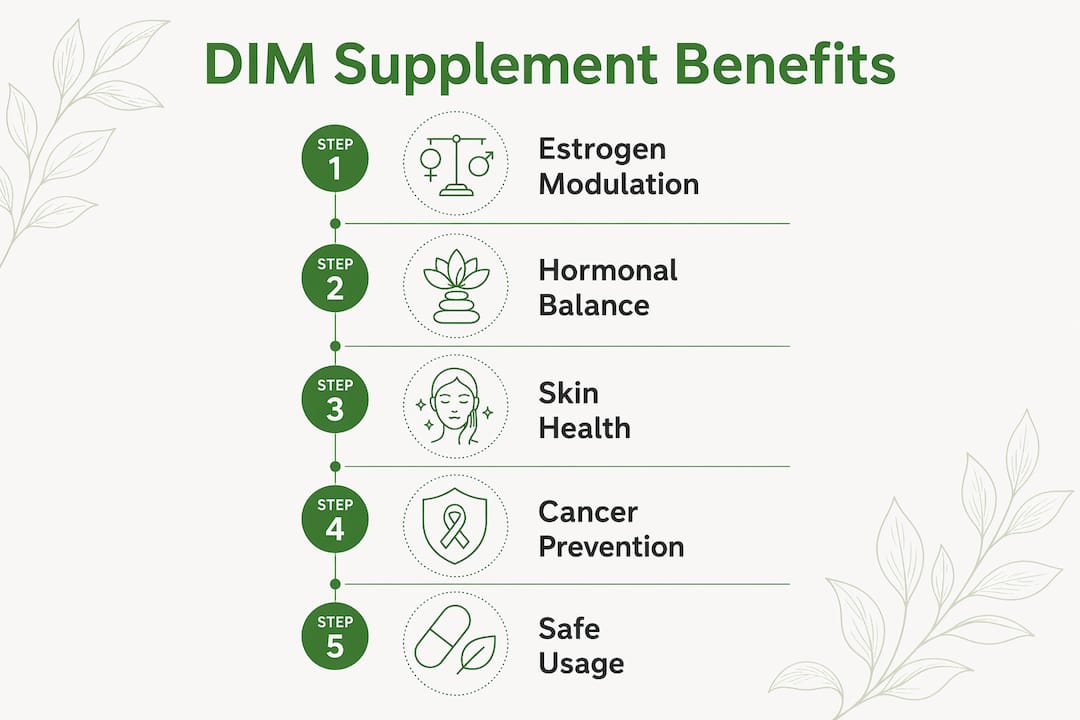
Hormonal acne is one of the most commonly reported areas of improvement. DIM works through the estrogen-androgen interplay, which means it may only benefit certain individuals depending on the root hormonal cause of their acne. If your breakouts stem from excess androgens amplified by estrogen imbalance, DIM may help. If your acne has a different root cause, results will likely be minimal.
PMS and perimenopause symptoms represent another area with meaningful user-reported benefits. Women dealing with bloating, mood swings, breast tenderness, and irregular cycles tied to estrogen dominance often report improvement after consistent DIM use. Perimenopause support strategies frequently include DIM as part of a broader approach to managing fluctuating hormone levels.
- Hormonal acne: Improvement reported after 8–12 weeks, though initial worsening is possible during adjustment.
- PMS symptoms: Reduced bloating, mood changes, and breast tenderness linked to estrogen dominance.
- Perimenopause: May ease hot flashes and mood instability tied to estrogen fluctuation.
- Estrogen dominance in men: Men with elevated estrogen relative to testosterone may benefit from improved metabolite ratios.
- Cancer prevention context: DIM is studied as an adjunct in hormone-related cancer research, though results remain preliminary.
“A significant research gap exists between improved estrogen biomarker ratios and proven long-term prevention of diseases such as cancer. DIM remains a supportive hormone metabolite modulator, not a proven disease treatment.”
The cancer prevention angle deserves special attention. Multiple human studies show that DIM changes estrogen metabolite ratios, but the clinical relevance of this surrogate marker for cancer risk remains uncertain. Improved ratios do not automatically translate to reduced cancer risk. Treat any cancer-related claims about DIM with appropriate skepticism.
Are there any side effects, risks, or important interactions?
DIM has a solid safety profile at standard doses, but side effects do occur and are dose-dependent. Knowing what to expect helps you use it wisely.
Common side effects include dark or orange-tinted urine, mild gastrointestinal upset, and headache, and these are more common at doses exceeding 200 mg per day. The dark urine is harmless and results from altered estrogen metabolite excretion. It is not a sign of liver damage, but it can be alarming if you are not expecting it.
- Dark or discolored urine: Harmless but common. Results from metabolite changes in urine. Reduce dose if it concerns you.
- Gastrointestinal discomfort: Nausea or bloating, especially on an empty stomach. Always take DIM with food.
- Headache: Reported at higher doses. Usually resolves as your body adjusts.
- Menstrual irregularity: Possible if estrogen drops too far. Monitor cycle changes in the first 8 weeks.
- Low libido: Rare, but can occur if estrogen metabolite shifts are too aggressive.
Drug interactions are the most serious concern. DIM may interact significantly with hormonal therapies, notably reducing the efficacy of tamoxifen in breast cancer survivors by altering metabolic pathways. If you take any hormonal medication, including birth control, speak with your doctor before adding DIM. DIM is also detectable in thyroid tissue after 14 days of use, which means people with thyroid conditions should proceed with medical guidance.
Pro Tip: If you are on any prescription hormonal therapy, consult your prescribing physician before starting DIM. The interaction risk is real and not worth skipping that conversation.
The upper safe limit sits near 600 mg daily, with no additional benefits noted above 300 mg. More is not better with DIM. Staying within the 100–200 mg daily range covers most people’s needs without pushing into side effect territory.
How should you use DIM supplements effectively and safely?
Effective DIM use comes down to three factors: the right dose, the right formulation, and realistic timing expectations.
The standard effective dose range is 100–200 mg daily for 8–12 weeks. This window gives your liver enzymes time to adjust and your hormonal environment time to shift. Benefits typically emerge over weeks through symptom improvements like reduced breakouts or PMS relief. You will not feel DIM working acutely the way you might feel caffeine. Patience is part of the protocol.
Formulation matters more than most people realize. Standard DIM powder is poorly absorbed. Enhanced absorption forms using lipid carriers or emulsifiers are critical for getting active levels into your bloodstream. Look for products that specifically state enhanced bioavailability. Taking DIM with a fat-containing meal also improves absorption meaningfully.
| Factor | Recommendation |
|---|---|
| Daily dose | 100–200 mg for most adults |
| Upper limit | 300 mg; no benefit above this level |
| Duration | 8–12 weeks before evaluating results |
| Formulation | Enhanced-absorption or lipid-based form |
| Timing | With a meal containing dietary fat |
| Monitoring | Track symptoms weekly; note cycle changes |
Whole food sources of cruciferous vegetables remain a valuable complement to supplementation. Broccoli, kale, and cabbage provide indole-3-carbinol alongside fiber, vitamins, and phytonutrients that support the same metabolic pathways. Supplements concentrate the dose, but food provides the broader nutritional context that supports phase II liver detoxification.
How does DIM compare to other hormone support options?
DIM occupies a specific niche in the hormone support space. Understanding where it fits helps you build a more complete approach.
Dietary cruciferous vegetables offer similar bioactive compounds but at much lower concentrations. You would need to eat a substantial amount of broccoli daily to match a 150 mg DIM supplement dose. For people with mild hormonal imbalance, cruciferous vegetables as safer, natural alternatives may be sufficient. For those with more pronounced estrogen dominance symptoms, supplemental DIM provides a more concentrated effect.
Other supplement options for hormonal balance include Vitex (chasteberry), which targets the pituitary-ovarian axis and works differently from DIM. DHEA supplements address adrenal hormone precursors and are more relevant when DHEA levels are clinically low. These options are not interchangeable with DIM. Each targets a different part of the hormonal system.
- DIM targets estrogen metabolism in the liver.
- Vitex influences luteinizing hormone and prolactin at the pituitary level.
- DHEA supports adrenal hormone production upstream of estrogen and testosterone.
- Lifestyle factors like sleep, stress management, and reducing alcohol intake all affect estrogen metabolism independently.
DIM supplementation is often unnecessary for people without symptoms of estrogen imbalance. If your hormones are functioning well, adding DIM is unlikely to produce noticeable benefits and may create unnecessary metabolic shifts. Use it when there is a clear reason, not as a general wellness supplement.
Key Takeaways
DIM supplements modulate estrogen metabolism toward the 2-hydroxy pathway, offering meaningful support for hormonal acne, PMS, and perimenopause symptoms when used at 100–200 mg daily in a bioavailable formulation for 8–12 weeks.
| Point | Details |
|---|---|
| Core mechanism | DIM shifts estrogen breakdown toward the 2-hydroxy pathway, not estrogen levels directly. |
| Best candidates | People with estrogen dominance symptoms like hormonal acne, PMS, or perimenopause changes. |
| Formulation matters | Enhanced-absorption forms outperform standard DIM powder; always take with food. |
| Safety and interactions | Avoid DIM with tamoxifen or hormonal therapies without medical guidance. |
| Realistic timeline | Expect 8–12 weeks of consistent use before evaluating whether DIM is working. |
What I’ve learned about DIM after years of watching people use it
Most people come to DIM expecting a dramatic hormonal reset. What they actually get is subtler and, in many ways, more useful. DIM does not override your endocrine system. It nudges one specific metabolic pathway in a direction that tends to be more favorable. That is a meaningful distinction.
The biggest mistake I see is people abandoning DIM after two or three weeks because they do not feel different. DIM is not a supplement you feel. It is a supplement whose effects show up in your skin clearing, your PMS becoming less severe, or your mood stabilizing around your cycle. Those changes take time and require you to pay attention.
The second mistake is ignoring formulation. Buying the cheapest DIM powder and expecting results is like buying a fat-soluble vitamin in a water-based capsule. The delivery system is part of the product. Shopnaturescraft’s Women’s DIM Complex addresses this directly with a formulation built around bioavailability.
My honest view is that DIM belongs in a broader hormone health strategy, not as a standalone fix. Pair it with consistent sleep, reduced alcohol, and a diet rich in cruciferous vegetables. The supplement fills the gap that diet alone cannot always close. That is where it earns its place.
— SuperNatural
Quality DIM supplements from Shopnaturescraft
Shopnaturescraft has been formulating clean, effective supplements since 2013, and their hormone support line reflects that experience. If you are ready to try DIM, their Women’s DIM Complex delivers 300 mg per serving in a bioavailable form designed for real absorption, not just label claims.

For a broader look at hormone health options, the full supplement collection at Shopnaturescraft includes targeted support for women at every stage, from cycle balance to menopause. Each product is made with quality ingredients and no unnecessary fillers. Your hormonal health deserves a supplement that actually reaches your bloodstream.
FAQ
What does a DIM supplement do exactly?
DIM shifts estrogen metabolism in the liver toward the 2-hydroxy pathway, producing metabolites that are less potent and considered more favorable for hormone-sensitive tissues. It does not raise or lower estrogen levels directly.
How long does DIM take to work?
Most people need 8–12 weeks of consistent daily use before noticing changes like reduced hormonal acne or improved PMS symptoms. Benefits emerge gradually through symptom changes, not acute feelings.
Is DIM safe to take daily?
DIM is generally safe at 100–200 mg daily for healthy adults. Side effects like dark urine and mild stomach upset are more common above 200 mg. People on hormonal medications, including tamoxifen, should consult a doctor first.
What are the best food sources of DIM?
DIM forms naturally from indole-3-carbinol in cruciferous vegetables like broccoli, cauliflower, kale, and Brussels sprouts. Dietary sources provide lower concentrations than supplements but offer broader nutritional support.
Can men take DIM supplements?
Men with symptoms of elevated estrogen relative to testosterone, such as excess body fat or reduced libido, may benefit from DIM’s effects on estrogen metabolism. Dosing and monitoring recommendations are the same as for women.

