


Two parents can stand in front of the same shelf of children's omega-3 supplements and walk away with completely different priorities.
One may care most about whether their child will actually take the supplement.
Another may immediately look for DHA.
A third may wonder whether a supplement is even necessary because fish already appears regularly at home.
None of them is necessarily approaching the decision incorrectly.
Children's diets, preferences, routines, and ages differ, which is exactly why choosing an omega-3 supplement makes more sense when the child's real life comes before the product.
Let's look at three representative families and how the same supplement decision can look very different in each household.
Family One: The Child Who Won’t Touch Fish
Dinner is going well until salmon reaches the table.
Suddenly, negotiations begin.
One bite?
Half a bite?
What if it's mixed with rice?
For families with children who consistently avoid fish, omega-3 intake may become something parents pay closer attention to.
Fatty fish such as salmon, sardines, trout, and mackerel are well-known dietary sources of the long-chain omega-3 fatty acids EPA and DHA.
DHA is especially relevant during childhood because it is a structural component found in the brain and retina.
A child who doesn't regularly eat fish isn't automatically deficient in omega-3s, but their eating habits may be one reason parents start investigating other dietary sources and supplements.
For this family, the first question isn't necessarily:
Which omega-3 has the biggest number?
It's:
What realistic options do we have when fish rarely makes it onto the plate?
Family Two: The Child Who Hates Swallowing Pills
This family's challenge is completely different.
Their child eats reasonably well and isn't particularly opposed to fish.
The problem is the supplement itself.
Traditional fish oil commonly comes in softgels, and swallowing one may simply not be practical for a younger child.
This is where delivery format becomes more important than it initially appears.
A product can have an impressive formula, but if taking it becomes a daily argument, that advantage may mean very little in the household where it's supposed to be used.
For some children, a gummy format may be easier to incorporate into an established routine.
That doesn't make gummies inherently superior to liquids or softgels.
It makes them more practical for a particular child.
Family Three: The Parents Who Want to Understand DHA
The third family isn't particularly concerned about flavor or supplement format.
They're researchers.
Before buying anything, they want to understand what all the terminology means.
Omega-3.
Fish oil.
EPA.
DHA.
Are they interchangeable?
Not exactly.
Omega-3 fatty acids are a family of fats.
EPA and DHA are two specific long-chain omega-3 fatty acids commonly associated with marine sources.
So when parents see a children's product described as Omega + DHA, they're not simply seeing two unrelated wellness buzzwords. DHA is itself an omega-3 fatty acid, but highlighting it separately tells parents that the formula specifically provides DHA rather than merely using the broader term "omega-3."
For this family, understanding the terminology makes the product much easier to evaluate.
Five Questions Can Reveal Five Different Priorities
The Medium article connected to today's topic approaches the decision through questions parents can ask themselves before buying.
That framework fits particularly well here because the three families above would answer those questions differently.
MyWellnessEra explores those considerations in:
Before You Buy an Omega-3 Supplement for Your Child, Ask Yourself These Five Questions
Rather than assuming every household should arrive at the same answer, questions like these help bring the child's actual diet and routine into the decision.
What All Three Families Still Have in Common
Despite their differences, there are several things none of these families should ignore.
A children's supplement needs to be appropriate for the child's age.
The serving directions matter.
The ingredient list matters.
And supplements should remain supplements—not candy simply because they happen to come in gummy form.
Most importantly, omega-3 supplementation shouldn't distract from the bigger nutritional picture.
Children still need varied meals containing protein, fruits, vegetables, whole grains, healthy fats, and other nutrient-rich foods.
The goal isn't to build nutrition around a gummy.
It's to determine whether the gummy has a useful place within the nutrition that's already being built.
Where Nature’s Craft Kids Omega + DHA Gummies Enter the Picture
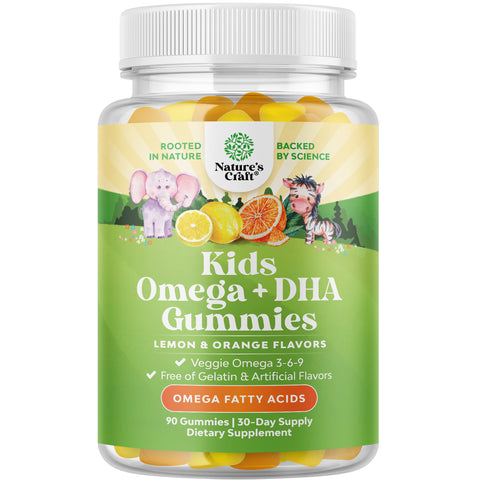
For families whose priorities include a child-friendly format and supplemental omega-3s, Nature’s Craft Kids Omega + DHA Gummies provide one possible approach.
The product is specifically formulated for children rather than simply repackaging an adult fish oil supplement.
Verified label records identify the product as Kids Omega + DHA Gummies from Nature's Craft, in a gummy format intended for children ages 4 and older. The label lists a serving of two gummies once daily.
The verified label lists:
- Fish Oil Powder — 100 mg per serving
- DHA — 13.2 mg per serving
- EPA — 2.8 mg per serving
- 60 gummies per container
- 30 servings per container
The label also identifies tuna fish as an allergen, which is an important practical detail for parents rather than something that should be buried beneath marketing language.
What Nature’s Craft Kids Omega + DHA Gummies Offer
For the three representative families, the benefits may look slightly different.
For the child who avoids fish: the product provides supplemental fish-derived omega-3s, including DHA and EPA.
For the child who struggles with pills: the gummy format avoids the need to swallow a traditional fish-oil softgel.
For the parents researching DHA: the label clearly identifies DHA and EPA amounts rather than simply using "omega-3" as an umbrella description.
More broadly, Nature's Craft Kids Omega + DHA Gummies offer:
- DHA and EPA nutritional support in a formula developed for children.
- A chewable gummy format that may be easier for children who don't take conventional softgels.
- A defined two-gummy daily serving, making the routine straightforward for parents.
- An alternative source of marine omega-3s for families looking to complement their child's diet.
The product should still be used according to its label, and the verified label specifically advises consulting a physician for children under four and in relevant medical circumstances.
The Fourth Family Might Not Need the Same Answer
There's one more family worth mentioning.
Their child loves salmon.
Fish appears regularly at home.
Their parents are already comfortable with the child's diet.
Should they automatically add an omega-3 gummy because other families do?
That's exactly why real-life context matters.
Supplement decisions shouldn't begin with:
“Everyone else is buying this.”
They should begin with:
“What does our child actually need from their overall nutrition?”
That answer may be different from one household to another.
The Product Is the Same. The Reason for Choosing It May Not Be.
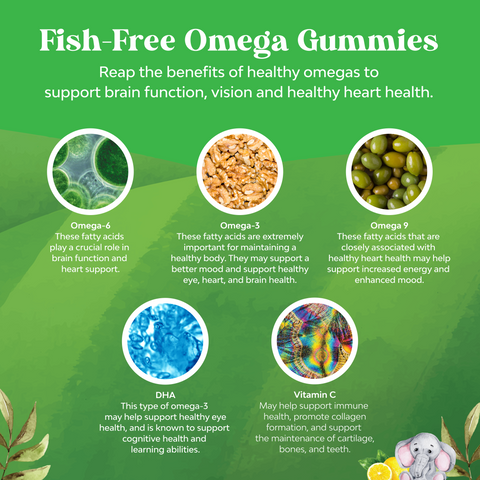
One family may appreciate Nature's Craft Kids Omega + DHA Gummies because their child doesn't regularly eat fish.
Another may appreciate the gummy format.
Another may specifically be looking for DHA.
Those different motivations illustrate why there isn't one universal script for choosing children's supplements.
The product label provides the facts.
The family's circumstances provide the context.
And when those two things are considered together, choosing an omega-3 supplement becomes less about finding whatever everyone else calls "best" and more about finding what genuinely makes sense for the child in front of you.

