


A menopausal bone supplement is a nutrition-based formulation designed to slow bone loss and maintain bone strength in women going through menopause. The clinical term for this category is “postmenopausal bone health supplementation,” and it covers products built around calcium, vitamin D, vitamin K2, magnesium, and soy isoflavones. These nutrients address a specific problem: estrogen decline accelerates bone loss during a critical 3–4 year window at menopause, raising fracture risk significantly. Understanding what these supplements contain, how they work, and when to use them gives you a real advantage in protecting your bones before problems start.
What is a menopausal bone supplement, and which nutrients matter most?
The core of any quality bone supplement for menopause is calcium. Women aged 51 and older need 1,200 mg of calcium daily to offset the accelerated bone loss that follows estrogen decline. Bone mineral density drops approximately 5% in the first year after menopause, then continues falling at 1–1.5% annually. That rate makes early supplementation a practical priority, not an optional extra.
Vitamin D works alongside calcium by controlling how much of it your body actually absorbs. Serum levels above 50 nmol/L are required for vitamin D to be effective, and most women reach that threshold with 800–1,000 IU daily. Sunlight exposure is the preferred source, but supplementation fills the gap when sun exposure is limited, which is common in winter months or for women who spend most of their time indoors.
Vitamin K2, specifically the MK-7 form, is the nutrient most people overlook. It activates proteins that direct calcium into bones rather than soft tissues. A three-year study found 180 mcg of vitamin K2 daily significantly decreased bone loss in postmenopausal women. That finding has shifted clinical thinking toward combination products that pair vitamin D3 with K2 for better outcomes.
Magnesium and soy isoflavones round out the most evidence-supported formulations. Magnesium supports bone crystal structure and regulates calcium transport. Soy isoflavones mimic estrogenic effects at a mild level, which may help slow bone resorption in women who cannot or choose not to use hormone therapy. You can learn more about supplements for hormonal balance to see how these nutrients fit into a broader picture.
- Calcium: 1,200 mg daily for women over 51; prioritize dietary sources first
- Vitamin D3: 800–1,000 IU daily; maintain serum levels above 50 nmol/L
- Vitamin K2 (MK-7): 180 mcg daily; directs calcium to bone, not arteries
- Magnesium: supports calcium transport and bone crystal formation
- Soy isoflavones: mild estrogen-like activity that may reduce bone resorption
Pro Tip: Look for a supplement that combines vitamin D3 and K2 in the same capsule or drop. These two nutrients work together, and splitting them across separate products makes consistent dosing harder to track.
How do bone supplements fit into clinical screening and bone health management?

Supplementation does not replace clinical assessment. DEXA scanning is recommended universally for women aged 65 and older, and for younger women who carry risk factors such as low body weight under 127 lbs or a parental history of hip fracture. A DEXA scan produces a T-score, and a T-score at or below -2.5 confirms an osteoporosis diagnosis. That number drives treatment decisions, including whether supplements alone are sufficient or whether prescription therapy is needed.
The FRAX tool adds another layer of precision. It calculates your 10-year probability of a major fracture using factors like age, weight, smoking history, and bone density. Women with high FRAX scores typically need pharmacological treatment, not just supplementation. Supplements are adjunctive in that context.
Here is how to think about where supplementation fits in your care plan:
- Get screened first. Request a DEXA scan if you are 65 or older, or younger with known risk factors. Your T-score determines your starting point.
- Identify your deficiency. Blood tests for serum 25(OH)D and dietary calcium intake assessment tell you what you actually need to supplement.
- Match your supplement to your gap. Supplementation is most effective when targeted at confirmed deficiency, not applied universally.
- Coordinate with your provider. If your T-score indicates osteoporosis, supplements support but do not replace bisphosphonates or denosumab.
- Retest periodically. Bone density and vitamin D levels change. Annual or biennial follow-up keeps your plan accurate.
What does recent research say about the benefits and limits of these supplements?
The evidence on calcium and vitamin D is more nuanced than most product labels suggest. Calcium and vitamin D provide modest benefits in slowing bone loss for non-institutionalized postmenopausal women, but they do not significantly reduce fracture risk on their own in women who are already nutritionally replete. The benefit is real when correcting a deficiency. It is limited when adding supplements on top of an already adequate diet.
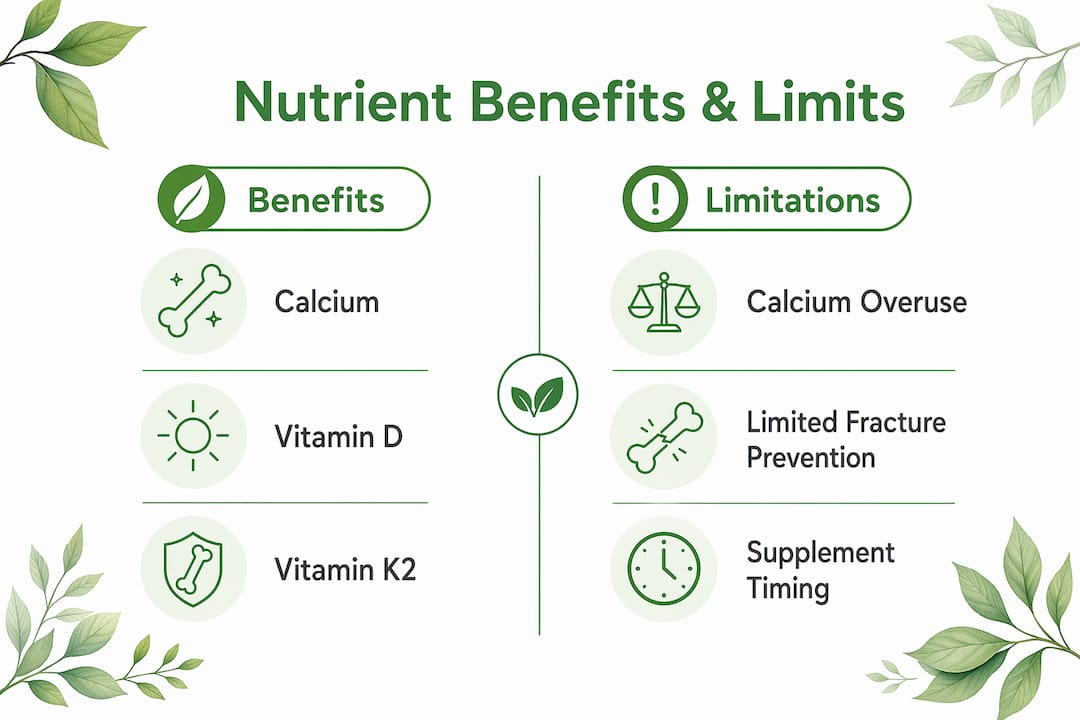
Vitamin K2 tells a different story. The three-year clinical data on 180 mcg of MK-7 daily shows a meaningful reduction in bone loss, and combining vitamin D with vitamin K2 improves bone formation markers beyond what either nutrient achieves alone. That synergy is why combination formulas have become the standard recommendation in updated clinical guidance.
| Nutrient | Evidence strength | Key benefit | Limitation |
|---|---|---|---|
| Calcium | Moderate | Slows bone mineral density loss | Limited fracture reduction alone |
| Vitamin D3 | Moderate | Enhances calcium absorption | Requires adequate serum levels |
| Vitamin K2 (MK-7) | Growing | Reduces bone loss over 3 years | Less studied in isolation |
| Magnesium | Emerging | Supports bone crystal structure | Fewer large-scale trials |
| Soy isoflavones | Emerging | Mild estrogen-like bone protection | Variable response by individual |
Adverse effects from over-supplementation are real and worth knowing. Excessive calcium above 1,000 mg daily from supplements may increase risk for kidney stones and raise cardiovascular concerns without adding fracture protection. The goal is to reach your recommended intake, not to exceed it.
Pro Tip: If you already eat dairy, leafy greens, or fortified foods regularly, calculate your dietary calcium before adding a supplement. You may need far less than you think, and a smaller dose supplement will serve you better.
How should you choose and use bone supplements effectively?
Start with your diet, not the supplement aisle. Dietary calcium from food is absorbed more efficiently than most supplement forms, and it carries none of the risks associated with high-dose pills. Once you know your dietary intake, you can calculate the gap and supplement only what you need.
When choosing a product, look for these features:
- Vitamin D3 paired with K2: The D3 form is more bioavailable than D2, and K2 ensures calcium reaches bone tissue rather than accumulating in arteries
- Calcium in split doses: Your body absorbs no more than 500 mg of calcium at one time, so split doses across meals improve uptake
- Magnesium included: Magnesium deficiency impairs both calcium absorption and vitamin D activation
- Third-party testing: Look for products verified by NSF International or USP to confirm label accuracy
- Appropriate dose: Target the 800–1,000 IU range for vitamin D and 1,200 mg total daily calcium from food plus supplement combined
Weight-bearing exercise strengthens bone by stimulating bone-forming cells called osteoblasts. Walking, jogging, resistance training, and yoga all qualify. Smoking accelerates bone loss directly, and alcohol above moderate intake interferes with calcium absorption. These lifestyle factors are not optional additions to supplementation. They are the foundation that makes supplementation work.
Shopnaturescraft offers organic vitamin D3 and K2 drops that align with the clinical dosing guidance above, making it straightforward to add this combination to your daily routine.
What misconceptions about bone supplements should you avoid?
The most common mistake is believing that more calcium means stronger bones. That logic does not hold up in the research. Doses above 1,000 mg daily from supplements add no proven fracture protection and may cause harm. Dietary calcium remains the first-line recommendation for a reason.
“Supplements are adjuncts to pharmacotherapy in osteoporosis; they are not replacements. Pharmacological treatments with bisphosphonates or denosumab show greater fracture risk reduction than supplementation alone.” Clinical guidelines on osteoporosis management
Other myths worth correcting:
- “Vitamin D alone is enough.” Vitamin D without adequate calcium does not build or maintain bone density. Both are required.
- “Supplements rebuild lost bone.” They maintain existing density and slow further loss. They do not restore bone that has already been lost.
- “Intermittent mega-dosing works the same as daily dosing.” It does not. High single doses of vitamin D have shown inconsistent results and may even increase fall risk in some populations.
- “If I take supplements, I don’t need a DEXA scan.” Supplementation without screening means you are treating a problem you have not measured. Screening drives the plan.
The consistent daily supplementation approach outperforms sporadic high-dose strategies in every meaningful outcome measure.
Key Takeaways
Menopausal bone supplements work best when they target confirmed nutrient deficiencies, combine calcium, vitamin D3, and vitamin K2, and support rather than replace clinical screening and lifestyle strategies.
| Point | Details |
|---|---|
| Supplement to fill gaps, not replace diet | Calculate dietary calcium intake before choosing a supplement dose. |
| Combine D3 with K2 for better outcomes | Vitamin K2 at 180 mcg daily significantly reduces bone loss over three years. |
| Screening drives the plan | A DEXA scan and T-score determine whether supplements or prescription therapy is needed. |
| Avoid mega-dosing calcium | Doses above 1,000 mg daily from supplements add no fracture protection and may increase kidney stone risk. |
| Act during the critical window | The 3–4 year phase of accelerated bone loss after menopause is the highest-impact time for intervention. |
Why I think most women start supplementing too late and too randomly
The 3–4 year window of accelerated bone loss right after menopause is the most important period for bone health intervention. Most women I see in the context of bone health discussions started supplementing years after that window closed, often after a fracture or a concerning DEXA result. By then, the goal shifts from prevention to damage control.
The other pattern I find frustrating is the random approach to supplementation. Women pick up a calcium tablet because they heard calcium is good for bones, take it inconsistently, and never test whether they were deficient in the first place. That approach misses the point entirely. Targeted supplementation based on actual deficiency status is what the evidence supports. Universal, unmonitored supplementation is not.
My honest recommendation is this: get screened early, ideally at the onset of menopause or perimenopause if you have risk factors. Use that data to build a supplement plan with your healthcare provider. Choose a formula that combines vitamin D3 and K2, split your calcium doses across meals, and pair everything with weight-bearing exercise. Supplements are one part of a system. They work well inside that system and poorly outside it.
— SuperNatural
Bone health support from Shopnaturescraft
Shopnaturescraft has been formulating clean, high-quality supplements since 2013, and bone health is one of the areas where ingredient quality makes a measurable difference.

For menopausal women focused on bone density, the D3 and K2 combination delivers the clinically supported pairing in one convenient product. If you prefer a chewable format, calcium gummies provide bioavailable calcium in a form that is easy to take consistently. You can browse the full range of premium vitamins and supplements at Shopnaturescraft to find the right fit for your current health plan. Every product is made with clean ingredients and formulated to meet real nutritional needs, not just to fill a shelf.
FAQ
What is a menopausal bone supplement?
A menopausal bone supplement is a nutrient formulation designed to slow bone loss during and after menopause. It typically contains calcium, vitamin D3, vitamin K2, and magnesium to support bone mineral density.
How much calcium do women need during menopause?
Women aged 51 and older need 1,200 mg of calcium daily from food and supplements combined. Dietary sources are preferred, with supplements filling any remaining gap.
Can bone supplements prevent fractures?
Calcium and vitamin D alone do not significantly reduce fracture risk in nutritionally replete women. Fracture prevention requires a combination of supplementation, screening, lifestyle changes, and in some cases prescription therapy.
When should you start taking bone supplements for menopause?
The most effective time to start is during the 3–4 year window of accelerated bone loss that follows the onset of menopause. Early intervention slows density loss before it reaches a clinical threshold.
Is vitamin K2 necessary in a bone supplement?
Vitamin K2 (MK-7) directs calcium into bone tissue and away from soft tissues. A three-year study found 180 mcg daily significantly decreased bone loss, making it a meaningful addition to any calcium and vitamin D formula.

