


Magnesium often enters the children's wellness conversation at bedtime.
That makes sense on the surface. The mineral is frequently associated with calm and relaxation, and children's magnesium gummies are commonly worked into evening routines.
But bedtime gives magnesium a surprisingly narrow résumé.
A growing child uses magnesium while running, learning, eating, building bone, contracting muscles, sending nerve signals, and producing cellular energy.
Those processes may look unrelated from the outside.
Inside the body, the same mineral connects them.
Muscles and nerves are constantly talking

Every playground sprint involves an extraordinary amount of communication.
Nerves send signals. Muscles respond. Muscles contract and relax. The heart keeps beating while the body adjusts to the changing demand for oxygen and energy.
Magnesium participates in normal nerve and muscle function throughout this process.
That's worth remembering because it moves magnesium out of the “nighttime supplement” box.
The mineral doesn't suddenly become relevant when pajamas go on.
It has jobs throughout the day.
Nature’s Craft Kids Magnesium Gummies provide magnesium in the citrate form, packaged as a raspberry-flavored gummy for adults and children over four. The suggested use is one gummy daily, preferably with food.
Growth brings bones into the picture

Calcium usually gets top billing when children's bone health comes up.
It isn't working alone.
Magnesium is also involved in normal bone structure and mineral metabolism. During childhood and adolescence—years characterized by substantial skeletal growth—that broader nutritional picture matters.
So do the basics surrounding any supplement: a varied diet, sufficient protein and energy, physical activity, vitamin D status, and other nutrients involved in normal growth.
A magnesium gummy doesn't replace those things.
It adds one mineral to that much larger network.
And that network extends further still.
Food, energy, movement, rest
Cells require energy to function, and magnesium participates in numerous enzyme-driven reactions involved in energy metabolism.
That doesn't make magnesium an “energy booster.”
It means energy production is another part of the body's everyday chemistry in which magnesium participates.
Now connect that with everything already happening:
Nutrition supplies raw materials.
Metabolism helps make those materials usable.
Nerves communicate.
Muscles move.
Bones grow and remodel.
Rest gives the body another environment in which normal physiological processes continue.
This is why reducing magnesium to a single outcome—particularly “calm”—misses much of the nutritional story.
For parents who are less interested in the biology and more interested in how actual children's magnesium gummies compare, the companion Medium article looks at Nature’s Craft alongside other verified options:
The Magnesium Aisle Has Become a Parenting Aisle
https://medium.com/@HealthJourneyDaily/the-magnesium-aisle-has-become-a-parenting-aisle-a32e2d357c1e
One gummy doesn't need to carry the whole day
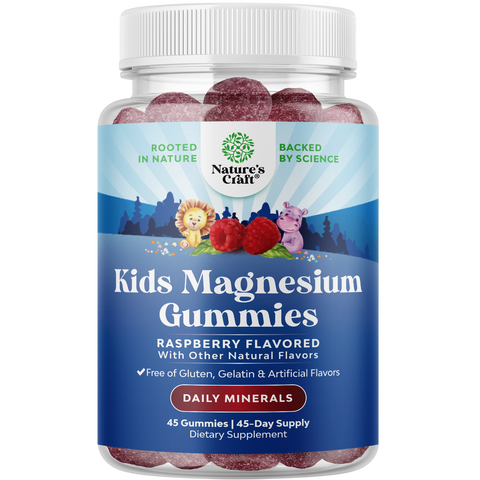
Nature’s Craft Kids Magnesium Gummies are available in 45- and 90-gummy options and use magnesium citrate. The raspberry-flavored gummies are intended for adults and children over four, with one gummy taken daily, preferably with food.
That's the practical part.
The larger wellness picture still includes magnesium-containing foods such as nuts, seeds, beans, whole grains, and leafy greens, alongside adequate sleep, movement, and an overall diet appropriate for growth.
And when parents are considering supplementation because of a specific symptom or concern, that concern deserves to be considered on its own rather than assuming magnesium deficiency is responsible.
A child's sleep problem, muscle complaint, mood change, headache, or digestive issue can have many possible explanations.
The gummy is a source of magnesium.
It doesn't have to become the explanation for everything else.

