


How libido supplements work biologically
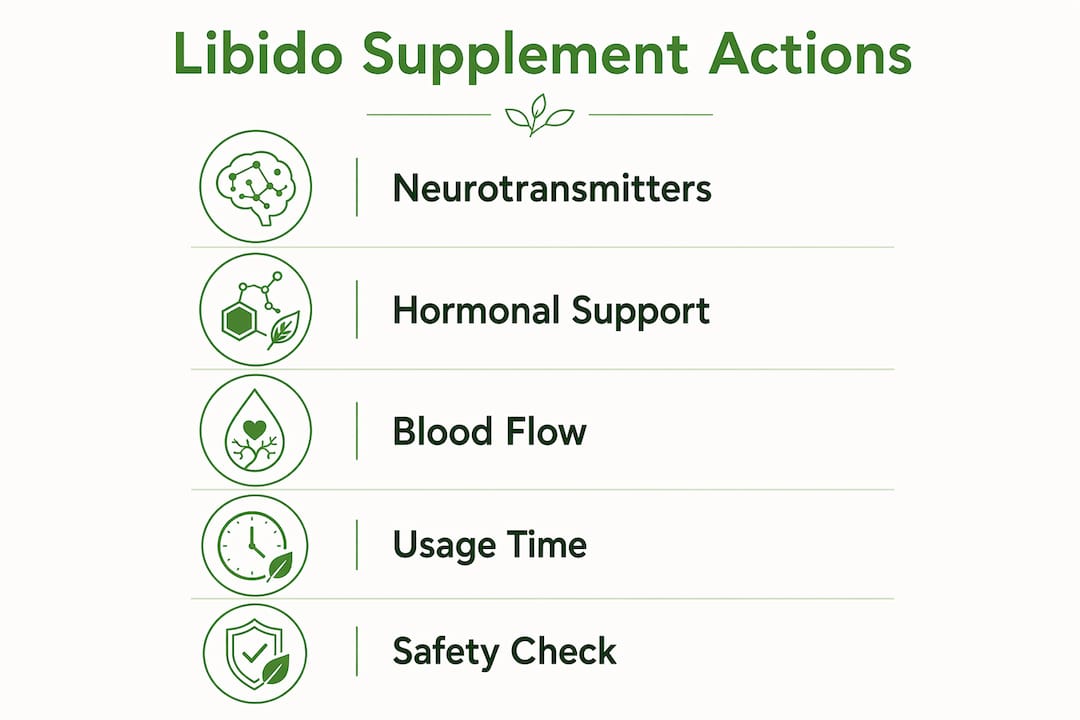
Libido supplements influence sexual desire through three main biological pathways: neurotransmitter modulation, hormone regulation, and local blood flow improvement. Understanding these mechanisms helps you evaluate whether a supplement is likely to do anything meaningful for you.
Neurotransmitter effects are central to how libido enhancement actually works. Dopamine drives motivation and reward, including sexual desire, while serotonin tends to have an inhibitory effect on libido when elevated. Supplements that shift this balance toward higher dopamine activity can increase sexual interest. Hormonal pathways matter just as much. Testosterone, regulated through the hypothalamic-pituitary-testicular axis, plays a direct role in sexual desire for both men and women. Some botanical ingredients appear to influence androgen enzyme activity, nudging testosterone levels upward within normal ranges.

Blood flow is the third pathway, and it operates differently from the first two. Nitric oxide causes blood vessels to relax and widen, which is physically necessary for arousal in both sexes. Ingredients that support nitric oxide production target this mechanism specifically.

One distinction worth knowing before you buy anything: libido supplements and potency supplements are not the same thing. Libido refers to sexual desire, a neurochemical and hormonal phenomenon. Potency refers to physical performance, primarily erection quality, which is largely vascular. Many products blur this line in their marketing.
Key biological effects of libido supplements:
- Increase dopamine activity to heighten motivation and sexual interest
- Modulate serotonin to reduce inhibitory signals on desire
- Support testosterone production via the hypothalamic-pituitary-testicular axis
- Promote nitric oxide synthesis for improved genital blood flow
- Reduce cortisol and stress hormones that suppress sexual drive
Table of Contents
- What active ingredients are actually in these supplements?
- What does the science actually say about effectiveness?
- Safety considerations you should know before buying
- How to evaluate and choose a libido supplement
- Clinical data and expert perspectives worth knowing
- Shopnaturescraft supplements for sexual vitality and overall wellness
- FAQ
- Key Takeaways
What active ingredients are actually in these supplements?
Most libido supplements contain a blend of botanicals, amino acids, and hormonal precursors. Here is what the research says about the most common ones.
Ashwagandha
Ashwagandha (Withania somnifera) is an adaptogenic herb from Ayurvedic medicine, and it has some of the strongest clinical backing of any ingredient in this category. Its primary mechanism involves reducing cortisol, the stress hormone that directly suppresses testosterone and sexual desire. It also appears to interact with GABA receptors in ways that may enhance gonadotropin-releasing hormone expression, supporting the hormonal cascade that drives libido.
- Reduces cortisol, which competes with testosterone production
- Supports testosterone synthesis through hormonal axis modulation
- Contains withanolides, compounds structurally similar to testosterone
- Shown to improve sexual desire scores in randomized controlled trials
L-arginine
L-arginine is an amino acid that serves as the raw material for nitric oxide synthesis in the body. More nitric oxide means better vasodilation, which is the physical mechanism behind arousal and erection. As a nitric oxide precursor, it targets potency more than desire itself.
- Provides substrate for nitric oxide production
- Supports vasodilation and blood flow to genital tissue
- More accurately classified as a potency aid than a libido booster
- People with heart disease should avoid it without medical supervision
Ginseng
Panax ginseng has been used in traditional medicine for centuries and shows up in many libido formulas. Its active compounds, ginsenosides, may influence the hypothalamic-pituitary axis and support energy metabolism. Some research suggests modest effects on erectile function and sexual satisfaction, though the evidence is less consistent than for ashwagandha.
- Ginsenosides may support hormonal signaling
- Potential mild stimulant effect that reduces fatigue during sexual activity
- Some evidence for improved erectile function in clinical studies
- Effects on libido specifically are less well established
Chasteberry
Chasteberry (Vitex agnus-castus) works primarily by influencing prolactin levels. High prolactin suppresses testosterone and reduces libido in both men and women. Chasteberry appears to act on dopamine receptors in the pituitary gland, which can lower prolactin secretion and, in turn, support a healthier hormonal environment for sexual desire.
- Modulates dopamine receptors in the pituitary gland
- May reduce elevated prolactin levels that suppress libido
- More studied in women, particularly for premenstrual hormonal imbalances
- Relevant for anyone whose low libido is tied to hormonal disruption
Maca
Maca (Lepidium meyenii) is a Peruvian root vegetable with a long history of traditional use as a libido tonic. Its mechanism is not fully understood, but it does not appear to work through testosterone directly. Instead, it may influence sexual desire through independent pathways involving plant sterols and alkaloids. Consistent daily use over several weeks is needed before any measurable effect appears.
- Does not significantly alter testosterone in most studies
- May act through independent neurochemical or endocrine pathways
- Requires 1–2 months of daily use for potential benefit
- Some evidence for improved sexual desire in postmenopausal women
DHEA
DHEA (dehydroepiandrosterone) is an adrenal hormone and a natural precursor to both testosterone and estrogen. As DHEA levels decline with age, supplementing it can help restore the hormonal substrate needed for sexual desire. It is one of the more physiologically direct ingredients in this category, though its conversion to active sex hormones varies considerably between individuals.
- Serves as a precursor to testosterone and estrogen
- Levels decline naturally with age, making supplementation more relevant for older adults
- Conversion to active hormones is highly individual
- Available over the counter in the US, though it is a controlled substance in some countries
What does the science actually say about effectiveness?
The honest answer is that the evidence base is uneven. Ashwagandha stands out as the most rigorously studied ingredient. In an 8-week randomized, double-blind, placebo-controlled trial, men taking 300 mg of standardized ashwagandha root extract twice daily showed a 17% increase in testosterone compared to a 2% change in the placebo group. A separate 8-week study found significant improvements in sperm volume, sperm count, and sexual desire domain scores on the International Index of Erectile Function, with no adverse events reported.
For most other ingredients, the picture is murkier. A review of top-selling men’s sexual health supplements found little or no evidence to support their performance claims. The placebo response in sexual dysfunction studies runs at roughly 30%, which tells you something important: the brain is doing a lot of the work regardless of what is in the capsule.
Sexual function is also genuinely multi-dimensional. Biological, psychological, and interpersonal factors all contribute to sexual well-being, which means even a supplement with real physiological effects is only addressing one part of a complex picture. A supplement that nudges testosterone or blood flow slightly upward will not override chronic stress, relationship tension, or underlying medical conditions.
Pro Tip: Botanical supplements typically require 4–8 weeks of consistent daily use before any effect becomes measurable. If you try a supplement for a week and feel nothing, that is not a fair test of whether it works.
Safety considerations you should know before buying
The FDA does not approve dietary supplements for safety or efficacy before they reach store shelves. Under the Dietary Supplement Health and Education Act, manufacturers are responsible for ensuring their products are safe, but no premarket review by the FDA is required. Products are only pulled from the market after the agency proves they are unsafe, which means problems can persist for years.
The most serious risk in this category is pharmaceutical contamination. The FDA has issued alerts confirming that products falsely labeled as natural dietary supplements contain undeclared sildenafil, tadalafil, or structural analogs of these drugs. These are phosphodiesterase type 5 inhibitors, the same class as prescription erectile dysfunction medications. When combined with nitrates, which many people with heart disease, high blood pressure, or diabetes take regularly, they can cause life-threatening drops in blood pressure.
Safety checklist for responsible use:
- Choose supplements with a Certificate of Analysis from a third-party lab (NSF International or USP verification)
- Avoid any product that does not fully disclose every ingredient and its dose
- Tell your doctor about any supplement you are taking, especially if you use prescription medications
- Stop use immediately if you experience chest pain, severe headache, or sudden blood pressure changes
- Be skeptical of products with dramatic claims and no published clinical data
How to evaluate and choose a libido supplement
Not all supplements are created equal, and the gap between a well-formulated product and a poorly made one can be significant. Here is what to look for.
Ingredient transparency is the first filter. A reputable product lists every ingredient with its exact dose, not a proprietary blend that hides individual amounts. If you cannot see how much ashwagandha or maca is in a capsule, you cannot assess whether the dose is clinically relevant.
Clinical evidence should support the specific ingredients, not just the category. Ashwagandha at 300 mg twice daily has clinical trial support. A product containing a trace amount of ashwagandha alongside a dozen unstudied botanicals is not the same thing. Check whether the ingredient form matches what was studied, since KSM-66 and Sensoril are standardized ashwagandha extracts with specific withanolide content, while generic ashwagandha powder may not deliver the same results.
Brand reputation and manufacturing standards matter more than marketing copy. Look for products manufactured in an FDA-registered facility following current Good Manufacturing Practices (cGMP). Third-party testing by organizations like NSF International or USP adds another layer of verification.
- Verify the dose matches clinically studied amounts
- Confirm third-party testing for purity and potency
- Check for cGMP manufacturing certification
- Research the brand’s history and any FDA warning letters
- Consult a healthcare provider, especially if you have any existing health conditions
Pro Tip: Lifestyle changes, including weight loss, regular exercise, and quitting smoking, have stronger and more consistent evidence for improving sexual function than most supplements. The best supplement strategy pairs a quality product with these fundamentals, not replaces them.
Clinical data and expert perspectives worth knowing
The clinical picture for libido supplements is more nuanced than most product pages suggest. Here is a summary of the strongest trial data available.
| Ingredient | Study Design | Key Finding | Duration |
|---|---|---|---|
| Ashwagandha (KSM-66) | 8-week RCT | 17% testosterone increase vs. 2% placebo | 8 weeks |
| Ashwagandha root extract | 8-week RCT, infertility clinic | Sperm volume and sperm count increased | 8 weeks |
| Multi-ingredient formula | Observational, postmenopausal women | Significant FSFI score improvement; testosterone increased | 8 weeks |
| Maca | Multiple trials | Gradual desire improvement with 1–2 months consistent use | 4–8 weeks |
A few things stand out from this data. First, ashwagandha’s testosterone effects were statistically significant but kept all participants within normal hormonal ranges. This is not a drug-level hormonal intervention. Second, the multi-ingredient study in postmenopausal women showed that sexual desire improvements can accompany modest hormonal shifts, supporting the idea that sexual function is multi-dimensional rather than purely hormonal.
“The most important sex organ you have is your brain. In men, the brain controls the stimulus to get blood flow to the penis, and furthermore, it controls orgasm and ejaculation. That’s why a lot of people with normal vascular function still have sexual dysfunction.” — Dr. Michael O’Leary, urologist, Harvard-affiliated Brigham and Women’s Hospital, via Harvard Health
The timeframe issue also deserves emphasis. Pharmaceutical treatments like sildenafil work within an hour. Botanical supplements work, when they work at all, over weeks of consistent use through gradual hormonal and vascular changes. Expecting immediate results from a botanical product sets you up for disappointment and makes it harder to assess whether the supplement is actually doing anything.
Shopnaturescraft supplements for sexual vitality and overall wellness
If you have read this far, you already know what separates a quality supplement from a marketing gimmick: transparent ingredients, clinically relevant doses, and third-party verified manufacturing. That is exactly the standard Shopnaturescraft has held since 2013.
Shopnaturescraft offers a range of premium wellness supplements formulated with clean, clearly labeled ingredients and no hidden fillers. Whether you are looking for ashwagandha in capsule form or a broader vitality support stack, every product is made in a cGMP-compliant facility with full ingredient transparency. You get exactly what the label says, nothing more and nothing less. Browse the full capsule supplement collection to find the right fit for your wellness goals, and check the product pages for dose details and third-party testing information.
FAQ
Do libido supplements actually work?
Some do, with caveats. Ashwagandha has the strongest clinical evidence, showing significant improvements in testosterone levels and sexual desire scores in randomized controlled trials. Most other ingredients have limited large-scale evidence, and placebo responses in sexual dysfunction studies can be substantial, highlighting the brain’s role.
What boosts libido most effectively?
Lifestyle changes, including weight loss, regular exercise, and quitting smoking, have stronger evidence for improving sexual function than most supplements. Among supplements, ashwagandha at a standardized dose has the most consistent clinical support for both men and women.
How long does it take for libido supplements to work?
Botanical supplements typically require 4–8 weeks of daily use before measurable effects appear. Unlike prescription medications that act within hours, natural ingredients work gradually by influencing hormone levels and vascular function over time.
What is the best supplement to support libido?
Ashwagandha, particularly in standardized extract forms like KSM-66, has the most robust clinical trial data for improving sexual desire and testosterone levels. Shopnaturescraft carries ashwagandha in clearly dosed capsule form with full ingredient transparency.
Are libido supplements safe?
Quality supplements from reputable, cGMP-certified manufacturers are generally well tolerated. The main safety risk comes from products containing hidden pharmaceutical ingredients like sildenafil analogs, which the FDA has confirmed exist in some “all natural” products. Always choose third-party tested supplements and consult your doctor if you take any prescription medications.
Key Takeaways
Libido supplements work by targeting neurotransmitters, hormones, and blood flow, but the evidence for most ingredients is limited and results require weeks of consistent use.
| Point | Details |
|---|---|
| Three core mechanisms | Libido supplements act on dopamine and serotonin pathways, testosterone regulation, and nitric oxide-driven blood flow. |
| Ashwagandha leads the evidence | An 8-week RCT showed a 17% testosterone increase in the ashwagandha group versus 2% in the placebo group. |
| Placebo effect is real | Placebo responses in sexual dysfunction studies run at roughly 30%, confirming the brain’s central role in sexual desire. |
| Safety requires due diligence | The FDA has confirmed hidden sildenafil analogs in some “natural” supplements, posing life-threatening risks with nitrate medications. |
| Shopnaturescraft quality standard | Shopnaturescraft offers clearly dosed, cGMP-manufactured supplements with full ingredient transparency for informed supplementation. |

